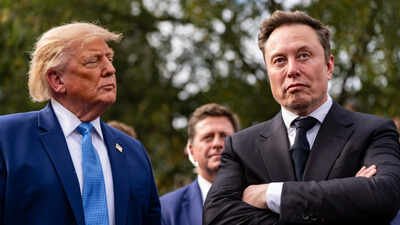
US president Donald Trump has responded after billionaire entrepreneur Elon Musk distanced himself from the Republican president’s Make America Great Again (MAGA) movement, following the party’s losses in the midterm elections. Musk, who spent more than $400 million backing Trump-aligned Republican candidates in November, said he felt “pretty foolish” about the money spent and insisted he was not a MAGA supporter.“I mean, I’m not MAGA,” Musk told The New York Times on Wednesday at the DealBook Summit, marking a notable shift in tone from his earlier public association with Trump’s political movement.Asked to explain his position, the Tesla and SpaceX CEO said: “I’m not sure what MAGA means.” He added, “But I, I don’t think I’m, like, if, if that means sort of blind adherence to a set of policies by the Republican Party, then I certainly don’t have that. I think there are, there, there are positives and negatives in both parties.”Trump, speaking to NBC News in a telephone interview on Thursday while returning from his Asia trip, appeared to play down Musk’s remarks. “He’s a friend of mine,” the US president said. “What can I tell you? I mean, you have to ask — there are lots of definitions out there.”Trump also said, “MAGA, to me, means something very specific, and when people veer from it, they don’t do very well.” He added: “But Elon is — Elon’s got very good intentions. I mean, he was with me the whole — he traveled with me.”Musk’s comments come after Republicans suffered significant losses in the midterm elections, with Democrats securing victories across several contests. Among the setbacks was the defeat of Texas Senate nominee Ken Paxton, whom Musk had backed with around $200 million.Reflecting on his political spending, Musk told DealBook columnist Andrew Sorkin that he would reconsider the amount if given another opportunity.“I feel pretty foolish about having spent so much money and not seeing much for it,” he said. “Or maybe it would’ve been much worse without that. But it certainly shows that American elections are not just about money.”Musk had been among Trump’s most prominent supporters, sitting alongside other technology billionaires at the president’s second inauguration on January 20, 2025. He also led the Department of Government Efficiency (DOGE), becoming one of the administration’s most visible figures.The political shift has wider implications for technology companies as Democrats prepare to take control of Congress and several state governments in January. Democratic lawmakers have signalled plans for greater scrutiny of artificial intelligence companies, data centre expansion and technology executives’ dealings with the Trump administration.Musk is not the only technology leader facing questions over political affiliations. Palantir chief executive Alex Karp recently told Politico, “I’ve been a Democrat my whole life. I grew up in a far-left environment.”Democratic lawmakers, however, appeared unconvinced by Musk’s attempt to distance himself from the MAGA movement. Responding to his remarks, Democratic Senator Ruben Gallego of Arizona wrote on X: “You are still getting a subpoena.” Democrats have indicated that they intend to scrutinise technology companies and their relationships with the Trump administration once they assume control of Congress in January.The prospect of increased scrutiny also extends beyond Musk’s political spending. Democratic lawmakers are preparing to examine technology firms’ dealings with the Trump administration, their artificial intelligence operations and the rapid expansion of data centres. Separately, Democratic lawmakers in Mississippi have called for an investigation into a reported surge of around 60,000 inactive voter registrations during the midterm elections compared with 2024. The increase was apparently linked to the integration of data from credit reporting agency Experian into the state’s voter-roll maintenance process. The issue has drawn attention following Democrat Scott Colom’s historic, narrow Senate victory over his Republican opponent.