Sachin Tendulkar turns 53 today, carrying a record that the warmth of anniversary writing has consistently failed to honour correctly. The 100 international centuries get presented, almost universally, as a glittering monument – a round number dressed in garlands. The harder reading is more useful, and considerably more honest. It is a record of sustained output across 21 years, seven months and seven days, stretching from his first international hundred in August 1990 to his 100th in March 2012. The monument, examined up close, turns out to be a quarry. Something was being hewn out of it, constantly, for over two decades.
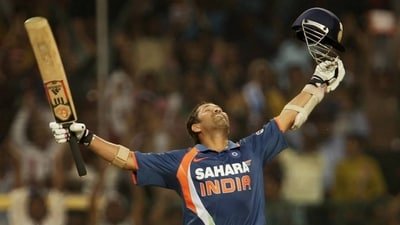
That time span is the actual story. Tendulkar did not build this number in one extended peak and then cruised past the finishing line. He made his first international hundred at 17 and his last at 38. Between those two innings lay different phases of batting, different physical states, and different versions of the one man carrying the whole accumulation forward.
The record starts with the spread
Tendulkar finished with 100 international centuries, split into 51 in Tests and 49 in ODIs. That combined tally remains the international record, and the only instance of any player reaching the landmark of 100. It is the range and duration, the ability to score internationally at the highest stage for long enough that both tallies climbed together.
Also Read: Sachin kept his word, fulfilled promise 15 years after teammate’s selfless act paved the way for Tendulkar’s India debut
The first century came in a drawn Test against England at Old Trafford on August 9, 1990. Tendulkar made 119 not out. The 100th arrived on March 16, 2012 against Bangladesh in Mirpur, where he made 114. What separates those two innings is not primarily quality; it is time. More than two decades of international cricket, compressed into a single statistical arc. A peak statistic tells you how high a player once climbed. This record tells you how long the climb kept going.
The age spread sharpens the point until it is unmistakable. Five international hundreds came before Tendulkar turned 20. Then 25 more between 20 and 24. Then, 35 between 25 and 29, the great, harvesting years. Then, 16 between 30 and 34. And then, stubbornly, 19 more after 35. That final number is the one that most analysts and experts drift past without stopping. Nineteen hundreds after an age at which most batting careers have already narrowed to a trickle. The record did not stop when the first great phase ended. It kept feeding itself from reserves that, by the arithmetic of most careers, should no longer have existed.
Form has to be recovered across a span like that. The technique has to be adjusted when the reflexes begin to slow. Hunger has to survive repetition, the peculiar burden of being required, every time, to do what you have already done many times before, in front of people who have forgotten how difficult it always was.
He did not stack them in one phase
The century timeline, broken down by period, makes the distribution vivid. Tendulkar made 12 international hundreds between 1990 and 1995. Then 39 from 1996 to 2000, the era of his most volcanic batting. Then 22 from 2001 to 2005, then 23 more from 2006 to 2010. Then four in his final burst between 2011 and 2012. These are the numbers of a player who kept rebuilding the conditions necessary for production.
The record is not interesting because 100 is a round and satisfying number. It is interesting because the production did not collapse after the prime years folded. Tendulkar had a decade of dominant batting, but he also had a late-career chapter substantial enough to keep the count moving. The decline, when it eventually came, never arrived in a straight line. The curve bent. The curve also kept bending back.
The ODI career changed when the role changed
One of the most important facts in Tendulkar’s career sits in an absence. He debuted in ODIs in 1989. His first ODI hundred did not come until September 1994, a gap of almost five years. That inconvenient detail tends to get left out of tributes, because it complicates the narrative of preordained greatness. It should not be left out. It is the detail that makes the record look real rather than ordained.
The explanation is a tactical pivot, and it is one of the clearest role-change stories in modern batting history. When Tendulkar was moved to open in ODIs in 1994, everything in his white-ball career changed shape. As an ODI opener, he scored 15,310 runs in 344 innings at an average of 48.29, with 45 hundreds. In all other ODI batting positions combined, he made 3,116 runs in 119 matches at an average of 33, with four hundreds. These look like numbers from two careers that are essentially different. One of them was unlocked by a role change. The other was what had existed before the change. The 100 hundreds were not inevitable from the first day he walked out in international whites. There was waiting. There was an adjustment. There was a single decision that turned one format’s career into something larger than the other format’s had yet become.
The opposition list keeps the record honest
A century record of this size can impress from a distance, only to dissolve when examined more closely against the quality of the opposition. Tendulkar’s record does not dissolve. He scored 20 international hundreds against Australia, the most by any batsman against any opponent in his era, along with 17 against Sri Lanka, 12 against South Africa, nine each against England and New Zealand, seven each against Pakistan and West Indies, and six against Bangladesh. Australia accounting for 20 of those 100 is the single number that does the most work. It means the record was built substantially against one of the two or three most demanding opponents of his entire career.
The spread also resists easy dismissal. This was not one opponent, one condition, or one psychological comfort zone inflating the count. The list spans Test cricket’s major sides and two formats that demanded different skills during an era when those skills were still being redefined. Tendulkar’s 51 Test centuries remain the all-time Test record, accumulated against every significant Test nation of his generation. The 49 ODI centuries were made during years when the format was sharpening and evolving, when the value of the opener was becoming decisive, when fielding restrictions and pitch surfaces were changing what hundreds cost to make. He stayed ahead of those shifts for an unusually long time.
When Tendulkar reached the 100th hundred, he stood 29 international hundreds clear of the next-highest tally at the time. That was a kind of separation that implies a different category altogether.
The Hundreds were not just ornamental
Tendulkar’s centuries are sometimes treated as private milestones – beautiful objects on a shelf, admirable but sealed off from the game’s results. The match data offers a firm correction. In Tests, India won 20 of the matches in which Tendulkar scored a hundred, lost 11 and drew 20. In ODIs, India won 33, lost 14, tied one and had one no result in his century-making matches. Across all 100 international hundreds, India won 53 times. That forecloses the dismissal of the record as a decorative accumulation. More than half of those games ended with Tendulkar’s side ahead.
The Old Trafford hundred came in a match India had to save. The Mirpur hundred came in a match where the heaviest weight pressing down on the innings was the public spectacle of an entire year spent waiting for the landmark itself. One innings served a Test. The other ended a chase that had become a national vigil. The conditions between those two days changed completely. The skill of getting to three figures, the restarts after the early balls, the concentration reset after each boundary, and the management of the last twenty runs did not.
Why the record still holds its force
Some records endure because no one has drawn near. This one endures for a harder reason. It combines accumulation with stretch across 200 Tests and 463 ODIs, both figures being evidence of durability before the century count is even considered. The record is not only about reaching a ceiling. It is about staying in the building long enough to keep touching that ceiling again, in conditions that keep changing.
On his 53rd birthday, the correct framework for reading the century record is not as a polished tribute, not as a museum exhibit placed reverently behind glass. It is a record built from a teenage hundred at Old Trafford in 1990 to a landmark hundred in Mirpur in 2012, through role changes, format changes and the slow arithmetic of age, without allowing the standard to fall for long. Tendulkar did not make 100 international hundreds in one long outpouring of brilliance. He kept dismantling the conditions that might have stopped the next one. He kept rebuilding the conditions that allowed it to happen. That is why the number still stands alone.