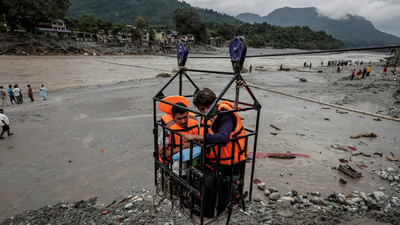
Gujarat, the tsunami, 26/11, and now Nepal. Some of the disasters etched deepest into public memory have one oddly specific thing in common: they happened on the 26th.The coincidence surfaced again after the August 26 catastrophe in Nepal, where a glacier collapse unleashed a wall of mud, rock and water through the Himalayan valleys, killing more than 1,300 people and leaving thousands missing. As images of the destruction spread, so did an old question: what is it about the 26th?But is the date really unusually deadly, or are we simply very good at finding patterns once we know where to look?
When nature struck on the 26th
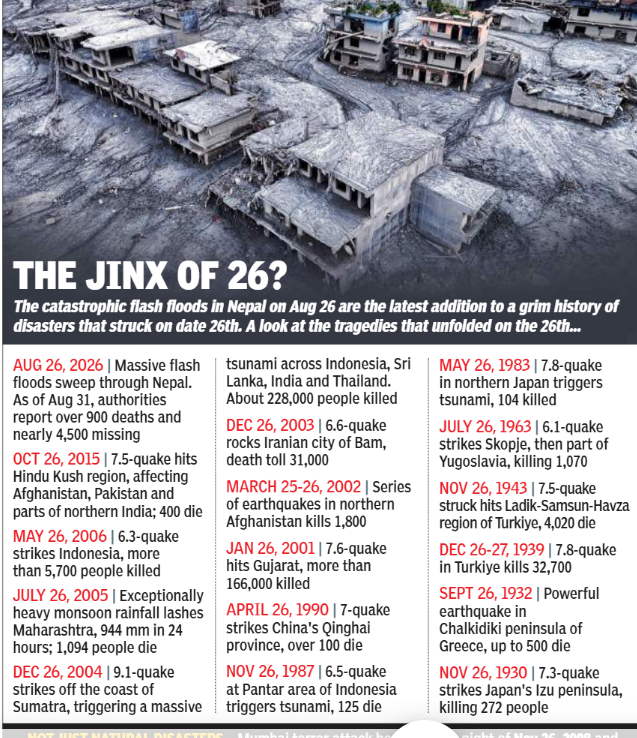
The natural disasters alone would be enough to build a legend around this date. The Gujarat earthquake of January 26, 2001, Republic Day, struck Kutch with such force that it killed close to 20,000 people and injured more than 160,000, flattening entire towns like Bhuj and Anjar. Three years later, on December 26, 2004, a magnitude 9.1 undersea earthquake off Sumatra sent a tsunami crashing into the coastlines of Tamil Nadu, Andhra Pradesh, Kerala and the Andaman and Nicobar Islands, part of a disaster that killed or left missing roughly 228,000 people across the Indian Ocean rim. The following July, on July 26, 2005, Mumbai received close to 944 mm of rainfall in 24 hours, a deluge that killed more than a thousand people across Maharashtra and brought the city to a standstill for days.

Gujarat earthquake of 2001
The pattern isn’t confined to Indian soil, or even to this century. Turkey’s Erzincan earthquake killed an estimated 32,700 people on December 26, 1939. The Skopje earthquake of July 26, 1963 killed around 1,070 and left 200,000 homeless. Iran’s Bam earthquake, which levelled a 2,000-year-old citadel city, struck on December 26, 2003, killing roughly 31,000 people. Indonesia’s Yogyakarta earthquake killed more than 5,700 on May 26, 2006, and the Hindu Kush earthquake of October 26, 2015 shook Afghanistan, Pakistan and parts of northern India simultaneously.
When the 26th turned man-made
Where the 26th gets stranger is that it isn’t only earthquakes and floods, events with no human author. It has also coincided with some of the worst disasters humans have caused deliberately or through negligence.The most seared into Indian memory is November 26, 2008, when ten Lashkar-e-Taiba gunmen launched coordinated attacks across Mumbai, laying siege to the city for nearly three days and killing 166 people. It is remembered simply as 26/11, a date that needs no year attached to be understood. It wasn’t an isolated instance of terrorism landing on this date, either, the Ahmedabad serial blasts of July 26, 2008, one of the deadliest terror strikes on Indian soil that year, fell on the same date. Outside India, the Kabul airport bombing of August 26, 2021, carried out during the US-led evacuation from Afghanistan, killed at least 183 people, including 13 American service members.

Lashkar-e-Taiba gunmen launched coordinated attacks across Mumbai
Industrial and nuclear disasters share the date too, and this is where the list stops looking like a coincidence confined to any one country or cause. Reactor No. 4 at Chernobyl exploded during a botched safety test on April 26, 1986, in what remains the worst nuclear accident in history. More than four decades earlier, on April 26, 1942, a gas and coal-dust explosion at China’s Benxihu colliery killed 1,549 miners through carbon monoxide poisoning, one of the deadliest mining disasters ever recorded.
Crashes, collisions and the 26th
Then there is a third category that rarely makes it into casual conversations about the 26th, but rounds out just how wide its reach is: ordinary transport disasters, the kind that don’t need an earthquake or a bomb, just a broken rail or a failed engine part.India’s Khanna rail disaster, a derailment and collision caused by a broken rail near Punjab’s Khanna town, killed 212 people on November 26, 1998. The Aurangabad air crash, when flight IC-491 went down while approaching the Maharashtra airport, killed 55 of 118 people aboard on April 26, 1993. Overseas, Lauda Air Flight 004 crashed in Thailand on May 26, 1991, after an uncommanded thrust-reverser deployment sent the Boeing 767 out of control, killing all 223 people aboard.
The date that refuses to be just a number
Laid end to end, the list stops looking like a curated coincidence and starts looking almost deliberately comprehensive — quakes, tsunamis, floods, terror attacks, a nuclear meltdown, a mine explosion, a rail crash, an air crash. Nearly every disaster category a newsroom covers has, at some point, chosen the 26th.
So, is the 26th actually cursed?
There’s a statistical explanation for this, and it’s less exciting than a curse. The British statistician David Hand has spent years studying coincidences like this, he calls it the law of truly large numbers. Basically, if disasters are happening somewhere in the world almost every day, and a month only has 28 to 31 possible dates, some date was bound to end up looking busier than the rest. It just happened to be the 26th. It could as easily have been the 9th.Then there’s confirmation bias, which does a lot of the heavy lifting here. Once you start looking for disasters on the 26th, you notice every one that fits and forget the ones that don’t. Bhopal’s gas leak, India’s worst industrial disaster, happened on the night of December 2-3, 1984. The Uttarakhand floods were in June 2013. The Balasore train collision that killed nearly 300 people was on June 2, 2023. None of these are anywhere near the 26th. Nobody brings them up when the “jinx” comes up, because once you believe a pattern, you stop counting the exceptions.

Uttarakhand floods of 2013
Numerology adds a third layer, and in India this one actually sticks with people. Add up 2 and 6 and you get 8, a number some numerology traditions link to upheaval and karmic reckoning. For anyone who already believes in that system, a disaster landing on the 26th isn’t a coincidence: it’s confirmation.
Share your thoughts in the comments
Be respectful · TOI community guidelines
There’s no actual link between a calendar date and earthquakes, floods or violence. But belief doesn’t need a mechanism. It just needs enough stories that fit, and the 26th has no shortage of those by now.
What the ‘jinx’ really tells us
So what does the list really tell us? Not that the date is cursed; just that disasters don’t check the calendar, and over a long enough stretch of history, every date ends up with its own body count. The 26th’s list happens to include some of the most consequential disasters of the last century, ones big enough that they changed building codes, early-warning systems, even how countries think about security. That’s really why the date sticks in memory. Not the number itself, but what it forced people to rebuild afterward.