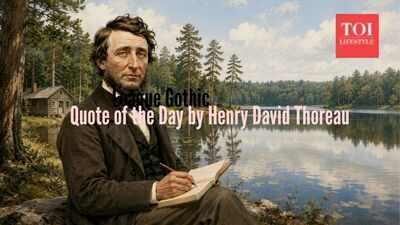
Every generation has its thinkers whose words seem to speak directly to the most serious concerns of that time. Henry David Thoreau is one example of such a figure. More than a hundred years after his death, his ideas continue to inspire those who seek a life of purpose beyond material success and social norms. He was a philosopher, writer, naturalist and social critic who encouraged people to think for themselves and to live according to their own values. His questions are timeless and his works are as relevant as ever: What is a good life? What is our connection with nature? And how much of our destiny is made by our own belief systems?Life and educationHenry David Thoreau was born on July 12, 1817 in Concord, Massachusetts, United States. He was from a poor family, and had been noted since childhood for his intelligence and curiosity. His dad was in the pencil business, his mother ran the home. Thoreau went to Harvard, where he studied broadly in classical literature, philosophy, mathematics and science. He was well educated but a free thinker, questioning accepted ideas and accepting no truth without proof. After graduation he taught for a short period of time but soon became disillusioned with traditional ways of teaching. He believed education should encourage creativity, critical thinking, not discipline and rote memory.Friendship with Ralph Waldo Emerson One of the most important influences on Thoreau’s life was his friendship with the philosopher-essayist Ralph Waldo Emerson. Emerson was a leading figure of the Transcendentalist movement, which emphasised the importance of individual conscience, self-reliance and a deep spiritual connection to nature. Emerson had seen Thoreau’s genius and fostered his intellectual growth. The two held many ideas in common about personal freedom, simplicity and the need to challenge social conventions. This friendship made Thoreau one of the most eminent voices of transcendentalism.The event most associated with Thoreau’s life was in 1845, when he decided to live in a small cabin near Walden Pond, a wooded area owned by Emerson. There Thoreau spent more than two years in comparative solitude. Contrary to popular belief, he wasn’t trying to completely abandon society. What he wanted was to try out simple living. He wanted to know what was really necessary to happiness, and what could be thrown away as an unnecessary diversion. He built his own cabin at Walden Pond, grew some of his own food, watched wildlife and spent most of his time reading, writing and thinking. That experience provided the background of his best known book, Walden, in 1854. In Walden, Thoreau lamented the fact that too many people spend their lives chasing after wealth, status and possessions to the neglect of what really matters. He told them to simplify their lives, to work on self-improvement, on meaningful work, to get more in touch with nature.Champion of the individual conscienceThoreau was interested not simply in individual philosophy but in social justice. In 1846 he refused to pay a poll tax as protest against slavery and the Mexican-American war. So he spent a night in the lock-up. Inspired by this experience was his influential essay Civil Disobedience. Thoreau argues in his essay that people have a moral duty to resist unjust laws. Writing StyleThoreau is still a popular read, partly because of his unique style of writing. His writing is a blend of close observation and philosophical reflection. He could write vividly about a pond, a tree, a bird, and then use those observations to explore larger questions about human existence. There are a number of elements that characterise his style such as:Simplicity: Thoreau was a sophisticated mind, but he put sophisticated ideas in clear and straight language. He prized truth and accuracy over needless embellishment.Love of Nature: Nature was not just the setting for his writing. It was a teacher, a well of wisdom, a journey to find oneself. His descriptions of woods and seasons, lakes and animals, are still among the best in English nature writing.Quote of the Day“What a man thinks of himself, that it is which determines, or rather indicates, his fate.” This quote is more than positive thinking or self-confidence. But Thoreau’s message goes much deeper. “The way you see yourself, that’s the direction of your life,” he says. The choices we make every day are determined by the beliefs we hold about our abilities, our worth, our potential, and our purpose. Those choices create the life they live, slowly. But Thoreau is careful to use the word “indicates” as well as “determines.” This distinction is important. He is saying that self-perception not only helps to shape the destiny but also reveals what sort of future a person is likely to head for.When people feel powerless, incapable or unworthy they may withdraw from opportunities, accept less than they deserve and limit their own growth. Over time those attitudes can become self-fulfilling. On the other hand, a person who believes he can learn, improve, and contribute meaningfully to the world will likely act bravely and persistently. Their self-esteem influences their decisions, relationships and dreams. Basically, Thoreau’s quote is about self-awareness. Outer circumstances are important, but so are inner attitudes, he believed. Character, beliefs and self-knowledge provide more about a person’s future than where he or she is in life.Modern psychology has demonstrated that beliefs about oneself can have a powerful effect on motivation, resilience and achievement. In many ways, Thoreau anticipated these insights long before scientific research explored them. In today’s world, we have social media, public opinion, external measures of success. Thoreau’s quote reminds us that the opinion we hold of ourselves may be the most important of all. This does not mean ignoring reality or pretending that difficulties do not exist.