Up until recently, my relationship with Artificial Intelligence (AI) was strictly surface-level. If you looked at my search history, my AI usage could be summarised in three distinct buckets: “Polishing my writeups,” “Tweaking recipes,” and “touching up my photos.”
To say my understanding of deep tech is bad would be a massive understatement. However, in a sudden bout of adult responsibility, I decided to use the chatbots for something very different.
I realised, right after checking my bank balance and seeing a number that looked suspiciously like a low phone battery percentage, that I needed to stop bleeding money and actually track my personal finances.
I wanted a chart. A simple, idiot-proof spreadsheet layout where I could log my expenses without getting a headache.
Naturally, I decided to run a little digital experiment. I copy-pasted the exact same prompt into four different chatbots to see which would give me the best layout.
What prompt did I use?
Please give me a detailed layout of a personal financial tracker. It should be such that I should be able to put in the numbers and it gives me an accurate description of how much I have spent, how much is remaining and what is my total savings
Things to include:
My salary
My total expenses (break down into categories like rent, electricity, outside food, groceries, medical bills, shopping, gifting, house help, subscription, EMI, travel, and anything else you can think of for an Indian household.
My total savings
Also add anything else you think I should include in the financial tracker for an Indian.
The chatbot showdown
Three of the four chatbots (Grok, ChatGPT, and Gemini) reacted exactly as I expected. Within seconds, they spit out the digital equivalent of a shrug: a few generic bullet points, some basic column suggestions, and a “Good luck with your budgeting!” sign-off.
And then there was Claude…
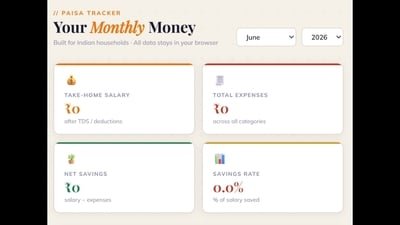
Claude didn’t just answer the prompt; Claude took it personally. It didn’t just give me column ideas, it built a completely custom, flawlessly structured, multi-tiered financial tracker blueprint out of absolute nowhere.
After Claude AI generated the result, I tweaked the requirements to get the current result.
Check it out the money tracker.
I sat there staring at my screen, completely stunned. I went looking for a basic shovel and accidentally unburied a high-tech excavator.
Naturally, because I am an insufferable friend, I have now made this accidental tracker my entire personality. I am actively bugging my friends, trapping my family in the kitchen, and spamming group chats to force everyone to test it.
They are exhausted. I am ecstatic.
Personally, a tracker that effortlessly crunches the raw numbers and spits out a flawless reality check of my monthly savings is a game-changer. I might not fully understand the algorithmic magic happening behind the screen, but my bank balance actually makes sense.
However, my sudden financial wisdom comes with a healthy dose of caution. Let’s be honest, there’s always a question mark around data privacy with AI. So, be careful about what you share with AI.