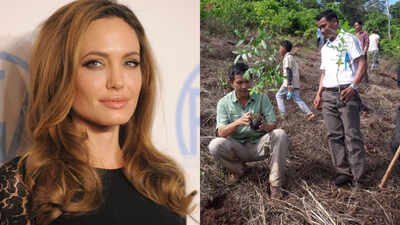
What began with the specific challenge of making heavily mined Cambodian land safe again, gradually grew into a much broader experiment in community-led conservation. Founded by Angelina Jolie in 2003, the Maddox Foundation initially focused on clearing landmines alongside rural communities. Over the following two decades, its work expanded into forest protection, healthcare, education, livelihoods and climate action, with local people remaining at the heart of the effort.
From clearing mines to rebuilding communities
According to the foundation’s official website, its early work centred on some of Cambodia’s most heavily mined areas. Clearing those sites was about more than removing a wartime danger; it opened land that communities could once again live on, work on and use for essential infrastructure. And by 2006, the organisation had established a satellite office in Battambang and its focus had begun to widen. With the immediate threat from landmines receding in some areas, attention turned towards what could be built on the reclaimed land.If we go by the website, that year marked a significant shift when the foundation took responsibility for protecting the 60,994-hectare Samlaut Multiple Uses Area. It is mentioned that instead of importing an outside conservation workforce, local residents were recruited and trained as forest rangers, creating employment while building a community-based system of protection against logging and poaching.
Conservation meets essential services
The foundation further mentions that its work in Samlaut soon extended beyond forest patrols. In 2009, it built the Boeng Ron Health Center in a remote part of Samlaut village. The facility was later expanded to include maternity and ophthalmic services. Healthcare programmes also moved beyond the clinic itself. Outreach services focused particularly on young mothers and children under five, combining medical care with education on health and nutrition, the foundation data states.Forest stewardship continued to develop alongside these social programmes. In 2011, the foundation worked with Cambodia’s Ministry of Environment, the Battambang Forestry Administration and local authorities to establish 11 community forestry schemes across four communes in Samlout.
From local rangers to public officials
A major milestone came in 2016, when the locally recruited and trained rangers were formally recognised as government officials under the direct supervision of Cambodia’s Ministry of Environment. The change effectively moved the ranger programme into the country’s official conservation framework while maintaining the partnership with the Maddox Foundation.Two years later, the foundation opened a permanent headquarters in Samlout. The all-Cambodian team gained a dedicated base for its field operations, while the facility also became a working centre for the ranger unit responsible for patrolling the protected forest. The same year brought an investment in education. Student dormitories were built at Samlaut High School to help young people from remote villages remain in school and complete their secondary education. Hundreds of students have since benefited from the accommodation each year.
Building livelihoods around conservation
The foundation’s approach increasingly linked environmental protection with economic opportunity. In 2019, it launched a sustainable beekeeping programme after recognising the problems associated with less sustainable wild-honey collection. Local farmers were then trained in beekeeping techniques, with particular encouragement for women to participate. The additional income offered an alternative livelihood while also reducing incentives to use pesticides on farmland.
A longer-term climate focus
By 2022, the work had expanded further into climate and landscape restoration. In partnership with the International Center for Environment Management, the foundation began strengthening reforestation efforts with rangers and local communities. Tree nurseries were established to produce seedlings for distribution and transplantation, helping restore degraded landscapes while involving residents directly in the protection of their natural surroundings.Two decades after its first landmine-clearing efforts, the Maddox Foundation’s work in Cambodia has therefore evolved into something considerably broader: a model that connects safety, conservation, healthcare, education and livelihoods, with local communities not simply benefiting from the programmes but helping to run and sustain them, the foundation data concludes.Images Courtesy: Facebook and Maddox Foundation