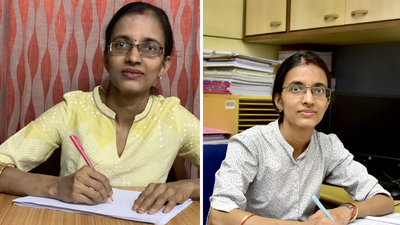
A mathematical problem that remained unresolved for nearly seven decades brought Kolkata mathematician Neena Gupta international recognition in 2014. Twelve years later, her work in algebraic geometry has earned her a place on the TIME100 Next India 2026 list, which recognises emerging leaders shaping the country’s future.According to the official website of TIME, Gupta, a professor at the Indian Statistical Institute (ISI) in Kolkata, has been named in the Health and Science Innovators category. Her achievement centres on a question first raised in 1949 by mathematician Oscar Zariski, known as the Zariski Cancellation Problem.As per an earlier TOI report, Gupta found a counterexample to a version of the problem in 2014, challenging an assumption that mathematicians had examined for decades. Her work demonstrated that two mathematical structures could become equivalent after an additional dimension was introduced, even though their original structures were not equivalent.The result was a significant contribution to algebraic geometry, a branch of mathematics that studies geometric objects using algebra.
What was the 70-year-old problem Gupta challenged?

Born in Kolkata in 1984, Gupta developed an interest in mathematics at an early age.
The Zariski Cancellation Problem asks a deceptively simple question: if two mathematical spaces become equivalent after adding an extra dimension, does that mean they must also have been equivalent before the dimension was added?In other words, can adding an extra dimension make two fundamentally different mathematical structures appear the same? Mathematicians had been investigating this question since Zariski proposed it in 1949. Gupta’s 2014 research showed that the answer was not always yes.According to the Press Information Bureau (PIB), Gupta demonstrated that a three-dimensional affine variety constructed by mathematician Takanori Asanuma provided a counterexample to Zariski’s original question in positive characteristic. Her result established that the cancellation property did not always hold in that mathematical setting.The research was published in her paper, ‘On the Cancellation Problem for the Affine Space A3 in Characteristic p.’ It showed that a mathematical structure could become equivalent to a four-dimensional affine space after an additional variable was introduced, even though the original three-dimensional structure was not equivalent to the ordinary three-dimensional affine space.The finding addressed a longstanding question in the field and became the foundation of several major recognitions for Gupta.
From childhood maths puzzles to research at ISI
Born in Kolkata in 1984, Gupta developed an interest in mathematics at an early age. Her mother, Gyanlata Gupta, encouraged her curiosity by organising problem-solving competitions between her and her brother. Her decision to pursue mathematics professionally took shape after a senior introduced her to the Mathematics Honours course at Bethune College. She graduated in 2006 and completed her master’s degree at the Indian Statistical Institute in Kolkata in 2008. She went on to earn a PhD in mathematics from the same institute in 2011, specialising in algebra.Her postgraduate experience also brought her face to face with the gender gap in the subject. According to India Today and various media, she was the only woman in her mathematics class. She has since stressed the importance of encouraging more girls to pursue mathematics and scientific research.
Awards that followed her breakthrough
Gupta’s work has earned several national and international honours. She received the Shanti Swarup Bhatnagar Prize in Mathematical Sciences in 2019. The official award citation recognised her counterexample to the Zariski Cancellation Problem and her research on K-theoretic methods related to invariants of group actions on affine spaces.In 2021, she received the Ramanujan Prize for Young Mathematicians from Developing Countries. She was also awarded the Nari Shakti Puraskar in 2022 and the Infosys Prize in Mathematical Sciences in 2024. The Infosys Prize recognised her solution to the Zariski Cancellation Problem. Her inclusion in TIME100 Next India 2026 adds another recognition to a career built around fundamental mathematical research.