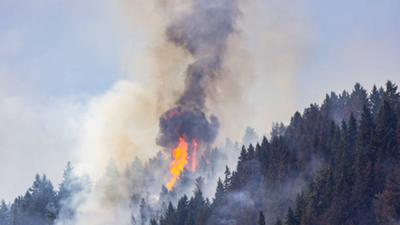
In Washington, a team of igniters are walking across the forest with canisters filled with a mixture of diesel fuel and gasoline. They walk in parallel, lighting grasses and shrubs, moving forward as flames spread in the back, and thousands of pine needles combust into a smoke show. At the same time, more than a dozen people are working to ensure that the blaze stays under control. What is being done is a prescribed burn on a forested ridge above a small town, Roslyn, that was nearly wiped out by a wildfire a few years ago, as per a report by Stateline.The spectre of wildfire is increasingly haunting the existence of communities throughout the West and this work could point to a new model of living with the phenomenon.
A fiery landscape
Before white settlers arrived in the late 1800s, the forests in this part of Washington burned roughly every decade. Fires were sparked by lightning or set by local tribes to manage the land. The ponderosa pine forests in the area thrive on fire, which mostly spares mature trees but opens the understory for lush regrowth that feeds many animals. For more than a century, state and federal land managers kept the fire away. Smokey Bear taught generations of Americans that wildfire was a scourge to be prevented. Officials throughout the country invested heavily in firefighting resources to suppress such blazes quickly.Without fire, forests grew denser. Trees competed for water even as climate change dried the landscape further. The parched trees grew vulnerable to pests and diseases. Brush, pine needles and dead branches piled up. The forests that had been spared from fire for 100 years became primed for infernos. Meanwhile, Americans moved into communities bordering these areas, settling on spots that were supposed to burn every few years.Over the past few years, wildfires have swept through communities in the West, devastating small towns and urban areas alike. For Roslyn, the wake-up call arrived in 2017. The Jolly Mountain Fire, sparked by lightning strikes in the nearby Wenatchee National Forest, advanced toward the town on Labour Day weekend. The fire’s incident commander gave local leaders a grim assessment.“(He said), ‘I hate to tell you, but if fire gets into these woods, we’re going to have to write off large portions of your town as indefensible,’” recalled Chris Martin, emergency management coordinator with the Roslyn Fire Department. “That was the change-of-underwear moment for Roslyn.”
A management technique
Thankfully, the fire changed course but Roslyn knew it was sitting on a matchbox. The mountain community of 950 with a rich coal mining history is a thriving tourist town that attracts campers, mountain bikers, artists and foodies alike. But it also ranks in the 99th percentile for wildfire risk nationwide.A few months after the near-miss, Martin offered to host a prescribed burn on forestland he owns above the town. The burn doubled as a training exercise for state, local and federal agencies. Residents, still shaken by the recent wildfire were alarmed to see smoke rising from nearby, but Martin and others created an outreach program to convince everyone that it was time to fight fire with fire.Ever since, the town has been burning. Martin keeps a map showing an ever-growing patchwork of black and yellow blobs surrounding the town. The black spots mark the 500-plus acres that local leaders have burned since 2017. The yellow represents areas where they’ve brought in logging equipment to thin trees and brush. Together, they form a rough semicircle around Roslyn that’s meant to act as a shield. If a wildfire hits this area, it will quickly be deprived of fuel — giving firefighters a chance to make a stand.“A lot of people have the perception that this is a problem with large federal and state land ownership and that private citizens don’t have a role to play,” said Greg Dillon, director of the U.S. Forest Service’s Fire Modelling Institute. “But in many places, there’s a stretch of private lands between (public forests) and homes that can catch on fire. It’s a really important and less understood piece of the fire risk picture.”Mike Norris, an assistant division manager in the prescribed fire program with the Washington Department of Natural Resources, said the state averages about 20,000 acres of prescribed burns across all lands each year. But Washington’s forests need three to five times that amount to stay healthy.
A collaborative effort
The burn in Roslyn brought together 30 people from multiple fire districts and Upper Kittitas County Fuels, an interagency network that works on prescribed burns and forest thinning projects. They worked alongside staff from The Nature Conservancy, a nonprofit that owns the parcel that was burned and is perhaps the foremost practitioner of prescribed fire on private lands.To burn just 55 acres, half a dozen organisations had to coordinate for two full days of burning and an extended monitoring period after the fire. Long before, crews dug boundary lines to hold the fire, filled portable tanks with water, laid out hoses and positioned fire engines and water tenders. Burn leaders conducted extensive briefings on safety, contingency plans and objectives.After all that, had atmospheric conditions changed slightly, the whole thing could have been cancelled. The painstaking efforts can fizzle in an instant because of strict clean air rules designed to protect communities from smoke. Fire advocates say their “burn windows” can be severely limited by well-intentioned regulations.While catastrophic fires are far worse for smoke, prescribed burners do need to account for its very real effects on communities. They conduct extensive outreach before each burn and prepare for scenarios such as an asthmatic neighbour who needs hotel accommodations or visibility concerns on a nearby highway.