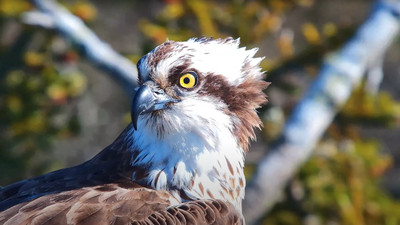
In 2017, conservationists began moving young ospreys from Scotland to Dorset. Five years later, the birds bred in southern England for the first time since 1847. A long-term study led by Bournemouth University (BU) has now shown why the project worked and how similar methods could help birds of prey recover more quickly. Published in the Journal of Animal Ecology, the study found that fast population growth depends heavily on a small number of “pioneering pairs.” These birds choose to nest far from established breeding colonies, helping the species spread into new areas.Researchers studied 54 years of osprey recolonisation data from northern Scotland. The records showed how nest locations and settlement patterns affect the spread of the species. The data, collected over many decades by the Roy Dennis Wildlife Foundation, provides rare information about how recovering species naturally return to areas they once occupied.
Understanding what slows natural recovery
Ospreys were once common across Great Britain. Severe persecution, egg collecting, and hunting eventually caused them to disappear as a breeding species by 1916.Natural recovery began in 1954, when a breeding pair returned to Loch Garten in the Scottish Highlands. However, the species has spread across Britain very slowly.Lead author Brittany Maxted, a doctoral researcher at Bournemouth University, explained that ospreys usually prefer to nest near other ospreys. This behavior is known as conspecific attraction. Most males also show natal philopatry, meaning they tend to breed close to where they were born.Together, these behaviors make it difficult for the species to spread over large distances.
Pioneering pairs help the species spread
The study found that most ospreys settle near existing nests. But a small number behave differently. These birds travel more than 20 kilometres (12 miles) from other ospreys and settle in empty areas.Maxted and her colleagues call these birds “pioneering pairs.” By moving into new areas, they create separate breeding groups and help the population expand faster.This pattern is similar to the way some invasive species spread. Researchers believe that mathematical models used to study invasive species could also help conservationists plan wildlife recovery.Dr Tim Mackrill, lead ornithologist at the Roy Dennis Wildlife Foundation and a co-author of the study, said the recovery of ospreys depends greatly on these rare long-distance movements.He explained that conservationists could speed up natural recovery by encouraging or creating pioneering movements. They can do this by building artificial nests in new areas or by moving birds there through translocation.Dr Roy Dennis OBE, founder of the Roy Dennis Wildlife Foundation, has monitored Scottish ospreys since the 1960s. He said the long-running dataset continues to reveal new information about the birds and supports the use of these methods to restore ospreys across the UK and Europe.
Translocation can save decades of waiting
The Dorset project showed how creating artificial pioneers can help establish a new population.Between 2017 and 2021, conservationists moved healthy seven-week-old Scottish osprey chicks to Dorset through a joint project involving the Roy Dennis Wildlife Foundation and Birds of Poole Harbour.The young birds were kept temporarily in special cages at Poole Harbour until they could fly. This helped them learn to treat the southern landscape as their home territory.Maxted explained that translocation can effectively create pioneering birds to start a new population.The first breeding pair at Poole Harbour included a male called 022, which had been moved from Scotland, and a female called CJ7. She had travelled from a population 200 km (124 miles) away and was attracted to the area by the presence of the translocated chicks.In 2022, the pair produced two chicks. They became the first ospreys to breed in southern England since 1847.Without the translocation project, Maxted said, Dorset might have had to wait another 60 years for breeding ospreys to return naturally.
New populations are beginning to spread
The Poole Harbour project has continued to show positive results. The original breeding pair returned to the same nest each year and successfully produced four chicks annually for three consecutive years.The young birds remain in Dorset during the summer, relying on their parents to provide fish before migrating south in early September.Other pioneering movements are now beginning to appear. A second pair has started breeding away from Poole Harbour. In addition, the first osprey born in Dorset in the wild has built a nest in the East Midlands, helping connect the southern population with the population at Rutland Water.Maxted said translocation is a powerful conservation tool, although it can take many years to produce results. Dorset is still in the early stages of recovery, but some wild-born chicks are already returning.Four young males that are old enough to breed are currently exploring possible nesting sites and searching for mates. Conservationists hope some of these birds will become pioneers themselves and help the population spread along England’s south coast.Artificial nests have already been built in nearby counties such as Devon and Hampshire. Based on the study’s findings, conservationists plan to build more nests to encourage the ospreys to establish new breeding areas.