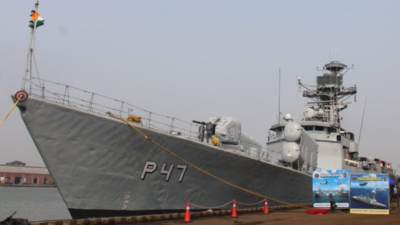
The defence ministry has signed contracts worth Rs 53,866.50 crore for eight Next Generation Corvettes (NGCs) for the Indian Navy. The agreements were inked in New Delhi in the presence of defence secretary Rajesh Kumar Singh. Garden Reach Shipbuilders & Engineers (GRSE) will build five of the ships, and Goa Shipyard Limited (GSL) the remaining three.What sets the project apart is who drew the ships. This is the first time the vessels have been designed in-house by the Indian Navy and then built by Defence Public Sector Undertakings (DPSUs) picked through a competitive process. The project goes back to June 2022, when it first came before the Defence Acquisition Council at a cost of around Rs 36,000 crore. The Cabinet Committee on Security cleared it only days before the signing, at a reported figure of over Rs 40,000 crore. The ministry’s announcement does not explain the difference from the contract value.
A modern corvette
Traditionally, a corvette is the smallest vessel rated as a warship, between 500 and 2,000 tonnes, built for coastal patrol and fast attack. The NGCs go well beyond that. At a displacement of 3,800 to 4,000 tonnes, they overlap with smaller frigates. They are expected to do more than 30 knots, with a range of 4,000 nautical miles at 14 knots, and will carry 160 sailors and 21 officers.The armament includes a 76 mm super rapid gun mount made by BHEL, eight surface-to-surface missiles, 24 anti-missile defence weapons and two triple 324 mm torpedo tubes. The sensor suite covers surface, air and fire-control radars, an infrared search and track system, a hull-mounted sonar, an active towed array sonar and a combat management system. That mix lets the ships work across the air, surface and sub-surface domains.
Replacing an ageing fleet
The ships will replace the Khukri-class corvettes, of which INS Kuthar and INS Khanjar remain in service, and the four Kora-class vessels still with the Navy. Their roles will include protecting maritime trade routes, anti-surface and anti-submarine warfare, coastal defence, littoral combat and surveillance.Beyond the Navy, the ministry points to the industrial effect. The build is expected to generate about 72 lakh person-days of work in the shipyards and 460 lakh person-days in ancillary industries and MSMEs over ten years. With a push for Made-in-India materials, equipment and technology, the programme is being presented as a step towards Aatmanirbharta in defence manufacturing.The first ship is targeted for delivery by 2030, which leaves a long road ahead. For now, the contract settles a question the Navy has been working on for four years: whether an Indian design and Indian public sector yards can deliver a frigate-sized warship at scale.