Former India batter Sanjay Manjrekar has questioned India’s team balance under head coach Gautam Gambhir after the T20I side suffered a shock 0-2 series defeat against Ireland in Belfast.
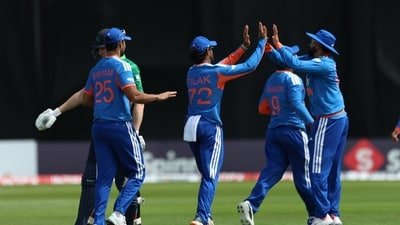
India, who entered the short series as heavy favourites, lost the opening T20I by 34 runs before going down by one run in the second match. The result gave Ireland their first-ever T20I series win over India and also raised immediate questions over the direction of India’s white-ball rebuild under Gambhir.
Manjrekar, reacting to the defeat, suggested that India may have overcorrected in their search for all-round options.
“It was too little earlier…under Gambhir, it’s too many. The ‘all rounders’. India need a PURE middle order batter, pronto!” Manjrekar wrote on X.
The remark came after India’s batting struggled in both matches despite having depth on paper. In the first T20I, Ireland posted 182/9 before bowling India out for 148 in 18.5 overs. Abhishek Sharma gave India a flying start with a 20-ball 49, but the middle order failed to convert that platform into a chase. Shreyas Iyer, Ishan Kishan, Tilak Varma, Shivam Dube, Washington Sundar and Axar Patel could not give India the kind of sustained innings required after the early momentum faded.
The second T20I made the concern sharper. Chasing 155, India were rocked early and slipped to 19/3. Sanju Samson and Abhishek Sharma were dismissed for golden ducks, while Iyer also fell cheaply. Ishan Kishan was then run out as India found themselves 39/4, leaving Tilak Varma to carry the chase almost alone. Tilak scored 55 off 46 balls, but India finished on 153/9, falling short by one run.
India’s balance comes under scanner
Manjrekar’s criticism appears to be aimed at India’s recent preference for players who can offer multiple skills rather than specialist batting security in the middle order. Across the two matches, India used several multi-skill options, including Washington Sundar, Axar Patel, Shivam Dube, Harshit Rana and Suryansh Shedge, who made his debut in the second T20I.
While the presence of all-rounders gives a T20 side flexibility, the Ireland series exposed a different problem. India had batting depth on the scorecard, but when the top order failed, and conditions demanded patience, the line-up lacked a specialist middle-order batter capable of absorbing pressure and controlling the chase.
Also Read: What just happened in Ireland? Fatigue, old frailties and a new captain contributed to India’s shambolic show
That is where Manjrekar’s “pure middle order batter” argument becomes important. His point is not simply that all-rounders are unnecessary, but that India cannot allow utility to replace batting depth completely. Against Ireland, India had options who could contribute in different departments, but not enough batters who looked built for difficult phases of an innings.
The defeat has also intensified scrutiny on Gambhir’s approach. India’s T20I setup has been moving towards aggression, flexibility and depth, but the Belfast losses showed that batting depth on paper does not always translate into batting assurance in pressure situations.
With India set to move into tougher assignments, the Ireland series may force a rethink. Manjrekar’s post has put the spotlight on one clear selection question: Does India’s T20I side need fewer compromise picks and at least one more specialist batter in the middle order?