Mumbai: Jacob Bethell proved England’s batting star in Saturday’s second T20I win over India at Old Trafford after scoring an impeccable 76* off 46 balls. It sealed a four-wicket win against the T20 world champions. While the first T20I was washed out, Bethell played a blinder the last time England played India in a T20I too, although it was in a losing cause.
In the T20 World Cup semi-final at the Wankhede Stadium in March, the left-handed batter smashed a 45-ball 105, but couldn’t take his team over the line chasing. Unlike Saturday, in that World Cup semi-final India batted first and their middle and lower order had put the total beyond England’s reach. Big-hitters Shivam Dube (43, 25b), Hardik Pandya (27, 12b) and Tilak Varma (21, 7b) built on opener Sanju Samson’s 89 to finish on 253/7. India batted England out of the game.
This time, Bethell tore into leg-spinner Ravi Bishnoi’s 17th over to clinch the chase. India once again batting first and had a chance to put up a total that would have been beyond the home side. After 13 overs, India were 130/3, well set to bat England out of the game. But the charge never came.
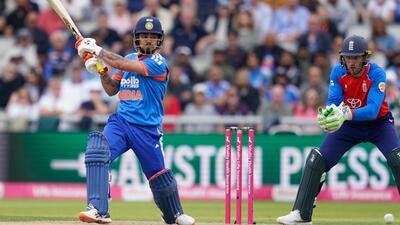
Once skipper Shreyas Iyer fell for 37 off 22 balls, the other batters couldn’t break the shackles. The boundaries dried up. Despite being set, Ishan Kishan couldn’t force the pace, scoring 49 off 40 balls without a six. Tied down by Sam Curran, Will Jacks and Liam Dawson, Shivam Dube and Kishan were trying to overhit the ball, losing shape and timing. On the second ball of the 17th over, when Kishan reverse swept Jacks for four, it was India’s first boundary after 14 deliveries.
From over number 14 to 18, India couldn’t force a single double-digit over with the best, the 18th, only fetching nine runs.
Kishan ran out of steam, Dube crawled to five off seven balls and Axar Patel made two off three balls. Sam Curran did the damage by removing Kishan and Dube, and captain Iyer acknowledged it. “I think Sam analysed the dimensions of the ground early, he did not give room to our left-handers. The batters are strong on the leg side, he was not letting them play there.”
India had the same issue in the debacle against Ireland. In both games that they lost in Belfast, the lower order didn’t contribute much. In the first game, barring Dube’s 15-ball 25, the other allrounders struggled. Washington Sundar made nine off 12 balls, Axar 15 off 16 balls and Harshit Rane eight off nine balls. In the second game, where India failed to chase down a target of 155, Axar made 14 off 18 balls, Dube 20 off 16 balls and debutant Shedge one run off five balls.
BATTING DEPTH
India didn’t get their combination right against England. Two pacers and three spinners didn’t fit the windy and bouncy Manchester pitch. Bishnoi’s three no-balls only compounded the issue. The difference between the World Cup-winning sides of Rohit Sharma (2024) and Suryakumar Yadav (2026) was the extra emphasis the two captains placed on batting depth. In the bowling attack, around three specialists, they loaded the team with bowlers who could bat.
It allowed the top order to play with freedom because of the cushion the lower order provided. And in case of strong starts, the lower order could bat the opposition out of the game.
In the successful 2024 World Cup campaign under Rohit, there were three allrounders — Hardik Pandya, Rvaindra Jadeja and Axar Patel — to go with three specialists —
Jasprit Bumrah, Arshdeep Singh and Kuldeep Yadav.
In the 2026 final, India had Jasprit Bumrah, Arshdeep Singh and Hardik Pandya to bowl pace. Axar Patel and Chakravarthy bowled with the back-up of part-timer Abhishek Sharma. India have dropped this year’s World Cup winning-captain Suryakumar Yadav and player of the tournament, Sanju Samson. The change they need to make in this series is to invest in and back rookie pace bowling all-rounder Suryansh Shedge for the right balance. While England have taken the lead, with three more T20Is to go, there’s enough cricket left for India to salvage the series.