Gujarat Titans were not cruising when Washington Sundar walked in against Sunrisers Hyderabad. They were 68/3 around the halfway mark, with the innings still searching for shape after early damage and a controlled SRH powerplay.
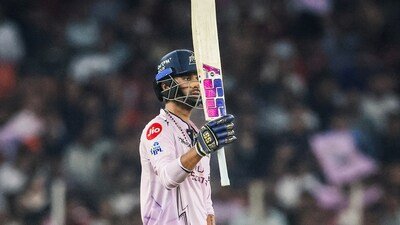
Sai Sudharsan had given GT stability. Sundar gave the innings its release. His 50 off 33 balls pushed Gujarat to 168, a total that later became far bigger once Kagiso Rabada, Mohammed Siraj and Jason Holder ripped through SRH’s chase.
Washington Sundar converts a fragile innings into a winning total
Sundar’s knock had clear match value because of where it came from. GT had lost early control. Shubman Gill and Jos Buttler were gone inside the first six overs. Nishant Sindhu also fell before the innings could properly open up. At that point, GT needed a batter who could absorb pressure without allowing SRH to lock the innings into a 140-150 range.
Sundar entered that phase and gave GT exactly that bridge.
His 50 came off 33 balls, with seven fours and one six. The strike rate of 151.51 was important, but the innings was more valuable because of its distribution. He did not burn balls and then leave the acceleration to others. He carried the innings into the final stretch himself.
In the middle overs, Sundar made 24 off 21 balls. That phase kept GT from slipping further. In the death overs, he made 26 off 12. That phase lifted the total into defendable territory.
That split explains the monetary jump. Our model valued Sundar’s performance at INR 2.72 crore for the match. His charged match cost was only INR 0.23 crore. His final profit stood at INR2.49 crore, the highest by any player in the game.
Why Sundar beat bigger names on profit
Kagiso Rabada had the greatest impact on our model. His three-wicket spell produced the highest overall impact score of the match. Shubman Gill had the highest total match worth at INR3.65 crore, driven heavily by captaincy value.
Sundar still finished as the biggest profit generator because his value-to-cost gap was the sharpest.
Sai Sudharsan produced a higher player-performance worth than Sundar, with INR 3.07 crore against a match cost of INR 0.61 crore. His profit came to INR2.47 crore. Sundar’s cost base was lower, and that pushed him above Sudharsan by a narrow margin.
The difference is small in amount and large in meaning.
Washington Sundar generated an INR 2.49 crore profit from an INR 0.23 crore match cost. That is an estimated 10.8x profit multiple on the cost charged for this match. His total return of INR 2.72 crore was nearly 11.8 times his match cost.
That is the strongest monetary story of the game.
Also Read: Pat Cummins refuses to panic after GT thrashing, says SRH still have ‘breathing room’ for playoff push
The knock changed GT’s innings value
GT’s 168 did not look like a crushing total at the break. The score became imposing only after SRH collapsed to 86. Still, Sundar’s innings gave GT the extra cushion that allowed their bowlers to attack without scoreboard anxiety.
A 145-type total would have changed the chase structure. A 168-run target forced SRH to take risks on a surface where strokeplay was already uncertain. Rabada and Holder then converted that pressure into wickets.
Sundar’s value sits in that pre-collapse zone.
He did not merely add runs to an innings. He altered the minimum GT could defend. His late push meant SRH were chasing a score that demanded intent from the start. Once early wickets fell, the required rate and scoreboard pressure became heavier together.
The monetary model rewarded that exact contribution.
His innings had recovery, acceleration, and final-score value. It also avoided the common T20 trap of a stabilising innings turning into a drag. Sundar repaired the innings first, then paid it off at the death.
GT’s best financial return came from the middle order
The match produced several strong monetary outputs. Gill’s total worth was the highest at INR 3.65 crore, but INR 3.60 crore of that came from captaincy value. Rabada produced INR 2.52 crore in match value and INR 1.75 crore in profit. Jason Holder produced INR 2.50 crore in value and INR 1.62 crore in profit. Sudharsan generated INR 3.07 crore in revenue and INR 2.47 crore in profit.
Sundar topped the profit table because he combined a high-impact batting contribution with a very low match cost.
That makes him the cleanest financial winner from GT’s 82-run win.
Rabada owned the impact column. Gill owned the total-worth column through captaincy. Sundar owned the return-on-cost column. But Sundar has the sharpest lead because his story is built on one clean equation: INR 0.23 crore cost, INR 2.72 crore value, INR 2.49 crore profit.
Method note
The monetary value is based on the match-specific rating-adjusted model output for GT vs SRH, Match 56. Player match worth includes the model’s converted performance value. Profit is calculated as: rating-adjusted total match worth minus charged match cost
For Washington Sundar, the calculation is: INR 2.72 crore match worth – INR 0.23 crore match cost = INR 2.49 crore profit
Captaincy value is treated separately where applicable. Shubman Gill’s total worth includes captaincy contribution, while Sundar’s value comes from player performance. The model is exclusively designed by the author. It is not an official IPL metric or salary calculation.