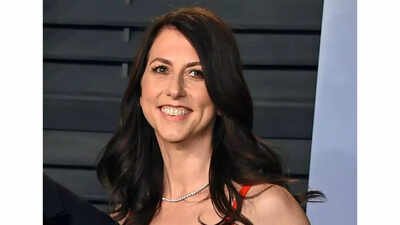
MacKenzie Scott, ex-wife of Amazon founder Jeff Bezos has become one of the most influential philanthropists in America by pioneering large-scale medical debt relief. According to a report by Fortune, through her donations to Undue Medical Debt (formerly known as RIP Medical Debt) Scott helped transform a small non-profit into a national force. Since 2020, her gifts totalling more than. $100 million have enabled the organisation to abolish more than $40 billion medical debt across all 50 states, providing relief to millions of families. The initiative of cutting down the medical debt is a small part of Scott’s larger philanthropic footprint. After her divorce from Bezos, Scott was left with a 4% stake in Amazon which she sold down over time. Scott has also given away more than $26 billion to more than 2,500 organisations which include Black colleges and universities, environmental groups, and economic equity nonprofits and more. As per Fortune report, the recent estimates suggest that her net worth stands at around $33.8 billion.
How MacKenzie Scott managed to abolish the medical debt of $40 billion
The model introduced by Scott is simple but powerful. The hospitals and physician groups routinely sell uncollectible patient debt in bulk portfolios at steep discounts. Instead of debt collectors buying these portfolios, Undue Medical Debt steps in as the buyer. With donations, it acquires the debt at pennies on the dollar and then abolishes it entirely. The math is striking: every $10 donated erases roughly $1,000 in patient debt. This arbitrage between distressed debt markets and healthcare dysfunction has created one of the most effective philanthropic models in recent years.
McKenzie Scott’s approach also inspired other billionaires
The model introduced by Scott also inspired other billionaires. Snap co-founder Evan Spiegel and his wife Miranda Kerr recently donated millions to the nonprofit, erasing $550 million in medical bills for 261,000 Californians. Hedge fund billionaire Daniel Och’s family foundation cleared $264 million in Miami-Dade, while New York City and Cook County, Illinois, have used public funds to retire hundreds of millions more. The largest single deal came in April 2025, when Undue Medical Debt retired a $30 billion portfolio, wiping out obligations for 20 million people.
A model with limits
Even with Scott’s outsized role in scaling the movement, the philanthropic momentum is unfolding against a backdrop of stalled policy reform. A Consumer Financial Protection Bureau rule that would have removed medical debt from the credit reports of 15 million Americans was vacated on July 11, 2025, by U.S. District Judge Sean Jordan of the Eastern District of Texas, who ruled it exceeded the CFPB’s authority and violated the Fair Credit Reporting Act. No federal medical debt cancellation legislation has advanced through Congress since.That gap between philanthropic scale and policy inaction is central to how critics view the model’s limits. Even Undue Medical Debt’s $40 billion in total relief, made possible in large part by Scott’s early and sustained backing, represents only a fraction of the estimated medical debt held by American households nationwide. Closing that broader gap through voluntary giving alone would likely require a sustained, decades-long commitment, one that also depends on continued access to a distressed debt market that may not always offer the same steep discounts it does today.