There was bounce, but the spongy kind that often undermined the big flashy shots. There was pace off the pitch, but the placement still had to be on point in a ground as unusual as Auckland. Winds swept across the ground to keep alive the chance of bringing in the clouds and with them some rain, making it a no-brainer to put New Zealand into bat. Once that was done, Shubman Gill walked his talk of using height and finding the right length in the middle overs with a four-pacer attack. India struck gold.
New Zealand have been here before, getting dismissed for 157 by India in Napier in 2019, 168 in Wellington in 2003 before that. But rarely have they been tested by the short ball so consistently.
With Auqib Nabi and Anshul Kamboj bowling tidy spells, India cranked up the pressure through Gurnoor Brar (3/44) and Arshdeep Singh (4/70) to dismiss New Zealand for only 185 before Virat Kohli guided them to a five-wicket victory with a splendid 74, off just 51 balls, in a rain-shortened game.
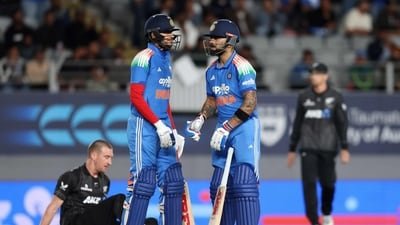
It wasn’t a smooth chase though, as the spongy bounce was bound to cut India both ways. First over of the innings, Rohit Sharma chased a full ball outside off and drove, only to find mid-off in the way. Gill was pinged in the groin by Kyle Jamieson before Blair Tickner made him hop to a snorter that took a ricochet off his glove and flew over the wicketkeeper for a scratchy four. Still, the India captain showed enough pluck to stick in and raise 113 runs with Kohli for the second wicket before the stutter came.
Gill went first, trying to get on top of a short ball aiming towards leg, only for the bat to turn in his hand and spear it into a high catch for Tom Latham. Kohli holed to deep square-leg next, again off a shorter delivery. Two balls later, Axar Patel pulled Jacob Duffy but Glenn Phillips leaped to his left at point and caught it. By the time Shreyas Iyer was dismissed—splicing a pull to Henry Nicholls at midwicket—New Zealand could afford themselves a chuckle. By the looks of it, anything above 250 could have produced a very different game.
But Kohli was also up for it. Jamieson squared him up early on in the third over but he responded with an emphatically flicked four behind square. To Duffy, Kohli just rocked back and pulled him behind square to release the pressure building up from 19 balls without a boundary. Jamieson induced an edge in the 13th over that landed wide of first slip but it was the kind of luck you need to thrive on a pitch like Auckland. A pull muscled over midwicket produced an unlikely six, but completely expected given how Kohli was middling the ball. And when he hammered Duffy for two fours in the 18th over, it was looking all too easy for Kohli but not quite for the rest.
Beyond the muddled finish, India would take strength from the figures of a bowling attack working in concert. Four wickets came from short deliveries and another four from good-length balls. The short ball wasn’t especially expensive, yielding 68 runs from 106 deliveries, while good-length bowling conceded 71 from 87. Kamboj was the glue holding everything together, averaging only 2.2 across 10 overs, conceding only 10 runs in his second spell of five overs (from 25th to 33rd overs) that derailed New Zealand with its discipline.
It was a telling distinction. India’s quicks were not simply peppering New Zealand with bouncers; they were varying their lengths and forcing batters to curb runs and manufacture untidy shots.
At Eden Park, where the bounce can be as deceptive as it is generous, that proved an effective way of taking control of an innings. Proof of that came as early as the fifth over, when Arshdeep dug one in short of a good length outside off, prompting Young to swivel into a pull but only get a top edge.
Nicholls offered a similarly unconvincing response four overs later. Short again from Arshdeep made Nicholls think the pull was a safe shot. Only he picked out square leg instead, and New Zealand were 40 for two. The dismissal of Tim Seifert, at 73 for three, was another illustration of India’s willingness to use the surface rather than merely bowl to conventional lengths.
Brar ran in hard and hit the deck harder, extracting enough lift from outside off to disrupt Seifert’s attempted pull. The resulting splice travelled to mid-on, where substitute Ruturaj Gaikwad took a straightforward catch. Brar’s contribution was significant, but Arshdeep remained the chief tormentor. His fourth wicket—of Phillips—came in the 36th over, off another good length delivery angled across the batter that was miscued to mid-off. And with that extinguished any hope New Zealand were harbouring of crossing at least 200.