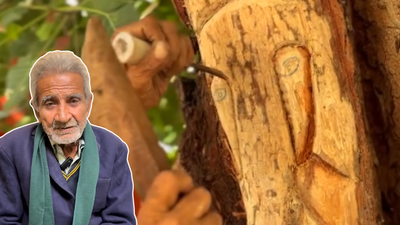
There was a time when Ishtiaq Ali returned home with the idols he had made, only to be told that they would not help run the household. Today, the 85-year-old artist from Kakori in Lucknow is drawing attention for carving Lord Ganesha directly onto a living tree. For decades, he has been making idols of Hindu gods and goddesses. His work has now drawn attention through videos shared on social media, including an Instagram video with Shubh Tales.In a new viral video, Ali is seen working on a tree and making the form of Lord Ganesha. The artist’s unusual method, his age and his understanding of idol-making have made his story stand out. But behind the images of the tree and the unfinished Ganpati is a longer story about a man who spent much of his life working for a living before finding purpose in his art.
From daily wage work to carving idols
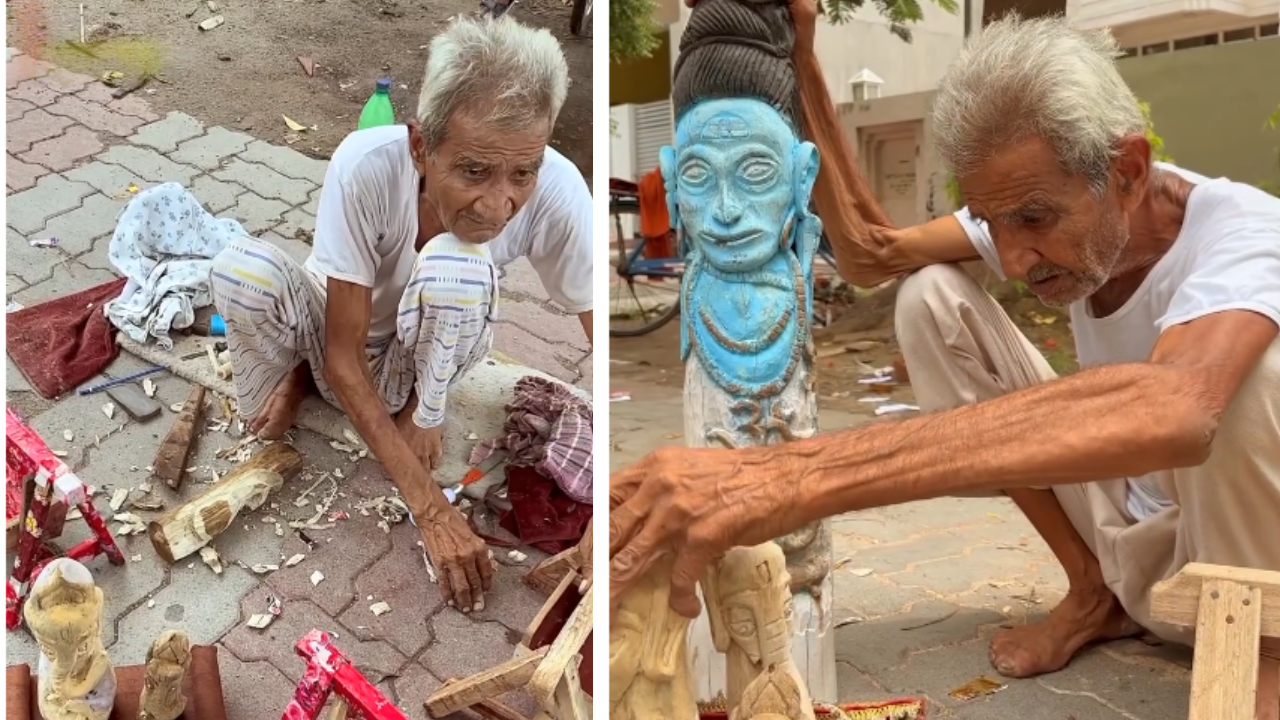
Around 10-15 years ago, he began making idols more seriously.
Ali spent his youth as a daily wage worker in Mumbai and Madhya Pradesh. He has spoken about growing up in poverty with his four brothers and two sisters. In a conversation with Shobhit Mathur (@Shubh Tales), he said, “When India got independence, we four brothers and two sisters grew up in a zoo, saw a lot of poverty.”He has also described how his life changed when he returned to the craft he loved. Around 10-15 years ago, he began making idols more seriously. His first successful carving gave his hands a new purpose. As age and circumstances made steady work more difficult, idol-making became his way of continuing to work. He shapes figures with patience, paying attention to their faces, hands, feet, jewellery and clothing.
His wife once asked him to throw the idols into the Gomti river
One of the most difficult parts of Ali’s story is the lack of appreciation he experienced in the early years. He had spent years making idols with his hands, but there was no one to ask about his work or appreciate it. When he returned home with the idols, his wife would tell him: “Take these and throw them into the Gomti. This will not run the household.” The situation has now changed, and the same idols began receiving attention across the country.
The Ganpati he is carving on a living tree
Ali’s current work includes a carving of Lord Ganesha directly on a living tree. The Instagram video describes him as an artist who does not simply paint a god’s image on paper or make a sculpture from a separate piece of wood. Instead, he works on a live tree. The tree remains unharmed. It also shows how a place that was once used for throwing garbage changed after people saw a religious image taking shape on the tree. People have stopped throwing garbage there.
Why the eyes are made last
Ali’s understanding of idols is also a major part of the videos about him. He explains that there is one part of an idol that is made at the very end: the eyes. Normally, the artist first completes the body, hands, feet, jewellery and clothing. The eyes are made last because, until then, the idol is considered only a sculpture and not the full representation of a deity.He says, “The eyes are made at the very end, because until the eyes are made, the idol does not have life. Until then, it is only a statue, not the form of God.” Ali said his hands tremble slightly when he makes the eyes. “After making the eyes, my hand trembles a little, because it feels that this is no longer just wood.”
The Muslim artist who explains Ganpati’s trunk
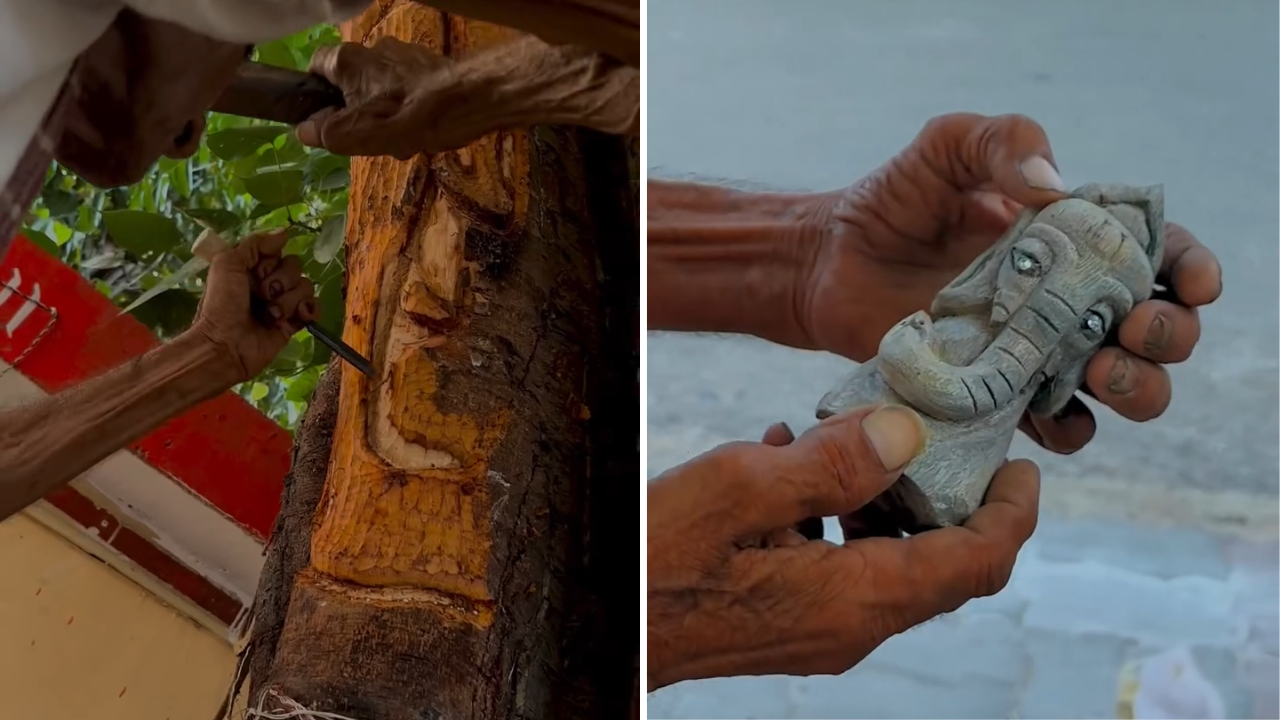
Ali’s current work includes a carving of Lord Ganesha directly on a living tree.
Another video about Ali focuses on a small detail of Lord Ganesha’s idol: the direction of the trunk. Ganesha idols with the trunk turned to the left are traditionally associated with homes, peace and balance. This is why many households prefer that form. Right-trunk Ganesha idols are referred to as Siddhivinayak, associated with power and siddhi, or spiritual accomplishment.
What aspect of Ishtiaq Ali story resonates with you the most?
3k+ users shared opinion today
5k+ users already voted today
3k+ users shared opinion today
Share Opinion
The video presents Ali explaining the difference. “Because this is not just a difference in design. Left-trunk Ganesha is considered auspicious for the home. It is believed to bring peace and balance, which is why most homes prefer this form. The right-trunk Ganesha is called Siddhivinayak. It is considered a form of power and siddhi, but it has to be worshipped according to specific rituals. It is considered a little more difficult, which is why these idols are mostly installed in temples and less often in homes,” he said in the video.
A five-inch Ganpati made for a Muslim man
Ali has also shared a story about a Muslim man who once approached him for a Ganesha idol. In an interview with Shubh Tales, he recalled: “One man came to me once and said, ‘Make a 5-inch idol for me of Ganesha. He said he would keep it in his house.’ I asked, ‘What’s your name?’ He answered, ‘Saleem.’ I asked, ‘What are you going to do with the idol?’ He said, ‘We’ll keep it in the house. We’ll use it as a decoration in our house.’ When I heard him saying that, I was very happy and my motivation to keep going increased.”His own explanation for continuing to make idols is also personal. In the Instagram video with Shubh Tales, he says: “When I sleep, I see Devi-Devtas in my dreams.”