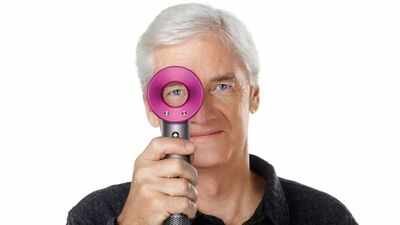
Sir James Dyson is widely recognised for changing the way people think about household appliances, though the idea that built his company did not arrive in a sudden flash of inspiration. It emerged from a practical irritation that many people had simply accepted. Frustrated by a vacuum cleaner that steadily lost its suction, Dyson began wondering whether the problem could be solved differently. That question led him into years of trial, redesign and repeated disappointment before he produced a machine that worked the way he believed it should.The process became far longer than anyone might have expected, stretching across thousands of experiments rather than a handful of sketches. Looking back, Dyson has often described those years not as a story of persistence alone, but as an exercise in learning through failure, questioning accepted ideas and refusing to abandon a solution simply because others doubted it.
James Dyson’s 5,127 attempts to solve one common household problem
The origin of Dyson’s best-known invention was surprisingly ordinary. Instead of trying to create an entirely new product category, he focused on improving something already sitting in millions of homes.He became increasingly dissatisfied with conventional vacuum cleaners whose performance dropped as dust accumulated inside disposable bags. Rather than accepting that limitation as unavoidable, he started examining why it happened and whether the design itself was responsible. That curiosity shifted into experimentation to create a cleaner capable of maintaining strong suction without relying on a traditional dust bag.Dyson’s development process stretched across 5,127 working prototypes before he arrived at the version he believed solved the problem. Each unsuccessful model revealed another weakness, prompting another redesign rather than convincing him to stop.He has spoken about failure in unusually practical terms. Instead of treating unsuccessful experiments as wasted effort, he regarded them as information. Every prototype exposed something that had not worked, narrowing the possibilities and pointing towards the next modification.
Why Sir James Dyson ignored criticism of his vacuum’s design
Developing a product is only one challenge. Convincing others to support it can become another. During the early years of Dyson’s vacuum cleaner, several aspects of the design attracted scepticism. One feature that divided opinion was the transparent dust container. Some retailers reportedly believed customers would dislike seeing the collected dirt and argued that the feature should be removed.Dyson and his engineering team viewed it differently. They felt the visible collection bin demonstrated that the machine was working exactly as intended, giving users a direct view of what had been removed from carpets and floors. Despite outside criticism, they decided to keep the design unchanged.That decision reflected a broader approach. While feedback can be valuable, Dyson has often suggested that creators cannot allow every external opinion to redirect a project before it has the chance to prove itself.
How Sir James Dyson turned everyday frustrations into better products
Dyson has repeatedly linked innovation to irritation rather than imagination alone. Instead of waiting for abstract ideas, he believes useful inventions often begin with everyday inconveniences that people tolerate without questioning.Small frustrations inside homes, workplaces or daily routines can reveal opportunities for improvement. Rather than adapting to products that function imperfectly, he has argued that these moments deserve attention because they expose weaknesses that better design might address.