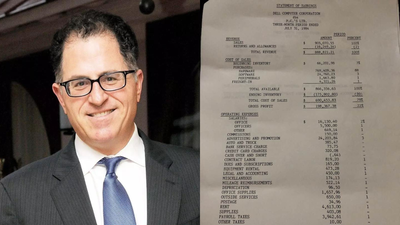
Dell CEO Michael Dell has publicly shared the “one page” that he says has changed his life 42 years ago. He shared a copy of Dell Computer Corporation’s statement of earnings for the three months ended July 31, 1984, on X (formerly Twitter). He said the document convinced his parents that he should not return to college after launching his business from his University of Texas dorm room.Sharing the financial statement on X, Dell wrote, “This one page changed my life. 42 years ago today, it convinced my parents I shouldn’t go back to college. I started by upgrading PCs from a dorm room. Today @Dell is helping build the infrastructure that powers AI, from the edge to some of the world’s largest AI factories. You never know which small decision will change everything. Keep building🚀🙏 #PlayNiceButWin.”The statement of earnings shows that Dell Computer Corporation, operating as PC’s Ltd., generated $888,821.21 in total revenue during the three-month period ended July 31, 1984, with $134,762.75 in earnings from operations.
From a dorm room business to direct PC sales
Dell founded the company in 1984 while studying at the University of Texas at Austin. Rather than manufacturing complete computers from the outset, he initially sold upgrade packages that included hard drives and memory expansions for existing personal computers to address specific customer requirements.As the business expanded, Dell adopted a direct-to-consumer sales model instead of relying on distributors and retail stores. Customers could order computers configured to their own specifications, allowing the company to assemble systems based on confirmed demand rather than producing inventory in advance.
How customisation became part of Dell’s business model
According to Harvard Business School, Dell’s direct-sales approach gave customers greater flexibility by allowing them to choose components based on their requirements rather than purchasing preconfigured machines from retailers.The model also enabled Dell to align manufacturing with incoming orders, reducing inventory costs and limiting excess stock. Harvard Business School notes that producing systems only after orders were placed helped the company manage components more efficiently in a rapidly changing PC market.Working out of a dorm at the university also implied that the company had limited resources in its initial days. To reduce operating costs, Dell avoided conventional retail distribution channels and maintained low inventory by concentrating on building computers based on customer orders.