Biographies of larger-than-life figures usually promise revelation—some fresh lens through which we can revisit a legend. With Michael, filmmaker Antoine Fuqua takes on the daunting task of revisiting the life of Michael Jackson, a man whose story has already played out on the world’s biggest stage. That raises a central dilemma: should a film like this reshape public memory, defend the man behind the myth, or confront the uncomfortable duality of genius and imperfection?
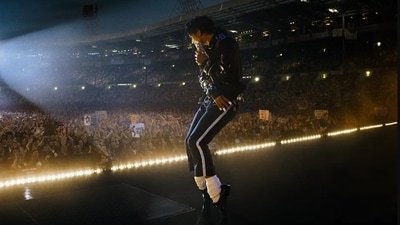
The narrative charts Jackson’s journey from a precocious child performer in Gary, Indiana, to a global superstar redefining pop culture. It moves through the Jackson 5 years, his evolution as a solo artist, and his collaborations with Quincy Jones, while placing heavy emphasis on his fraught relationship with his father, Joe Jackson. Milestones like Off the Wall and Thriller are recreated, leading up to his peak years, before the film abruptly closes with a suggestion that the story will continue.
The good
What keeps the film intermittently engaging is, unsurprisingly, the music. Jackson’s catalogue still carries an undeniable charge, and the recreations of his landmark performances are mounted with enough polish to trigger nostalgia. Jaafar Jackson, stepping into the role, delivers a performance that is physically convincing—capturing the voice, rhythm, and delicate poise that defined the icon. In quieter stretches, he manages to convey a certain fragility, hinting at the emotional scars beneath the spectacle. The film’s most coherent through-line is Jackson’s attempt to break free from his father’s control, positioning his artistry as something born out of both discipline and damage.
The bad
But the film rarely digs deeper than that surface. It rushes through time, jumping from one defining moment to another without allowing any of them to breathe. The result feels less like a narrative and more like a checklist of greatest hits. Crucially, the film avoids engaging with the most controversial aspects of Jackson’s life, leaving a noticeable gap at its core. By refusing to grapple with those complexities, it presents a version of Jackson that feels incomplete—flattened into a figure of sympathy rather than a fully realised human being.
The supporting cast is largely underwritten, existing only as extensions of Jackson’s journey. Even Colman Domingo’s portrayal of Joe leans towards exaggeration, reducing a complicated relationship into a single-note antagonist. Visually too, the film struggles—over-edited sequences and distracting camera movements often sap the energy from moments that should soar. What should feel immersive instead comes across as staged and distant.
The verdict
Michael plays it safe at every turn, opting for reverence over risk. It doesn’t challenge how we see the artist, nor does it fully explore who he was beyond the spotlight. For a story this layered, the film feels curiously one-dimensional—glimpses of brilliance overshadowed by an overwhelming lack of depth.