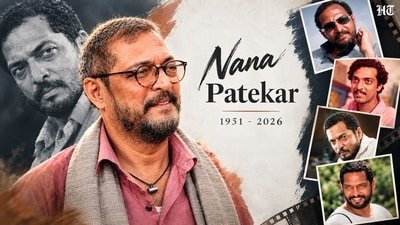
There are stars, there are superstars, and then there are artistes. In a career spanning almost 50 years, Nana Patekar never strived to be anything more than an actor. And that is what made him an artiste, perhaps one of the finest Hind cinema has seen. For a man like him to emerge in the 80s, challenge the notion of what a ‘Bollywood hero’ is supposed to look like and then change the rules by which the game was played was no mean feat. Nana’s success paved the way for many actors, who did not want to take the ‘road more travelled’ to stardom.
Not a star, but an actor
Born Vishwanath Patekar into a Marathi family in 1951, Nana began his acting career in his late 20s. There was no grand launch, no face on the giant poster, but a quiet debut with the 1978 Marathi film, Mimagaman. He worked in several Marathi films in the next few years, before playing Nathuram Godse in a small role in the British television series Lord Mountbatten: The Last Viceroy. In the mid-80s, as his acting began to be appreciated, Nana’s screen time increased. One of the earliest Hindi films that got him noticed was Aaj Ki Awaz (1984). And then, two years later, Ankush happened.
The 1986 film, directed by N Chandra, focused on four unemployed young men whose wayward ways are corrected by a mother and a daughter in their neighbourhood. When the daughter is sexually assaulted, the youngsters take the law into their own hands. Nana’s energetic performance, fast-talking dialogue delivery, and pensieve stare made him stand out. This was the role that gave rise to what would later become the Nana template.
The unconventional ‘hero’
As the 90s rolled in, Nana had established himself as an acclaimed actor. His appearance in Mira Nair’s Oscar-nominated 1987 film Salaam Bombay earned him praise. And then, for Parinda, he earned his first National Film Award for Best Supporting Actor. But the tag ‘supporting actor’ stuck. His performances were being praised, but he was almost always cast alongside more ‘saleable’ names in big films. He decided to change that himself.
In 1991, Nana turned director with Prahaar, the story of a retired Army officer who decides to dole out justice in his own way. The film featured Madhuri Dixit alongside Nana, who starred in the lead role himself. The film was a moderate success at the box office and later became a cult favourite on cable TV. Tiranga and Krantiveer completely transformed him into a box office draw in the mid-90s. The former was a masala action film in which he starred alongside the veteran Raaj Kumar. The latter was a social drama in which he played another renegade vigilante. Krantiveer also gave one of Nana’s earliest ‘viral’ scenes. Despite not looking the part and not acting like a star, Nana Patekar was one, now. For Krantiveer, he won the Best Actor National Award. He was a leading man, now.
Throughout the 90s and 2000s, Nana starred in smaller films and appeared in supporting roles in blockbusters, balancing both aspects of his career and refusing to be assigned a single label. Was he a ‘hero’ or a ‘character actor’? Nobody could box him. In 2004, he played his last major leading role in a commercially successful film, Ab Tak Chhappan.
The chameleon who could do comedy
Nana Patekar had dabbled in comedy in the 90s as well. His performance in the famous Love Rap from Krantiveer was on TV sets for months, a cultural phenomenon. But till the 2000s, comedy was a part of his repertoire in a role. In 2007, he appeared in Welcome, an ensemble comedy in which he played his zaniest role to date. Uday Shetty became an icon, and Nana Patekar proved that he was more than just a ‘serious’ actor. Performances in Bluffmaster, Phir Hera Pheri, and Hattrick had already hinted at his superior comic timing.
Controversy’s favourite child
As accomplished an actor as Nana was, controversy followed him. In 2008, Tanushree Dutta accused the actor of sexually harassing her on the sets of the movie Horn ‘Ok’ Pleassss. She filed a complaint with CINTAA (Cine & TV Artists Association) that year, repeating the allegation in 2013 and 2018. Nana denied all allegations. In 2018, CINTAA apologised to Tanushree, admitting that the “chief grievance of sexual harassment wasn’t even addressed (in 2008)” but added that since the case was more than three years old, they could not reopen it.
In 2018, the actor filed a police complaint, and an FIR was registered against Nana. This was the beginning of India’s #MeToo movement. However, a year later, Nana was cleared of the sexual harassment charges. The B-Summary report filed by the Oshiwara police station in Mumbai said that the complaint filed by Tanushree Dutta could be “malicious” and “out of revenge”.
Madhoo, his co-star in Yehswant, recalled that he slapped her in a scene without warning, prompting her to slap him back. The actor maintained that it was for the scene, but Madhoo said years later that she felt professional boundaries were crossed.
These controversies, however, failed to affect his career. Nana worked in successful and critically acclaimed films like Rajneeti, Natsamrat, and Ab Tak Chappan 2 in the 2010s.
Nana Patekar’s final performance was as a maverick, unpredictable police officer in Vishal Bhardwaj’s O’Romeo, released in 2026. The actor died six months later, aged 75, at his Goa home.