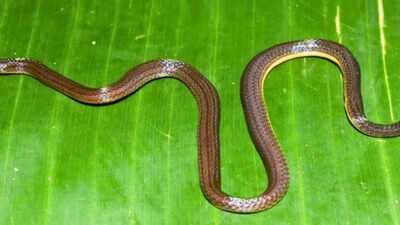
A new species of snake called Calamaria garoensis has been found in Garo Hills, an area located within the state of Meghalaya. The finding has received a considerable amount of attention since Meghalaya Chief Minister Conrad K Sangma appreciated the efforts of the team behind the discovery. The discovery further contributes to the increasing list of species that can be found in the northeastern part of India, an area characterised by thick forests and abundant wildlife. This particular finding came about following collaborative efforts of different academic organisations from both India and Indonesia.
Rare snake species Calamaria garoensis discovered in Meghalaya
Calamaria garoensis has been found and described through the joint efforts of scientists who work for organisations such as Help Earth, Cotton University, Assam Don Bosco University, Mizoram University, the Zoological Survey of India, and the National Research and Innovation Agency of Indonesia. This cooperation entailed scientific activities from various specialities with special focus on field research and taxonomy. This scientific endeavour is indicative of an organised scientific effort by scientists working in India as well as abroad. Field surveys in the Garo Hills played a vital role in discovering the unique characteristics of the snake.
Meghalaya Chief Minister’s response to the discovery
Meghalaya Chief Minister Conrad K Sangma acknowledged the discovery through a public statement. He congratulated the research team for their work and highlighted the importance of such findings for the state’s natural heritage.The statement also pointed to the ecological value of Meghalaya’s forests. The discovery of Calamaria garoensis was described as an example of the biological richness present in the region. The recognition from the state leadership reflects increasing attention to biodiversity research and conservation efforts in Meghalaya.
Garo Hills biodiversity hotspot reveals dense forests and hidden reptile species
The Garo Hills region is part of the Meghalaya biodiversity hotspot. It contains dense tropical and subtropical forests that support a wide range of flora and fauna. Many species in this region are still being documented due to limited scientific exploration in certain areas.The discovery of a new snake species adds to existing records of reptiles in the region. It also supports ongoing studies that indicate northeastern India as one of the important zones for herpetological diversity.Calamaria snakes are generally small and secretive in nature. They often remain underground or within leaf litter, which makes detection difficult. This characteristic explains why new species within this group can still be identified.
International collaboration in new species identification and taxonomic research
The identification of a new species required cooperation between multiple institutions. Researchers from universities and scientific organisations contributed data, field observations, and analysis.Such collaborations are important in taxonomy and biodiversity studies, especially in regions where species diversity is high but documentation is still incomplete. The involvement of international research bodies also strengthens the validation process for new species identification.