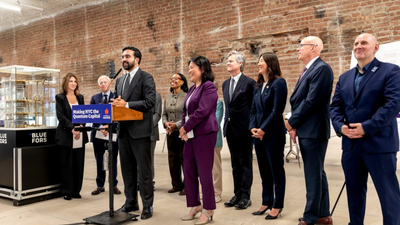
New York City Mayor Zohran Mamdani has committed $29.2 million in city money to New York University’s (NYU) new quantum technology lab, and the city wants a share of whatever comes out of it. Under a deal announced on October 14, New York City will receive 15% of NYU’s central administration proceeds from any intellectual property created at the lab using tools the city helped fund. It also gets three seats on the lab’s executive advisory board.The Quantum Fabrication Facility, or QFab, will occupy 23,000 square feet at 770 Broadway in Manhattan and is expected to open in 2030. NYU is adding $255 million of its own, $100 million for construction and $155 million for a decade of operations, which takes the project to $284 million. “We are building a city where economic justice doesn’t come at the expense of innovation,” Mamdani said.
New York City will get a 15% cut of NYU quantum lab proceeds
The city’s share covers equity, royalties, milestone payments and patent licences. If a startup built on QFab research goes public or gets acquired, part of that payout comes back to the city. Mamdani called the agreement a new national standard, then added, “or, as we say in the industry, a standard model.”Deputy Mayor for Economic Justice Julie Su said that when the public invests in a technology at the start, it should share in the success. She has also said the 15% figure isn’t a magic number, and that it’s too early to estimate what the deal could earn.That uncertainty is the main criticism. Aaron Bartnick, a Columbia University fellow and former Biden White House official, has argued that venture capitalists would treat an early-stage quantum bet as high risk, and questioned whether taxpayers signed up for that kind of exposure.Asked at the event whether President Donald Trump, whose administration has taken stakes in private companies, inspired the model, Mamdani replied: “No, he’s not the inspiration.”
QFab opens quantum chip-making tools to CUNY students and startups
The lab will house cleanrooms, cryogenic systems and a deep-ultraviolet lithography stepper. NYU Tandon Executive Dean Juan de Pablo said startups can’t afford such a machine on their own but need it for prototyping. It can print around 300 million transistors on an 8-inch silicon wafer, each roughly 1,000 times smaller than the width of a human hair.Students from the City University of New York (CUNY), starting with Borough of Manhattan Community College and City Tech, will train there too. De Pablo put that number at over 3,000 and said he wants to extend access across the CUNY system. Public school students get summer bootcamps. Over its first decade, QFab is expected to support more than 100 companies and reach 35,000 New Yorkers, while NYU plans to add 35 faculty and postdoctoral positions.
New York City bets on a $2.7 trillion quantum industry
Quantum technology is projected to generate up to $2.7 trillion in global economic value by 2035. De Pablo said the number of quantum startups in the city has quadrupled to more than 80 in six years, many working alongside IBM. What they lacked, he said, was a facility like this one.Mamdani opened the event by running through New York’s scientific firsts, from the discovery of deuterium at Columbia in 1931 to DNA research at the Rockefeller Institute. He then added a 15-year-old in the Bronx who scored 91 on his biology Regents exam in 2007. “In case you’re wondering, he’s now the mayor,” he said.The payoff from QFab, if it comes, is still years out. The lab opens in 2030, and turning its chips into products will take longer. What the city has secured for now is a written claim on that future, and a say in what gets built.