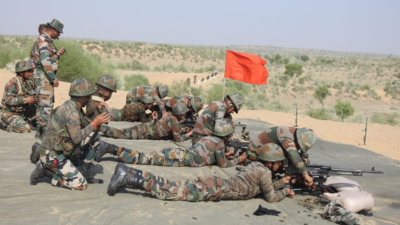
The Indian Army has kicked off the procurement process for 1,547 thermal imaging night sights meant for its 7.62mm medium machine guns, with the equipment required to help troops spot and engage human targets, both day and night, at an effective range of 1,800 metres or more. The Request for Information (RFI), issued by the ministry of defence, calls for thermal sights along with accessories and support equipment, part of a push to keep frontline troops operationally effective around the clock, regardless of light conditions or terrain difficulty.The requirement carries particular weight for medium machine guns, which are tasked with providing sustained fire support to infantry units. Unlike conventional night-vision equipment that relies on amplifying available light, a thermal weapon sight works by detecting heat differences, letting a gunner spot a person, vehicle or other heat source even when image-intensification systems start losing effectiveness. The army’s requirement on engagement out to 1,800 metres underscores just how much emphasis is being placed on extended-range detection and engagement.Earlier in August, the army had floated a separate RFI for image-intensification and thermal imaging sights for the SIG-716 rifle, the Negev light machine gun and the AK-203, reflecting a broader intent to arm soldiers with a mix of sensor technologies rather than banking on just one for night operations.The two technologies, worth understanding, work quite differently. Image intensifiers amplify whatever light is available, even at extremely low levels, to build a usable picture. Thermal imagers instead pick up infrared radiation and convert temperature differences into an image, meaning they need no external illumination at all, a real edge when operating in both extremely low and no light conditions, especially during no moon phases and during cloudy nights.This would help check infiltration along the Line of Control, where troops contend with rocky, uneven terrain thick with vegetation and shadows. Spotting a person moving through such ground with conventional optics can be tough, especially on a moonless night. A thermal sensor, however, can pick up the contrast between a human body and its cooler surroundings, often making movement far easier to catch.There’s also the camouflage factor, camouflaged clothing designed to visually blend into rocks or foliage don’t necessarily hide a person’s heat signature, giving thermal sights an edge there too, though dense vegetation, walls and specialised thermal camouflage can still blunt or block that advantage.Passive detection is another plus. Since thermal sights don’t need an illuminator, troops can observe an area without giving away their own position through a light source, useful for surveillance along a sensitive, contested border. Many of these systems also work fine in daylight, meaning a single sight can realistically cover a far wider range of conditions than older, night-specific gear.None of this makes thermal imaging a silver bullet, though. These systems tend to be costlier and more power-hungry than standard sights, and they don’t always offer the same crisp visual detail that image-intensification gear provides. Heavy rain, fog or snow can also chip away at performance, which is why most modern militaries now treat thermal and image-intensification technology as complementary tools rather than one simply replacing the other.