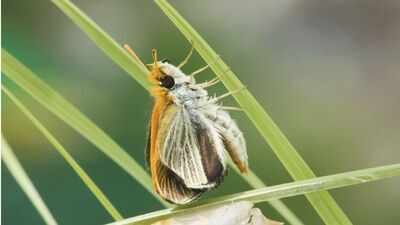
On a summer day in Michigan, a tiny Poweshiek skipperling butterfly takes flight over a restored prairie. The butterfly is smaller than a quarter, but its return marks a major change for a species once feared to be close to extinction.Researchers at Michigan State University (MSU) and their conservation partners have helped bring the Poweshiek skipperling back from the brink. According to the university, the recovery effort has involved raising the endangered butterflies in captivity, restoring their habitat and releasing them into the wild.Researchers are now seeing hundreds of butterflies at some sites, a major change from the situation in 2022, when only nine Poweshiek skipperlings were found in the wild in the US.“We were actually able to save that species from extinction,” says David Pavlik, a research assistant at MSU’s WK Kellogg Biological Station and John Ball Zoo. “We released 102 butterflies in 2022 and more than 1,300 butterflies in 2025,” he proudly adds.In the early stages of the program, researchers were simply trying to stop the species from disappearing from the few populations still found in Michigan. Today, some butterflies are released to strengthen existing populations, while others are used to establish new ones.
Nine to more than 1,300
The Poweshiek skipperling was once found across much of the Midwest, from Iowa and the Dakotas to Michigan and southern Canada. However, its numbers began falling rapidly in the early 2000s.By 2022, researchers had documented only nine Poweshiek skipperlings in the entire United States. At one stage during the recovery programme, more butterflies were being kept in captivity than existed in the wild anywhere in the world.That made captive breeding an important part of the effort. Researchers raised the butterflies before releasing them into suitable habitats. More than 1,300 captive-reared butterflies were released in 2025, compared with 102 in 2022.“The most exciting thing about this research is starting to see butterflies in the field,” said Bill Flanagan, conservation manager at John Ball Zoo. “In 2022, there were a grand total of nine butterflies found in the US Now we’re seeing hundreds of them in these sites.”
Michigan becomes refuge
Michigan has played an important role in the survival of the Poweshiek skipperling. The state is surrounded by the Great Lakes and has rare prairie fen wetlands, which provide important habitat for the species.Today, the Poweshiek skipperling survives in only a few locations in southeast Michigan and in one population in Manitoba, Canada. “Michigan is a stronghold for these species,” Flanagan said. “We’re the perfect place to help save them.”Most of the world’s remaining prairie fens are found in southern Michigan. These habitats have been restored by the Nature Conservancy and other land managers, creating places where the butterflies can survive and reproduce.“Without conservation efforts like this, there wouldn’t be these habitats where these species can thrive,” Pavlik said. “Restoring prairie habitat benefits not only Poweshiek skipperlings, but also many other rare species.”
A short window
The recovery work is difficult because of the butterfly’s life cycle. Poweshiek skipperlings spend nearly their entire lives as caterpillars. They emerge as adults for only about two weeks each summer.That short adult period gives researchers a limited opportunity to release and track the butterflies. Missing that period can mean losing an entire year of conservation work.Researchers use specially designed hoop houses to recreate the hot and humid conditions of Michigan’s rare prairie fens. The caterpillars are kept in individual enclosures and monitored as they develop.Before release, each butterfly is briefly anesthetised and marked with a Sharpie so researchers can identify it later. Some butterflies are also marked with a small dot of paint. This allows researchers to track their survival and see how far populations spread between prairie fens.The work has now expanded to two other endangered butterflies. Researchers at MSU and John Ball Zoo are raising and reintroducing the Mitchell’s satyr and Karner blue as part of the Great Lakes Rare Butterfly Program. Both species have been released into their native habitats this summer.