Dear Tollywood, please stop objectifying your female characters for no reason. Stop assaulting them in the name of romance or vengeance. Stop behaving like you don’t understand consent in 2026. Especially when you give your male characters grace in all ways that matter.
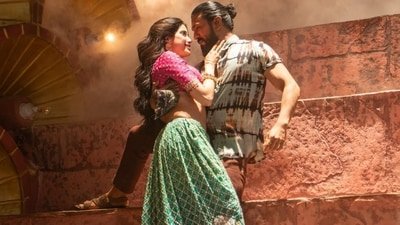
I watched Buchi Babu Sana’s Ram Charan and Janhvi Kapoor-starrer Peddi’s premiere show and walked out feeling like I had watched two different films. One film understood dignity, questioned the loss of identity, and depicted the struggle of a man who wanted to be viewed simply as a human being. But all that applied only to its male lead. *Spoilers ahead*
(Also Read: Peddi movie review: Janhvi Kapoor feels wasted in Ram Charan film that raises important questions about identity)
Peddi’s assault of Achiyamma
Peddi (Ram) is a character who’s often referred to as aata coolie (a player for hire) and konda vada (a person from the hills) because his village has no identity of its own. On the other hand is the privileged daughter of a village elder, Achiyamma (Janhvi), whose only concern is to ensure her father stays at the top of the local totem pole.
The first time Peddi sees her is one of the most uncomfortable scenes to sit through. The director insists on zooming in on her body parts, even as the male lead describes her face’s beauty. He even declares ‘mutteyali’ (must touch her) because her father won’t agree to their marriage, nor will she ever fall for someone like him. Peddi keeps fantasising about her in the name of romance, even remarking in one scene, “Idi chupistonda, cheptonda? (Is she showing or telling?)”
Of course, the penultimate scene comes when Peddi makes good on his promise and kisses Achiyamma during a power cut. As she sits there sobbing, she is asked by a male aide to forget about it to protect her father’s career. All this is played off as the most romantic thing on earth, as AR Rahman cues the song Chikiri Chikiri in which Peddi sings, “Padta, venake padta (I’ll keep following you).”
Everything’s alright as long as the hero does it
The irony doesn’t even lie in how a film about dignity and identity gets away with objectifying and overtly sexualising its female lead in the name of commercialism, no. It lies in how we’re told everything is alright, as long as the hero does it and not the villains.
Rambujji (Divyendu) has a gripe with Achiyamma, so he decides to have his friends publicly disrobe her. Peddi, of course, saves the day at the last minute, but this violation of her is not given the same treatment as the previous kiss. This is shown as a grave injustice done to a woman; she sobs much like she did when she was kissed without consent. But that’s not the point. The point is a cool fight scene that follows after; that’s more important.
In a later scene, Achiyamma meets Peddi to thank him for saving her dignity. She touches his chiselled body and realises he’s the same man who kissed her without her consent. After she slaps him for the transgression, he explains to her, “Some people express love with songs or letters. I only know how to do it through touch.” Besides, he’s not even asking her to date him; you see, he wants marriage. She agrees, it’s totally okay.
Even as I watched Buchi Babu Sana perfectly grasp the concept of the inherent worth of humans before and after these scenes, I realised that Tollywood hasn’t moved an inch in treating female characters as human beings. She’s either treated with reverential purity or sexualised for voyeurism, even vilified if she has self-worth. It has almost been a decade since it was pointed out that Baahubali had raped Avantika, and yet nothing has changed. We’re still here, having the same conversations about consent and objectification.
If this is all we’re going to get in commercial cinema, maybe it’s time filmmakers, actors, and even the audience stop pretending that Telugu films have given the female lead something to chew on.
Signed sincerely, a film journalist and a tired woman.