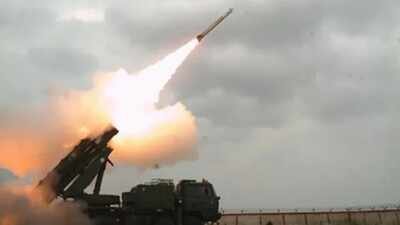
In the opening move of Operation Sindoor, the Indian armed forces struck nine terror targets deep inside Pakistan. The biggest of these targets were the Lashkar-e-Taiba headquarters and Hizbul Mujahideen’s headquarters located in Muridke, north of Lahore and in Bahawalpur west of Anupgarh in Rajasthan. The deepest terror target was the Hizbul headquarters, which was approximately a 100km deep inside Pakistan.India is now developing a version of the Pinaka rocket which can hit targets 120km away. This variant is known as the Long Range Guided Rocket. At the range of 120km all the targets hit on the first day of Operation Sindoor. The Pinaka rocket, with a warhead of 100kgs, lacks the punch of bigger and more prominent weapon systems such as the Brahmos and the Pralay missiles which can carry between 300-1,000kgs payload. But the rocket can be fired in a salvo mode in which multiple rockets from the same launcher can drop a 100 kg warhead with a scalpel like precision.The lack of depth has been a critical worry for Pakistan. Most of its cities are located in the fertile plains of the Punjab, near the Indian border. So is the alignment of the demographic geography of the country, which thins out as the country moves westward, with the vast number of Pakistanis living between the Indian border and the Indus river. The Pakistani military, which thinks of India as an existential threat, has deployed seven of its nine corps near the border with India while the other two look after vast borders in the restive Balochistan and Khyber Pakhtunkhwa provinces.The lack of this depth puts many cities in Pakistan, the most prominent of these being Lahore well within the artillery firing envelope of Indian artillery. Many other cantonment towns such as Gurjanwala, Sialkot, Mangla, Bahawalpur and Rahim Yar Khan are within the range of these projectiles.Pinaka has evolved from a 40 km range to guided variants striking up to 120 km, enabling precision firepower. Suryastra, envisioned as a next-generation rocket system, aims to extend reach and accuracy, rivaling missile capabilities. Together, this shift embodies India’s shift toward non-contact warfare—delivering deep, precise strikes to disrupt logistics, command centres and air defence systems before ground forces engage. These systems enhance deterrence, punitive strike options, and operational flexibility while minimising troop exposure across contested borders.Pinaka and Suryastra exemplify India’s transition to precision, long-range rocket artillery. With advanced guidance, modular warheads, and networked targeting, they reduce reliance on manned platforms while complementing drones, cruise missiles, and airpower. These systems embody non-contact warfare—dominating battlespace through deep strikes, disrupting logistics and defences. The US army too demonstrated this capability against Iran, this underscores how modern conflicts are increasingly decided by technological reach and precision rather than direct troop engagement.