‘Tumhara naam Jay Mehra nahi, Gay mehra hona chahiye’. This dialogue depicts the lens that Bollywood saw the LGBTQIA+ community from between the ’90s and early 2000s — caricaturish, effeminate and always the butt of jokes. For years, queerness was not treated as an identity to be understood but as a punchline to be laughed at. But then came an awakening.
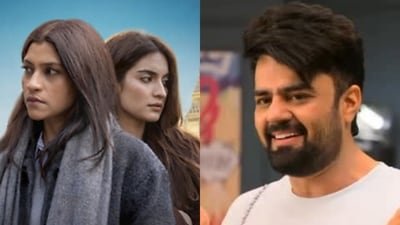
The 2010s saw a shift. For perhaps the first time, queer characters were allowed to exist as people with desires, flaws and stories of their own, rather than as punchlines orbiting heterosexual protagonists, with stories like Kapoor & Sons (2016), Aligarh (2015), the web series The Married Woman, Taali and Class.
As things seemed to be getting better, came Tu Meri Main Tera Main Tera Tu Meri (2025). A token gay couple made their way into the story, but not to add anything substantial, but just to ogle at the leading men Kartik Aaryan, as why would a gay couple be monogamous and respectful? It would have been easy to pass it off as a one-off incident, as 2026 began with a story like Accused where a lesbian couple was at the centre of a story, but their sexuality wasn’t a point of contention, but something considered normal and accepted.
But progress, it seems, is neither permanent nor guaranteed. Recent releases suggest Hindi films may be slipping back into their old tropes. Last month’s release Pati Patni Aur Woh Do was a comedy-of-errors with one man and three women. But there was also a seemingly queer effeminate cop, who didn’t add to the story but was there to just sway, talk in a “queer” way and become the butt of jokes. Suddenly, you are reminded of the cricket scene in Pyar Kiya To Darna Kya (1998), and one realises we’ve gone back in time, but in the wrong context.
A storyline of the protagonist and another character being perceived as gays also made it in, and was handled with insensitively, but what’s shocking was to see Ayushmann Khurrana deliver a monologue on inclusivity at the end, after having shown what they did. Interestingly, this came from the same director Mudassar Aziz, who handled the issue quite convincingly in his last film Khel Khel Mein, but here he went full 90s and not in a good way.
The recently released Hai Jawani Toh Ishq Hona Hai also has a sequence where actor Maniesh Paul acts ‘gay’ in a situation. He imitates the most stereotypical tropes that the queer community has long been fighting against — dropped hand, acting effeminate and talking in a sultry, feminine voice, and we are supposed to laugh at it? It’s not that queer characters aren’t funny, but the problem is when the joke continues to be queerness itself.
We are celebrating Pride month, but these examples makes one wonder, is the representation we are giving the community on screen, worth feeling proud of? If Bollywood truly wants to claim progress, it must stop using queer identities as shorthand for comedy and start treating them as worthy of the same complexity it affords everyone else.