“And our very own Rohit Sharma is back.”
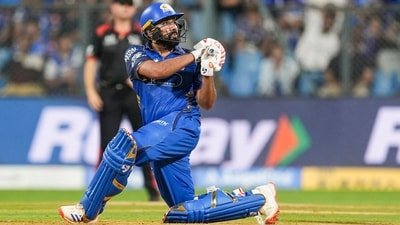
Even before stand-in skipper Suryakumar Yadav uttered the seventh of those eight words, the Wankhede Stadium transformed itself into a cacophonous cauldron. The packed house at the unofficial home of Indian cricket – with due respect to the iconic Eden Gardens and the sprawling Narendra Modi Stadium – wasn’t unaware that it wouldn’t be another two hours before the former India captain would make an on-field appearance, but having waited more than three weeks, what was a mere 120 minutes?
Rohit didn’t disappoint. He took his time initially, which was perfectly understandable given that he had been denied game-time for 21 days owing to a hamstring injury, but when he convinced himself that he had had the measure of the pitch and the bowling, he broke free like only he can. On 15 off 15 deliveries when he lashed the second of his six fours, off the hapless Avesh Khan, Rohit’s switching of gears was perceptibly comprehensible. By the time he was dismissed by left-arm spinner M Siddharth, the 39-year-old had lashed a match-high 84 off 44, ensuring that the franchise that he had led to five titles still stayed in contention for a Playoff slot, however distant and fanciful that might appear.
ALSO READ: A return worth INR 5 crore: Rohit Sharma keeps Mumbai Indians alive with a vintage ‘Hitman’ knock
This has been a funny old season for Mumbai Indians, whose six-wicket rout of Lucknow Super Giants on Monday night was only their third victory in ten outings. If there is an award for the most underachieving franchise of the season, the serial former champions will be the undisputed front-runners. They have a line-up to die for – a plethora of proven destructive batters, an army of pace virtuosos spearheaded by Jasprit Bumrah and Trent Boult. A 30% success rate is almost impossible to reconcile to, but such is the nature of the IPL beast that reputation has no bearing on outcome, a power-packed team is no guarantee for success.
Time away, but the hunger never faded
Rohit’s had a funny old season, too. In Mumbai’s tournament opener against Kolkata Knight Riders on March 29, he slammed 78 off 38 during an opening salvo of 148 with Ryan Rickelton that allowed his side to hunt down KKR’s 220 for four with five deliveries to spare. That was Rohit’s first competitive fixture since January 18, in the last of three One-Day Internationals against New Zealand. It was also his way of proclaiming that match practice or not, there was plenty of fight left in the old dog yet.
Rohit had used the seven weeks between the New Zealand ODIs and the start of the IPL to work on his fitness. Shedding more than 15 kilos following an extensive, exhaustive and exhausting fitness regimen that included high-repetition strength training and cardiovascular work, he appeared leaner and meaner than at any stage in the last half-dozen years. Light on his feet and determined to prove that he was anything but a spent force, Rohit dumped his fury on a quality KKR attack that included Zimbabwean Blessing Muzarabani, one of the stars of the T20 World Cup, and ace tweakers Varun Chakravarthy and Sunil Narine.
When he followed it up with 35 in the next clash, a week later against Delhi Capitals, it seemed as if Rohit was on to a good thing. But after making 5 against Rajasthan Royals, Rohit did his hamstring on April 12 at the Wankhede against holders Royal Challengers Bengaluru, forced to retire hurt on 19 early in the sixth over after a 57-run opening salvo alongside Rickelton.
It was a bitter blow to a franchise that had summarily axed him as captain ahead of the 2024 season – when he was still the Indian skipper – and replaced him with Hardik Pandya. MI had their reasons, no doubt, including the fact that they perceived Pandya as the future and wanted to build a brand around him, but the manner in which Rohit was dismissed left a bitter aftertaste that will be neither forgotten nor forgiven.
Rohit has maintained a studied and dignified silence, but it’s unlikely that he wouldn’t have been hurt. He responded with his first IPL century in a dozen years that same year when he made 417 runs, and topped it with 418 last season when he struck at 149.29, his two best strike-rates in completed seasons. By the time of IPL 2026, he was only a one-format international, having retired from T20Is and Tests, and the opening statement against KKR therefore seemed pithy and pregnant with possibilities.
Which is precisely why his 84 on Monday must be viewed through a different, dazzling, revealing prism. His magnificent essay, quintessentially Rohit in that power was an afterthought as timing and sinewy grace held centrestage, testified to his hunger, his resolve, his ambition. And, perhaps, his angst. That he took time to play himself in despite being confronted by a target of 229 spoke to his experience, but also his belief in his ability to make up for a tepid start. That he then broke free with two fours and as many sixes off successive deliveries from the unsuspecting Avesh Khan reiterated that forced competitive hiatus or not, there was no loss in destructive efficacy.
Rohit didn’t rush himself back into action, he didn’t give in to the temptation of becoming a hero when his team was in the middle of a dreadful run. Given where he is at in his career, he can ill afford to overreach. But once he was certain of his fitness, of his ability to last an innings if not the entire game (thanks to the luxury offered by the impact sub rule), he didn’t hold back. Despite having played only half his team’s games, he is the third highest run-maker at 221, behind only Rickelton (380) and Naman Dhir (256); only Rickelton (33) has more sixes than his 15. Time away from the game has done little to blunt either his competitive edge or his acclaimed ball-striking abilities. The Hitman isn’t riding away into the sunset, not anytime soon.