Ruturaj Gaikwad’s 15 off 21 against Sunrisers Hyderabad was a major batting failure and one of the clearest reasons Chennai Super Kings lost control of the innings. An opener facing 21 balls in a T20 match cannot return without a single boundary and leave behind only occupation. CSK needed direction from one of their senior top-order batters, and instead, Gaikwad gave them a passage of play that kept the scoreboard breathing but never pushed the innings forward.
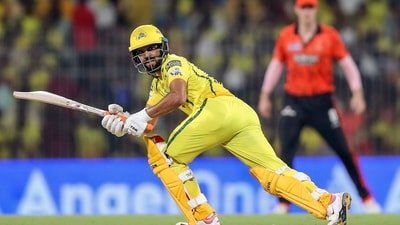
The damage was not only in the final number. It was in the way the innings moved around him. Gaikwad stayed long enough to influence CSK’s tempo, yet never reached a point where SRH had to alter their fields, change their lengths, or protect a boundary option. His 15 runs came entirely through singles. There was no hard two, no lofted release, no calculated hit over the infield, no over where he took ownership of the scoring rate. By the time he walked back, CSK had already lost balls that should have belonged to intent. There was no doubt that the wicket was difficult to bat on, but that does not justify going into a shell. A perfect example was Ishan Kishan, he found it hard to get going too, but that did not make him give up the intent to play attacking shots.
Gaikwad’s innings left CSK chasing momentum from within their own innings
The most damaging part of Gaikwad’s knock was that it transferred risk to everyone after him. A top-order batter can fail quickly and still leave the innings with time to recover. Gaikwad’s failure was more severe because it wasted time without creating an advantage. He did not simply miss out. He slowed the shape of the innings.
That is a serious charge because Gaikwad is not a fringe batter trying to find his feet. He is one of CSK’s most established names. He has the game, the record and the authority to set the batting tone. Against SRH, that authority was missing. The innings did not look like a senior batter absorbing pressure before taking control. It looked like a senior batter waiting for a rhythm that never arrived.
His scoring pattern made the problem impossible to hide. Fifteen singles from 21 balls may appear to show strike rotation, but rotation without threat does not disturb a bowling side. SRH could keep bowling into their plans because Gaikwad was not forcing them out of their comfort zone. The innings became safe without becoming useful.
That is where CSK paid the price. The middle order did not inherit a platform. It inherited a scoring-rate problem.
The SRH knock also fit into a larger concern raised by Gaikwad’s IPL 2026. Earlier against the Gujarat Titans, his 74 not out off 60 had already raised the same question in a less obvious form. The final score gave him cover, but the innings had moved too slowly for too long. He was 48 off 48 after 15 overs before a late push corrected the look of the scorecard. CSK did not get enough early tempo from an opener who had batted deep.
The two innings looked different, but they pointed to the same issue. Gaikwad’s best version gives structure, then accelerates. In IPL 2026, too often, the structure has arrived without enough acceleration. The innings have waited for him rather than moved through him.
The rise of Mhatre and Urvil
That becomes a bigger problem because CSK now have fresher top-order options pushing the conversation. Urvil Patel and Ayush Mhatre have shown enough promise to make the old hierarchy less automatic. They bring early movement to the innings. They play with visible scoring intent. They are not carrying Gaikwad’s IPL body of work, but they are offering something CSK badly need: urgency at the top.
Ayush Mhatre’s presence especially sharpens the debate. He gives CSK a younger, faster top-order profile. Urvil adds another attacking option. Their emergence does not erase Gaikwad’s record, but it does reduce the protection that reputation usually gives. CSK can no longer rely solely on past achievements to assess the top order. They have to look at pace, role clarity and future balance.
On IPL 2026 form, Gaikwad’s automatic place in the CSK top order deserves scrutiny. Not because he has become a poor batter. He has not. The question is whether this version of him fits the direction CSK need to take. A side rebuilding around younger batters cannot allow its senior opener to absorb 21 balls for 15 without boundary intent, especially in a game where the innings needed someone to take command.
Gaikwad’s class still deserves respect. He has proved himself across IPL seasons. He has won the Orange Cap. He has carried CSK innings before with control, timing and high-quality shot selection. This season looks more like a poor tournament than a permanent decline.
Also Read: India squad for Afghanistan series LIVE Updates: Big names to be rested for Test; Padikkal, Aquib Nabi in contention
That is why the conclusion should not be a harsh verdict on his career. It should be a hard demand from his role. Gaikwad can still be the anchor who gives CSK direction in the next phase of their batting rebuild. He can still guide players like Urvil and Mhatre, calm difficult passages, and turn youthful aggression into a proper innings plan.
But he has to adapt. He cannot be an anchor who waits too long. He cannot let rotation become a substitute for intent. He cannot leave CSK carrying the cost of his caution.
The SRH innings should sting because it was not a random failure. It was the kind of failure that forces a team to rethink roles. Gaikwad’s record gives him another route back. His 2026 tempo cannot be the route forward.