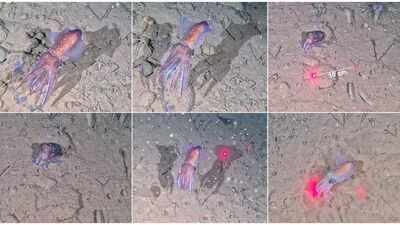
In the icy waters of Northeast Greenland, scientists have documented something never seen before: a rare Arctic bobtail squid living in its natural habitat while guarding clusters of eggs. Captured on high-resolution underwater video, the observation marks the first confirmed in situ record of the species, Rossia moelleri, and provides the first direct evidence that it reproduces in one of the most remote marine environments on Earth.According to the study, published in the journal Polar Biology, this was filmed inside Northeast Greenland National Park, the world’s largest national park, where researchers used a remotely operated vehicle (ROV) to explore a little-studied Arctic fjord. The finding fills a major gap in scientists’ understanding of Arctic cephalopods and offers an important baseline for tracking marine life as the rapidly warming Arctic continues to change.
A rare encounter beneath Arctic ice
The mature female bobtail squid was spotted during an expedition in September 2025, swimming and resting along a rocky fjord wall about 50 metres (164 feet) below the surface. The surrounding seawater measured -1.6°C (29.1°F), cold enough to remain liquid only because of its salt content.Nearby, researchers found three clusters of egg capsules firmly attached to the rocky seabed. The grape-like clusters contained an estimated 22, 33 and 50 eggs, strongly suggesting the squid had laid them there and was remaining close to them during development. This is the first confirmed observation of Rossia moelleri and its eggs in Northeast Greenland National Park and the first direct evidence that the species reproduces in this remote Arctic habitat.The team captured the footage using a 4K camera mounted on an ROV, allowing them to observe the animal without disturbing its natural behaviour.
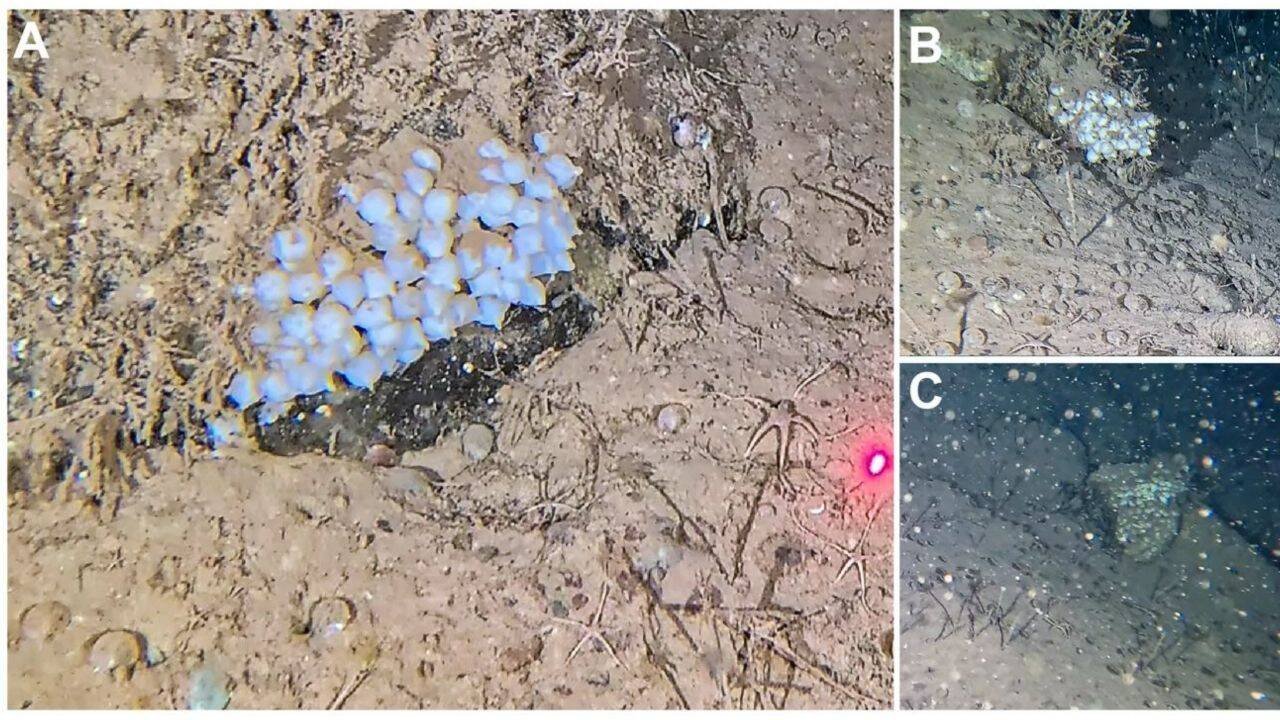
Credit: Maroni, P.J., Cornet, J., Skorikova, Y. et al./Springer Nature
Why the discovery matters
Although cephalopods, including squid, octopuses and cuttlefish, are important predators and prey in marine food webs, surprisingly little is known about those living in Arctic waters. Historical records of Rossia moelleri from eastern Greenland have been sparse and, in some cases, uncertain.The new observations confirm that the species inhabits the region and is actively reproducing there, extending its verified distribution into one of the planet’s least-explored marine ecosystems. Researchers say this information is particularly valuable because the Arctic is warming faster than any other region on Earth, making baseline biodiversity records increasingly important.The study also highlights the scientific value of documenting reproduction rather than simply recording the presence of a species. Evidence of successful breeding indicates that the squid is not merely passing through the region but is capable of completing its life cycle under these extreme environmental conditions.
A squid adapted to freezing seas
The Arctic bobtail squid is a relatively small cephalopod, measuring around 10 centimetres (4 inches) in length. Unlike the giant squid that inhabits deep oceans, bobtail squid spend much of their lives close to the seafloor, where they hunt small crustaceans and fish while avoiding larger predators.The environmental conditions recorded during the expedition closely matched what scientists already knew about the species from other Arctic seas. Previous observations have shown Rossia moelleri laying eggs in waters between -1.8°C and 2.1°C, making the newly documented site well within its known ecological range.Researchers identified the squid by combining its physical characteristics, body size, habitat and the distinctive appearance of its egg masses, distinguishing it from the other two recognised Arctic Rossia species.
Unlocking one of the Arctic’s biggest mysteries
Northeast Greenland National Park covers nearly 972,000 square kilometres (375,000 square miles), making it the largest national park in the world. Yet despite its enormous size, its underwater ecosystems remain among the least studied anywhere on the planet.Scientists note that only a handful of cephalopod records have previously been documented from within the park’s marine boundaries. The successful use of a compact ROV demonstrates how lightweight, low-impact technology can help researchers explore remote polar habitats that are difficult for larger research vessels to access.Apart from identifying a unique squid species, the find is also significant for any future research in this field because cephalopods have relatively short life spans and are able to respond very fast to changes in temperature and salinity of the oceans; thus, they serve as important indicators of changes in the environment.With regard to future research, it is expected that further observations will determine whether or not Rossia moelleri continues being a constant inhabitant of Northeast Greenland and whether or not its presence is changing along with the changes in climate of the region. For now, the remarkable footage offers a rare glimpse into a hidden chapter of Arctic marine life, one that had remained unseen until scientists looked beneath the ice with the right technology.