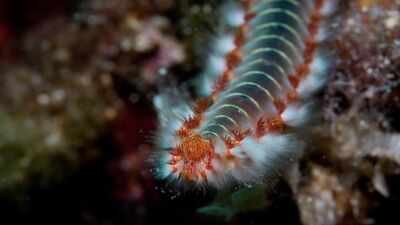
Imagine you’re playing “20 Questions” and you start with the classic opener: “Animal, vegetable, or mineral?” Most of the time, a sea worm would be an easy answer: animal. But one particular marine species, the ancient and still-living bristle worm Perinereis cultrifera, complicates that simple choice.This worm is a predator, and it hunts with jaws that are as fascinating as they are fearsome. Those jaws aren’t made of bone or simple protein alone; they’re built from a combination of structural proteins and metal ions that give them hardness and toughness similar to metals. That unusual blend has led scientists to use a new word for them: bio‑metals.
What are bio-metals?
Scientists have long talked about “metal‑like biomaterials” when describing biological structures that act somewhat like metals. For example, materials in animals that are very strong or conduct electricity well. But bio‑metals are defined more precisely.To count as a bio‑metal, a biological material has to show three key features. Firstly, high hardness as it resists being scratched or indented. Secondly, a specific way of responding to strain; when you press on or deform it, it behaves in a patterned, measurable way. Thirdly, a particular internal structure which means metal ions and proteins are arranged together to form a solid network that gives the material its unique properties.The jaws of Perinereis cultrifera are a perfect test case. In a study published in Biophysics Reviews, researchers from TU Wien (Vienna University of Technology) and the University of Vienna examined how these mouthparts behave under stress and how they’re built at the microscopic level. Their goal was to better define what separates bio‑metals from other tough biological materials like bone or shell.
How metal ions harden a worm’s bite
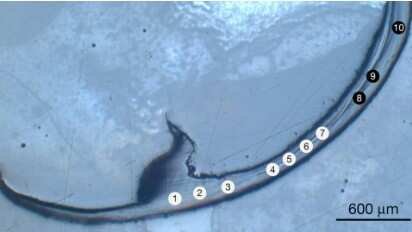
Photo credit: Zelaya-Lainez et al.
To understand the jaws’ strength, the team used a technique called nanoindentation. Think of this as pressing a very tiny, sharp tip into a material to see how much force it takes to make a dent. By doing this repeatedly across different parts of the jaw, scientists can map out how hardness changes from place to place.They combined these mechanical tests with chemical analysis and detailed imaging of the jaw structure. The results confirmed an important pattern: Metal ions are concentrated at the jaw tips. Then the central parts of the jaws contain fewer of these ions.This means the very ends of the jaws, the parts that actually bite and crush prey, are chemically reinforced. The higher metal content at the tips likely makes them much harder and more resistant to wear, giving the worm a sharper, more durable bite.
A tiny size effect with big implications
The researchers didn’t stop at measuring overall hardness. They also tested the jaws at different indentation depths, pressing more shallowly or more deeply to see how the material responded. That’s where they saw something particularly interesting: a phenomenon known from traditional metals like copper and silver.It’s called the Nix–Gao nanoindentation size effect. In simple terms, it means that smaller areas of a material can be harder to dent than larger areas. As the region being tested gets tinier, the material often appears stronger.In the worm’s jaws, this effect showed up clearly. When the indentation was very small, the local changes in strain were sharper, and that seemed to increase how defects inside the atomic structure “interlocked” and resisted deformation. This is similar to what happens in metals, where dislocations (tiny defects in the crystal lattice) interact differently at small scales.Seeing the Nix–Gao effect in a biological structure is one of the clues that these jaws behave, in some ways, like metal.
Similar to metals, but not the same
Despite these metal‑like traits, the jaws are not simply nature’s version of copper or silver. They also have unusual mechanical properties that set them apart.One of the standout findings was size‑dependent elasticity as the jaws didn’t just show size‑dependent hardness; their elastic behaviour, how they spring back after being deformed, also changed depending on the scale of the test.This size‑dependent elasticity is not typical in standard crystalline metals like copper or silver, which tend to have more uniform elastic properties at different scales.Christian Hellmich, one of the study’s authors, highlighted this as a defining feature of bio‑metals. It suggests that the interplay between protein structures and metal ions in these jaws produces mechanical responses that ordinary metals don’t display, as per a report by Science Daily.To dig deeper, the team used mathematical models to explore how these elastic effects might arise at the atomic level. The idea is that the way proteins, water, and ions are arranged creates a complex, hierarchical structure that responds differently to strain at different scales. While their models offer hypotheses, Hellmich notes that scientists are only at the beginning of understanding these intricate natural materials.
Learning from nature’s material design
The study of bio‑metals isn’t just about admiring a sea worm’s bite; it may help guide future engineering. If nature can create structures that are hard and tough where needed (like jaw tips); show smart size‑dependent behaviours; and use a mix of proteins and ions rather than pure metals, then engineers might be able to design new materials inspired by the same principles.The researchers plan to study additional species, to see how common bio‑metals are in nature and how they vary. They also want to refine their theoretical models and perform more detailed computations. And, explore how genetic changes might alter the material properties—linking biology directly to material design.As Hellmich put it, there’s genuine excitement about “the beauty, elegance, and refinement found in and produced by nature.” Bio‑metals like the jaws of Perinereis cultrifera show that the line between “animal” and “mineral” isn’t always as clear as a game of 20 Questions would suggest. In the tiny mouthparts of a marine worm, nature has quietly been engineering metal‑like materials for millions of years.Thinking about this, what interests you most: The idea that living organisms can naturally build metal‑like structures, or the possibility that studying them could inspire completely new kinds of human‑made materials?