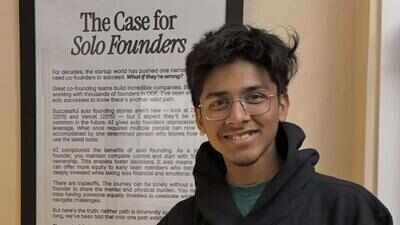
Mumbai-born entrepreneur Dhravya Shah built his own-company Supermemory, an AI startup that raised $3 million in seed funding. Shah also managed to secure a US O-1 visa. Shah’s entrepreneurial journey started from selling his first company at 16 to walking away from the IIT dream. His journey also highlights how a solo founder turned a dorm room project into a critical infrastructure for AI products. Supermemory began as a hackathon project in 2024 — a consumer “second brain” app that rocketed up the GitHub charts, surpassing 10k stars and becoming one of the fastest-growing OSS projects of the year.“Not long after launching the consumer version of Supermemory, Dhravya started getting inbound from other startups asking for help setting up memory systems for their own products. When Dhravya started pulling the thread, he saw that if he really wanted to have an impact improving memory for AI he would need to start serving other developers. He’s been pursuing it ever since,” reads Solofounders blog.
From dorm room projects to Supermemory
Before starting Supermemory, Shah shipped more than 15 open-source tools from his college dorm, never charging users. One of these a personal context collector gained traction and evolved into Supermemory. His approach has been marked by constant pivots, moving from a consumer “second brain” to the universal memory API that now powers AI applications.
Dhravya Shah secured $3 million seed funding
In October 2025, Shah raised $3 million (TechCrunch confirmed $2.6M, while Indian outlets reported $3M) in seed funding for Supermemory. The round was led by Susa Ventures, Browder Capital, and SF1.vc, with backing from industry leaders including Google AI chief Jeff Dean, Cloudflare CTO Dane Knecht, DeepMind PM Logan Kilpatrick, and Sentry founder David Cramer. Supermemory’s technology extracts structured “memories” from unstructured data—files, chats, emails—and builds a knowledge graph to surface context for LLM-based apps. Early customers included Cluely, Montra, and Scira
Walking away from IIT
Shah’s path was unconventional. He abandoned his IIT aspirations to pursue entrepreneurship, a decision that led him to build Supermemory at 19. His story has been widely covered in Indian media as an example of how young founders are reshaping the AI landscape.
Recognition and U.S. O-1 visa
Shah’s achievements earned him the U.S. O-1 visa, reserved for individuals with extraordinary ability. This recognition underscores his growing influence in the AI ecosystem and validates Supermemory’s role as a foundational layer for AI products.
Why Supermemory matters
Persistent memory remains a major challenge for AI systems, which often lose context across sessions. Supermemory addresses this gap by enabling multi-session coherence and faster retrieval than retrieval-augmented generation (RAG) alternatives. Its differentiation lies in lower latency and robust access-control design, making it a promising infrastructure tool for developers.