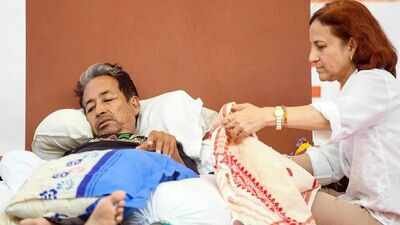
A day after the Delhi high court declined to direct the transfer of climate activist Sonam Wangchuk from Safdarjung Hospital to a private hospital, his wife Dr Gitanjali J Angmo on Monday challenged the order before a Division Bench, alleging that it “illegally confines” him to the government hospital despite him not being under arrest.According to PTI, Angmo argued that “Sunday’s order effectively directs that neither Wangchuk nor his wife have decisive authority in determining medical treatment.” She further told the court, “Sunday order illegally confines Sonam Wangchuk to Safdarjung hospital without arrest.”This came after Wangchuk’s wife sought an urgent hearing before the Division Bench challenging the Single Judge’s order on Sunday, contending that it violates Wangchuk’s fundamental rights to bodily autonomy, informed consent and personal liberty. In her appeal, Angmo argued that the Single Judge’s order effectively takes away the authority of Wangchuk and his family to make decisions regarding his medical treatment by leaving the final decision to the doctors at Safdarjung Hospital.The plea states that the order does not adequately address the issue of informed consent and ignores the settled legal principle that a competent patient has the right to accept, refuse or discontinue medical treatment.It further argues that although the Single Judge recorded that Wangchuk is neither under arrest nor detention, the order effectively confines him to Safdarjung Hospital without any legal authority.The appeal alleges that the order authorises medical intervention, including the administration of food, without Wangchuk’s consent, thereby violating his bodily autonomy under Article 21 of the Constitution.It also contends that his continued stay at Safdarjung Hospital infringes his rights under Articles 19 and 21, as it prevents him from continuing his peaceful hunger strike and protest at Jantar Mantar.According to the appeal, Wangchuk was never consulted before being shifted to Safdarjung Hospital, and neither he nor his wife was given the opportunity to choose the hospital or the doctors treating him.The plea further argues that there was no evidence of any deterioration in his health warranting such coercive action. It says that if the authorities believed immediate medical intervention was necessary, they should have sought the court’s permission before removing him from the protest site.The appeal seeks to set aside the July 19 order and requests directions allowing Wangchuk to be shifted to a private hospital of his choice while safeguarding his rights relating to medical treatment and personal liberty.On Saturday, Justice Mini Pushkarna refused to grant interim relief, observing that there was no prima facie violation of Wangchuk’s personal liberty, as the government’s decision to shift him from the protest site was taken to protect his life after his health deteriorated during a 17-18 day fast.The court noted that the transfer to Safdarjung Hospital was carried out in compliance with a Division Bench order dated July 16 directing daily medical monitoring and necessary medical intervention to prevent further deterioration in his condition.The High Court also observed that doctors were administering only those medicines and oral electrolytes to which Wangchuk had consented and found nothing to suggest that force was being used against him or that his bodily autonomy had been violated.It further recorded the Centre’s submission that Wangchuk’s wife, brother and brother-in-law had been granted unrestricted 24×7 access to meet him and that a separate room had been provided for the family. The court also noted the Centre’s assurance that Wangchuk’s medical reports would be shared with his family.Holding that no case for interim relief was made out, the high court directed the Union government to file a status report within three days and listed the matter for further hearing on July 24.