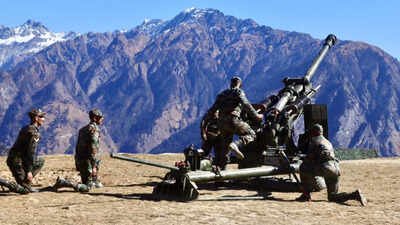
Artillery is once again at the centre of modern warfare. As militaries increasingly embrace long-range precision strikes, drones and stand-off weapons, the ability to destroy targets from a distance is becoming a decisive advantage. Former Chief of Defence Staff General Anil Chauhan described Operation Sindoor as India’s first “non-contact conflict”, underlining how future wars are likely to rely less on close combat and more on precision firepower.For India, this shift comes at a time when the Regiment of Artillery is undergoing its most significant transformation in decades.The modernisation is being driven by the Field Artillery Rationalisation Plan (FARP), which aims to replace legacy guns with a new generation of indigenous artillery systems. For decades, the backbone of India’s artillery was the 105mm Indian Field Gun and its lighter variant, the Light Field Gun. Designed and developed in India, these guns served across every terrain—from the Rann of Kutch to the icy heights of Siachen.
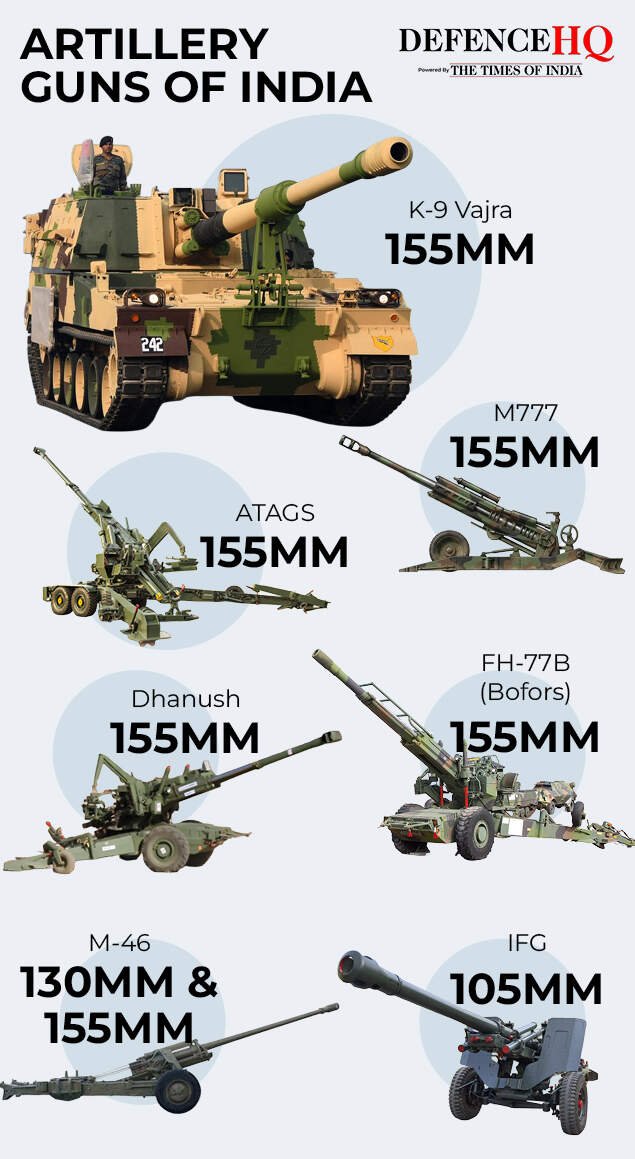
Today, that legacy is giving way to more powerful 155mm systems
Leading the transformation is the Advanced Towed Artillery Gun System (ATAGS), an indigenous gun jointly developed by DRDO and Indian industry. Alongside it is the Pinaka Multi-Barrel Rocket Launcher, which has steadily evolved into one of the world’s most capable rocket artillery systems. While the standard Pinaka has already been inducted, India has also successfully tested a version capable of striking targets up to 120 kilometres away.The K-9 Vajra-T self-propelled howitzer, originally based on South Korea’s K9 Thunder, has also been extensively indigenised, with a large proportion of its components now manufactured in India. Meanwhile, work is underway on a Mobile Gun System based on the ATAGS platform to provide highly mobile long-range fire support.Most of these systems fire Nato-standard 155mm ammunition—the same calibre that proved its worth during the 1999 Kargil War, when the Bofors FH-77B became synonymous with India’s artillery dominance. Building on that legacy, Advanced Weapons and Equipment India Limited (AWEIL) has developed the Dhanush howitzer, an upgraded version of the Bofors featuring a longer barrel, greater range and modern fire-control systems.
The transformation is not being driven by the public sector alone
Private companies are playing an increasingly important role. Bharat Forge’s Kalyani Group has developed systems such as the MArG 39 and Bharat-52, while Tata Advanced Systems and Larsen & Toubro have emerged as key partners in programmes ranging from ATAGS to self-propelled artillery. The growing collaboration between public and private industry reflects India’s broader push for defence self-reliance.
The next leap is already under way
India is investing in advanced ramjet-assisted artillery shells capable of travelling significantly farther while maintaining high precision. Such technologies have gained prominence after recent conflicts demonstrated that long-range, accurate artillery can shape the battlefield as effectively as air power.With indigenous gun systems, advanced rocket artillery, expanding private-sector participation and next-generation ammunition under development, India is steadily building one of the world’s most diverse artillery ecosystems.If this momentum continues, India’s artillery modernisation could do more than strengthen the Army, it could establish the country as a global firepower superpower in the era of non-contact warfare.