The Revolutinaries
Director: Nikkhil Advani
Cast: Bhuvan Bam, Rohit Saraf, Pratibha Ranta, Gurfateh Pirzada, and Jason Shah
Rating: ★★.5
There is a scene in Nikkhil Advani’s The Revolutionaries that is very evocative of SS Rajamouli’s RRR. As the British forces close their vice-like grip on some revolutionaries, our heroes leap from the shadows, overwhelming the Brits and turning the tables. The entire eight-episode series, based on true events from the Indian freedom struggle, is mounted like a massive action spectacle, further deepening the RRR parallels. Sadly, that is where the similarities end. Despite its attempts and aspirations to be a grand action film with ‘entertaining’ history, The Revolutionaries never fulfils those ambitions.
The premise
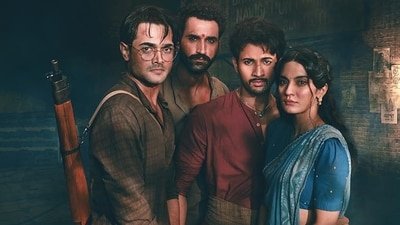
Set in British India just before World War I, The Revolutionaries introduces us to Rash Behari Bose (Bhuvan Bam), who attempts to assassinate Viceroy Lord Hardinge. A young Sachindranath Sanyal (Rohit Saraf) witnesses this heroic act and wants to join the revolution, even as his family urges him to remain in the shadows. Sachin is also grappling with his planned marriage to Pratibha (Pratibha Ranta), a young girl with revolutionary thoughts. Hunted by Lt Col Dyer (yes, the very same), Rash goes into hiding in the Sanyal family’s house in Varanasi, before he is forced to escape to Calcutta with Sachin. Here, they unite with Bagha Jatin (Gurfateh Pirzada) and formulate a new plan to seize power from the British with an armed mutiny.
The praiseworthy approach
The Revolutionaries is not a docudrama. It is an action potboiler that takes elements of history and showcases them with a heightened sense of reality, almost in a mass masala action genre. It is an approach we have seen on cinema with RRR and Kranti. Here, the research is on point. The Easter eggs (for anyone familiar with that part of Indian history) are lip-smacking. And the action is never too over-the-top, yet still spectacular. It is an approach that is well-suited to the subject matter. Presenting revolutionaries like desi action heroes is a brilliant choice. But where the series falters is that it never allows the viewer to connect with them as humans. They always feel like characters played by actors, and not real men and women.
Why The Revolutionaries falls short
The uneven pacing of the show can be excused. After all, it is difficult to sustain momentum in a narrative that involves many subplots and characters, most of whom are real and many of whom are well-known. But what cannot be excused is how the show fails to elicit the emotion that a story on the sacrifice of freedom fighters should. Emotion has been the backbone of Indian storytelling, and that is wanting here.
The biggest ick, for me, was watching Rohit Saraf and Gurfateh Pirzada appear like models in a 2026 fashion catalogue, rather than living, breathing revolutionaries from 1915. The chiselled body is a choice that can be understood for cinematic reasons, but the lip gloss and manicured beards do not help. It removes the suspension of disbelief so quickly that you can hardly connect with two of the four protagonists of the show. The stakes, after that, rarely seem real.
Bhuvan Bam, to his credit, has done well. He has acted well and looked the part, even if the script did not always help him. Pratibha Ranta shines in the brief moments the show gives her, particularly in some scenes from the final two episodes. Apart from them, the two real scene stealers are Jason Shah and Paoli Dam. As the evil Col. (later General) Dyer, Jason Shah creates a villain worth noticing. He has both the aura and the menace to represent the threat of the British Empire. The show even brings in his stammer, which very few outside of history students know about. But it does begin to look like a shtick beyond a point. Paoli Dam, in her brief role, brings more humanity to the narrative than the four protagonists put together.
The Revolutionaries is streaming on Amazon Prime Video.
Hardly revolutionary
The Revolutionaries squanders an opportunity to showcase a chapter of the Indian freedom struggle that very few know about. It also gets lost in its ambition to be grand and cinematic, sacrificing sound storytelling on the altar of grandeur and mass entertainment. The Legend of Bhagat Singh, by Rajkumar Santoshi, and Kranti, by Manoj Kumar, remain the gold standard for presenting the freedom struggle in an entertaining manner in Hindi storytelling. I’d rather go for a rewatch of either this weekend.