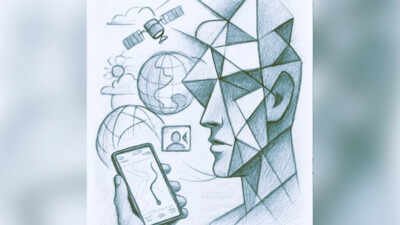
Success has a strange effect on wonder. It turns miracles into infrastructure!Think about what your phone does before breakfast. It tells you where you are, where you are going and how long it will take to get there. It knows what the weather is doing. It can show you a photograph taken on the other side of the planet, translate a language you don’t speak and put you in a video call with someone thousands of kilometres away.None of this feels miraculous anymore.
Parallax is the apparent shift of an object when viewed from different positions
That, to me, is the more interesting problem. Not that people don’t know enough science, but that so much of the science around us has become invisible precisely because it works. Somewhere between discovery and daily life, science acquired the unfortunate habit of disappearing once it became useful.Consider GPS. The blue dot on your screen works because satellites carry clocks that experience time differently from clocks on Earth. Gravity affects the passage of time; so does speed. Engineers have to account for both effects with extraordinary precision.That’s Einstein’s relativity quietly making sure you don’t miss your turn. We don’t think about it that way. We don’t need to. We just follow the blue line. And perhaps that is the point. Science succeeds by becoming ordinary.The trouble begins when ordinary becomes invisible.We have become very good at living among miracles. But there is another reason this matters, and it has less to do with wonder than with judgement. We are now surrounded by claims that demand a scientific way of thinking.Is that health claim true? Does that new technology actually work? Is the climate statistic being presented honestly? Did the study really find what the headline says it found? Is that photograph real? Is that video real? Was it even made by a person?AI has made those questions harder, not easier.We’re entering a world in which information can be produced faster than we can verify it, and certainty can be manufactured more easily than evidence. This is where scientific temper stops being a phrase from a textbook and becomes a practical necessity.It does not mean that everyone needs to understand quantum mechanics or read research papers for breakfast. It means developing the habit of asking a few unfashionably simple questions: How do we know? What is the evidence? How certain are we? What don’t we know? And what would make us change our minds?That last question may be the hardest.We are instinctively drawn towards information that confirms what we already believe. Science asks us to do something less comfortable: follow the evidence even when it takes us somewhere we did not expect to go. That is not the same as doubting everything. Scientific temper is not cynicism. It’s a disciplined curiosity.And in a world where medical misinformation can travel faster than a correction, where technological promises can outrun technological reality, and where a convincing image can be created in seconds, disciplined curiosity is not a luxury. It’s a defence.Perhaps this is also why space continues to fascinate us. Distance restores perspective. A spacecraft travelling millions of kilometres to another world forces us to confront scale again. A telescope looking billions of years into the past reminds us that our own moment is astonishingly small. Space takes things that have become familiar on Earth and makes them strange again.It changes our vantage point.That is why I have called this column Parallax. In astronomy, parallax is the apparent shift of an object when viewed from different positions. The star has not moved. We have. And that tiny change in where we stand can tell us something fundamental about what we are looking at. I like the idea as a way of thinking about science, too. Sometimes we don’t need another fact. We need another angle.A rocket launch can be a story about engineering, but also about ambition and economics. A satellite can be a technological achievement, but also a question about who gets to use the data. A scientific breakthrough can be cause for celebration, but also an invitation to ask what comes next.The facts may remain the same. The view can change. And perhaps, in a world increasingly crowded with information, that is what we need most: not simply to know more, but to look again.Postscript:I’m not a scientist. My academic education was in sociology, economics and industrial relations. For much of my student life, I was quite comfortable leaving equations, labs and research papers to people who understood them better than I did. That distance has turned out to be useful. I approach these stories with the questions a curious outsider might ask: What does this actually mean? Why does it matter? How do we know? And what happens if we look at it from somewhere else?That, I hope, is where Parallax begins.