Toaster, the black comedy thriller starring Rajkummar Rao and Sanya Malhotra, marks the directorial debut of Vivek Daschaudhary. HT sat down with the director to talk about the film post-release on Netflix, his collaboration with Rajkummar Rao and why he thinks a character like Ramakant continues to exist in India. (Also read: Farah Khan agreed to act in Toaster because of Rajkummar Rao and Patralekhaa, says Vivek Daschaudary | Exclusive)
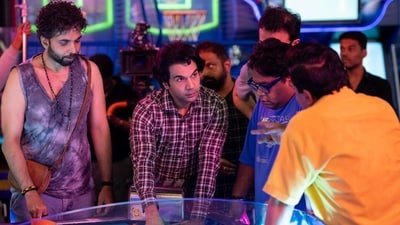
Toaster stars Rajkummar as a miserly man whose wife (Sanya) suffers because of his penny-pinching habit. He keeps track of every rupee spent, leaving her exasperated. However, things spiral out of control when they buy a toaster as a wedding gift for someone. There is definitely something special about this toaster, as almost everyone in the city begins a chase for it.
On the response to Toaster
Upon asking about the response to the film, Vivek says, “The reactions have been very warm so far. The film has been out for a few days, and I am hoping that the reactions will keep growing from here on. It has been overwhelming because people have appreciated and liked the film, and that is something which is empowering for a first-time filmmaker. I hope that the film makes more people laugh.”
“There was a time when more small-scale films like these were being made, but it fizzled out after a point. In the early 2000s to the 2010s, there were still so many films like these, and they did well. It became the flavour of the season. Now I hope Toaster is in line with more such films to be made, with more stories from our cities and towns,” he says.
Rajkummar Rao not only stars in Toaster but has also co-produced it along with his creative partner Patralekhaa under their newly launched KAMPA Films banner. Talking about their collaboration, Vivek says, “It was Patralekhaa who did all the producing part of the job for the film. It was Patralekhaa who took on the challenge, and she did it all by herself. She did a great job. Raj was really focused on the character. It was a team effort, yes, and the two of them decided how to work on the film and who should take care of what. I am really proud that I could do my first film with them; it was so easy to work with them. There was such a good vibe on set, and it really made everyone’s job quite simple.”
‘The intention was not to make Ramakant unlikable’
Ramakant is a kanjoos, but the film never humiliates or degrades him for it. Vivek says there was a balance that was required to ensure this. “Yes, it was very important that the viewer not start out disliking this character from the outset,” he notes. “That would make the viewer stop rooting for him. Yes, he is a kanjoos guy but eventually he is that family man who also really loves his wife. He is probably that person who would want to keep everybody happy but yes, there is this one miserly quality about him- which the film also terms as some sort of bimaari (illness). It is like a trait that he has inherited from his father, who was a bigger miser.”
He continues, “The intention was not to make him unlikable. We always wanted to have that middle ground where his actions would make someone say, ‘Aisa kyu kar raha hain (Why is he doing this)?’ But that is how some people function. Aisa karte hain log (This is how it is for some). I wanted the audience to relate to some of that ‘kanjoosi’ of Ramakant, with their own family or someone from the neighbourhood- that, yes, that person was somehow like Ramakant only. I feel it is part of Indian culture; it is rooted in something. Saving money. It will always be there. It is a trait; some outgrow it while others continue to live with it. Maybe we don’t see so many people like him anymore; that’s why people might say ki abhi aisa kaun karta hain (who behaves like that now)? But I think, for people living in a metrocity, they would not know what’s happening in a tier-2, tier-3 city. There might be so many Ramakants roaming here and there! I hope that Toaster reaches some Ramakant in real life and it changes him for the better!” (giggles)
In Toaster, Sanya Malhotra’s Shilpa is married to Ramakant but does not get out of the relationship, even though she has a mind of her own and can see how she is being stifled by a man who is only interested in saving money. When I ask the director why that is so, he says, “Shilpa really loves Ramakant. He has a problem, and she dislikes how he behaves in certain situations, yes, but she would not leave him or go without trying to make him a better person.”
“At the end of the day, he is a good person, and she sees how both of them can be together and make a life for themselves. She would always want to make Ramakant a better person, and that is why she gives him another chance in the end. That is how Shilpa is as a person; she would be with him,” he concludes.
Toaster is available to watch on Netflix.