
For Indian professionals working in the US, an H-1B extension is more than a routine immigration formality. It is a crucial bridge to maintaining legal status and keeping their path to permanent residency, or a green card, alive as they navigate a backlog that can stretch for decades.Many rely on successive extensions while waiting for their employment-based green cards. A proposed change by the Trump administration could make that process more uncertain, even for workers whose previous visa petitions were approved.The administration has proposed scrapping the US immigration policy known as “deference to prior approvals”. Under the policy, US Citizenship and Immigration Services (USCIS) generally gives weight to an earlier favourable decision when reviewing an extension petition involving the same employer, worker and underlying facts, unless certain exceptions apply.The policy requires immigration officers to consider previous approvals, while the proposed change could make it easier for them to reassess a worker’s eligibility.The proposal, published on October 14, is not yet a final rule. If implemented, it could mean closer scrutiny of extension applications from Indian H-1B holders, including those who have spent years building their lives and careers in the US while waiting for employment-based green cards.The change could also affect workers in other visa categories, including L-1 intracompany transfers.Rajiv Dabhadkar, founder of the National Organisation for Software and Technology Professionals (NOSTOPS), told TOI,
“Removing deference would not itself change green card queue positions or automatically invalidate existing H-1B approvals. However, it could affect how subsequent petitions are assessed while individuals wait for permanent residency.”
Immigration attorney Bhumireddy Sai Srinivas Reddy told TOI the proposal could make the long wait for permanent residency more uncertain for Indian H-1B holders.
“For Indian H-1B holders in the EB-2/EB-3 backlog, this rule changes the nature of the green-card wait itself. Most are living on three-year AC21 extensions, four, five, six renewals over a decade. Today each renewal presumes the last approval was correct. Under the proposed rule, every renewal becomes a fresh trial of eligibility, with specialty occupation, wage level, and employer relationship all back on the table,” he said.
Indians accounted for about 70 per cent of all H-1B beneficiaries in fiscal year 2025, according to USCIS data, making them a significant group potentially affected by any change to how work visa extensions are adjudicated.

Indians accounted for 71% of H-1B visa recipients.
What is the US deference policy, and what could change?
The US Department of Homeland Security (DHS) and USCIS have proposed removing a provision under 8 CFR 214.1(c)(5), which generally requires the agency to give “deference to a prior approval” when adjudicating a request to extend a non-immigrant worker’s petition involving the same parties and underlying facts.The DHS explains: “When adjudicating a request filed on Form I-129 (Petition for a Nonimmigrant Worker) involving the same parties and the same underlying facts, USCIS gives deference to its prior determination of the petitioner’s, applicant’s, or beneficiary’s eligibility.”However, deference is not an unconditional guarantee of approval.Under the existing regulation, USCIS can depart from an earlier determination if there was a material error, a material change or new material information that adversely affects eligibility.Employers use Form I-129 to petition for foreign workers in several temporary employment categories, including H-1B, L-1, O-1 and other non-immigrant classifications.If the proposal is finalised, USCIS officers would still be able to consider previous approvals where relevant. However, they would no longer be required to begin from a position of deference to an earlier decision.
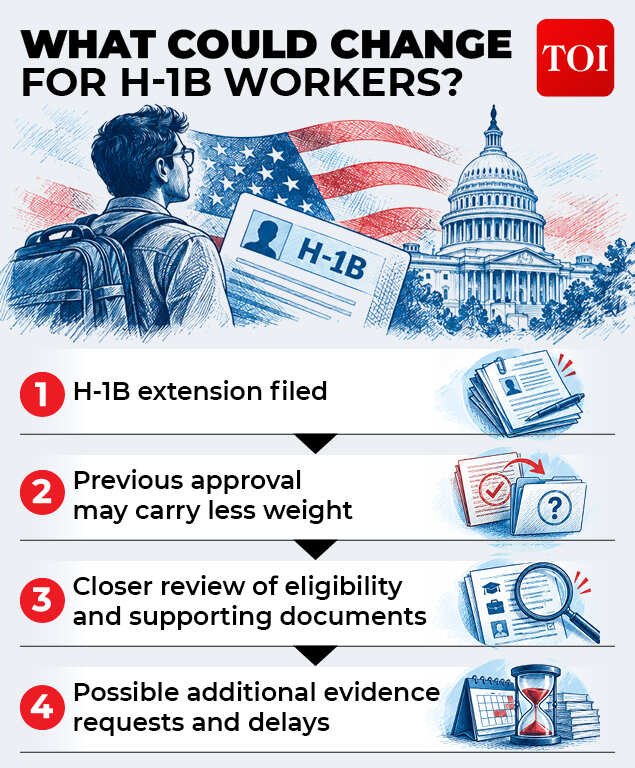
How the proposed change could affect H-1B extensions.
The proposed change would therefore alter the framework for reviewing extension petitions, rather than automatically changing the basic eligibility requirements for each visa category.
How could this affect Indian H-1B professionals waiting for green cards?
The proposed change could be particularly consequential for Indian professionals who have spent years working in the US while waiting for employment-based green cards.The H-1B visa allows US employers to hire foreign workers in specialised occupations, with an annual cap of 65,000 visas and another 20,000 for qualifying US advanced-degree graduates.It is generally granted for up to three years and can be extended for another three, with certain workers eligible for extensions beyond the usual six-year limit while pursuing employment-based green cards.For many Indian professionals, the green-card process can stretch over decades because of the high demand for employment-based immigrant visas and country-specific limits on their allocation.A recent analysis by the National Foundation for American Policy (NFAP) estimated that nearly one million Indians are stuck in the US employment-based green-card backlog, accounting for close to 79 per cent of the estimated 1.26 million people waiting in the first three employment-based preference categories.The NFAP analysis also estimated that an Indian professional entering the queue in 2026 could face a potential wait of 179 years in the EB-2 category and 38 years in EB-3, under its modelling assumptions.These projections show the scale of the backlog, although actual waiting periods depend on factors such as visa availability, category and priority date, as well as future policy changes.This would not automatically mean denials, but could increase documentation requirements and uncertainty over processing times.Dabhadkar said, “Additional scrutiny could mean more evidence requests, higher legal and administrative costs, and uncertainty over continued employment, affecting workers’ career decisions and long-term planning.”
More scrutiny, additional paperwork for employers?
If USCIS officers seek additional evidence, employers may have to submit more detailed documentation relating to job duties, compensation, work locations, business operations, contracts and workers’ qualifications.Employers may also need to demonstrate that workers continue to meet the eligibility requirements of their respective visa categories, rather than relying heavily on the fact that an earlier petition was approved.An analysis by the Vasquez Law Firm said the proposal could change how USCIS reviews subsequent petitions.“A worker may feel the practical effects even though the employer is often the petitioner,” the firm noted, explaining that employers may have to document the offered role, business operations, compensation, contracts, work location and the worker’s qualifications again.The firm also said workers may need records showing that they have continued to maintain their non-immigrant status.DHS estimates that the proposed rule would impose nearly $133,987 in additional annual costs on petitioners and lead to around 6,044 additional requests for evidence (RFEs) each year.The department says the change could increase adjudication workloads and operational costs as officers spend more time reassessing eligibility and reviewing additional evidence.Reddy said delays caused by additional evidence requests could have consequences for workers whose employment authorisation depends on timely decisions.“The real risk is delay, not denial. More RFEs mean more petitions pending past the 240-day work-authorization window and a worker who hits day 241 must stop working, even with an approved I-140 and a decade of lawful status. With automatic EAD extensions gone, an H-4 spouse’s work authorization can lapse in the same queue,” he said.For employers, the consequences could include greater legal and administrative expenses, more time spent preparing extension petitions and less certainty in workforce planning. For workers, additional requests for evidence could prolong the decision-making process.
Why does the Trump administration want to end deference?
The Trump administration argues that the existing policy could limit the ability of immigration officers to examine applications independently.In its proposal, the DHS said the deference policy may have resulted in “perpetuating erroneous prior approvals and creating an environment in which fraudulent and meritless petitions are less likely to be detected before approval”.The department also argued that some employers may have interpreted the policy as reducing their obligation to show that a worker continues to meet the requirements of the requested visa classification.According to the proposal, the existing regulation effectively shifts the burden from the petitioner to the USCIS officer, who must justify departing from an earlier approval.The DHS says removing the requirement would better align its regulations and adjudication practices with its interpretation of the Immigration and Nationality Act, under which the burden of establishing eligibility for immigration benefits rests with the petitioner.“Removing the deference requirement would also help to ensure that USCIS officers fully review the facts and evidence in every case to ensure continued eligibility,” the proposal states.

Timeline of changes to the US deference policy.
The policy has changed several times over the years. USCIS first issued guidance on deference in 2004, rescinded it in 2017, and reinstated it in its Policy Manual in 2021. The DHS formally codified the policy in December 2024. The latest proposal would reverse that codification.
What happens next?
The proposal is open for public comments until November 13, 2026. Interested parties can submit feedback through the federal rulemaking portal, citing DHS Docket No. USCIS-2026-0529.Employers, immigration attorneys, and other stakeholders can use the consultation period to raise concerns about the potential impact on workers and businesses.For Indian professionals, the proposal would change how extension petitions are reviewed, not H-1B eligibility requirements or the existing six-year limit. Current rules remain in effect until a final rule is published and takes effect.