The Mumbai Indians were watching the Lucknow Super Giants build a first-innings total that could have pushed the match beyond a normal chase. LSG were 123/1 after eight overs, Nicholas Pooran was 63 off 20 balls, and Mitchell Marsh was set on 44 off 24.
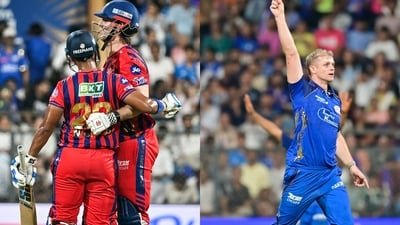
Corbin Bosch changed that innings in five balls. He removed Pooran at 8.1 and Marsh at 8.5, turning LSG from 123/1 to 125/3 and cutting out the two batters who were driving the total towards the 250 zone.
Bosch’s two balls carried a ₹75 lakh contextual value
In our impact valuation model, Corbin Bosch’s two wicket balls carry a hard ledger value of ₹55.94 lakh. The Pooran wicket is valued at ₹28.24 lakh in the base bowling-event ledger. The Marsh wicket is valued at ₹27.71 lakh.
The contextual valuation puts the combined value at around ₹75 lakh.
Pooran’s wicket rises to roughly ₹42 lakh because of the exact state of the innings. He was batting on 63 from 21 balls, striking at 300, and had more than 11 overs available. His innings had already moved beyond a fast start. He was in the phase where every additional over could have changed the final total by 15 to 25 runs.
Mitchell Marsh’s wicket rises to roughly ₹33 lakh because he was already set on 44 from 25 balls. He had given LSG stability at the other end while Pooran attacked. Removing him in the same over gave MI a double strike instead of a single breakthrough.
Together, the two balls were worth around ₹75 lakh because Bosch removed the two most damaging players in LSG’s innings at the exact point where their scoring ceiling was highest.
Pooran’s wicket was the premium event
Nicholas Pooran was the centre of LSG’s surge. He had reached 63 from 21 balls, the innings running at a rapid pace. At 123/1 after eight overs, LSG had already crossed the halfway mark of a 240-type innings with 12 overs still available.
That made the first ball of Bosch’s over a major event.
Pooran’s wicket did not carry high value because of the name alone. It carried high value because of his current innings state. He was set, destructive, and already operating at a strike rate that could break a match open. A batter on 63 off 21 with 71 balls left in the innings creates a different level of threat.
Bosch removed that threat immediately.
The dismissal at 8.1 cut out the most explosive run source in the match. It denied LSG the most dangerous continuation scenario: Pooran batting into the 12th, 13th or 14th over from an already-set position.
That is why the Pooran wicket deserves a contextual worth of around ₹42 lakh. The base event ledger shows it as ₹28.24 lakh, but the match state raises the value. The wicket removed the batter most capable of converting a brilliant start into a crushing total.
Marsh’s wicket completed the damage
Marsh’s wicket at 8.5 gave the over its real weight.
After Pooran fell, LSG still had a set opener at the crease. Marsh was on 44 off 25 and had already settled into the surface, the pace of the innings and the scoring rhythm. He gave LSG a route to maintain control even after losing their most explosive batter.
Bosch removed him four balls later.
That wicket changed the structure of the innings. LSG moved from two set batters to two new batters in the space of five deliveries. The score shifted from 123/1 to 125/3. The over removed both the accelerator and the set partner.
Marsh’s dismissal carries a hard ledger value of ₹27.71 lakh. The contextual worth rises to around ₹33 lakh because of the pairing effect. One wicket had slowed LSG. The second wicket forced a reset.
Marsh had the platform to bat deeper. He had the tempo to keep LSG above a 12-run-per-over path. His wicket stopped LSG from absorbing Pooran’s dismissal without losing innings speed.
The over lowered LSG’s total ceiling
LSG still finished on 228/5. That score shows the strength of their first eight overs.
The Bosch over reduced the damage from a possible 250-plus innings to a total MI could still attack. Pooran and Marsh had already created a massive base. Keeping even one of them through the next four overs could have pushed LSG into a range where Mumbai’s chase would have needed something close to perfection.
Bosch’s two balls prevented that extension.
The value sits in the ceiling he removed. Pooran was the player who could add 40 more in 12 balls. Marsh was the player who could hold the innings together and still score at a high pace. Their partnership had given LSG both explosion and control.
Bosch broke both parts of the innings at once.
That is why the contextual number sits at around ₹75 lakh. The model gives the two deliveries a hard value of ₹55.94 lakh. The innings situation adds an extra layer because the wickets came against set players at a high scoring rate before the innings had entered its back half.
Also Read: Rishabh Pant’s forced smile fails to hide his hurt, LSG captain leaves it to the gods after suffering 6th straight loss
Bosch’s match ledger needs separation from the two-ball value
Bosch’s overall bowling ledger does not reach the same height as these two deliveries. His full spell had expensive moments, and those balls drag down the total match value of his bowling card.
The two wicket balls need separate treatment.
A bowler can produce an uneven spell and still deliver two major events. Bosch did that. His over at the ninth-over mark produced a direct intervention in the match’s first innings direction. It cut out Pooran and Marsh before LSG could carry their platform into the death overs with set batters.
Bosch’s two-ball strike was worth around ₹75 lakh because it removed the two batters responsible for LSG’s most dangerous phase. Pooran’s wicket was the higher-value event at ₹42 lakh. Marsh’s wicket followed at ₹33 lakh. The hard ledger total was ₹55.94 lakh, and the contextual premium reflects the innings state.
Method note
This valuation is based on a cricket impact model developed by the author. The model studies batting, bowling, fielding, match situation, phase pressure, role difficulty, manual performance rating, and event importance, then converts those contributions into a rupee value using player cost, match context, and expected season usage. It is not an official IPL metric, salary calculation or franchise accounting figure.