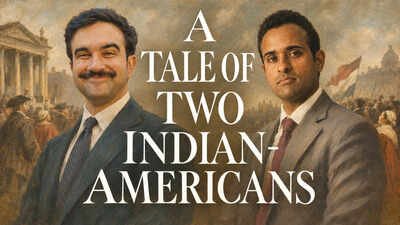
One of the most famous opening lines in literature comes from Charles Dickens’ A Tale of Two Cities: “It was the best of times, it was the worst of times, it was the age of wisdom, it was the age of foolishness, it was the epoch of belief, it was the epoch of incredulity, it was the season of Light, it was the season of Darkness, it was the spring of hope, it was the winter of despair, we had everything before us, we had nothing before us, we were all going direct to Heaven, we were all going direct the other way—in short, the period was so far like the present period, that some of its noisiest authorities insisted on its being received, for good or for evil, in the superlative degree of comparison only.”And that’s as apt a description as one can have for Republicans and Democrats after the midterms. For Dems, it’s the best of times, the age of wisdom has returned and it’s the season of light. For the MAGA-cannibalised GOP, it’s the worst of times, a winter of despair. It’s the happiest Dems – and their global surrogates across the world – have been since a man with the middle name Hussein declared “Yes We Can”. For Republicans, it’s the most devastating loss in decades, with Kansas waving goodbye for the first time since 1932 while the Texas Senate seat flipped after 38 years.In the Lone Star State – the online memes have already labelled it the Lone Saar State – the Republicans’ bilious anti-Indian rhetoric ensured that the Texas House would now have a Pooja in its midst, a befitting reply to the slogan: “Don’t Pooja my Texas.”Much like the 2024 US election, which was billed as an internecine desi fight thanks to Kamala Harris’ Tamil Brahmin ancestry and Usha Vance’s Telugu roots, Indian-American representation in the midterms was off the charts.Now, just to be clear, Indian-Americans make up roughly 1.5% of the US population and 1% of its eligible electorate, and even Texas – where Bo French’s anti-India rant will live on in history as the most famous political upheaval since a Gujarati man was asked to deboard a train in South Africa for being brown – has an Indian population of only 2%, with just 1% being voters.Now, in both cases, we flirt with what logicians call post hoc ergo propter hoc, but we digress.While Trump made historic gains among numerous groups in Texas (and the US) in 2024, including Indian-Americans, those gains were largely eroded by the time the midterms came around. And all elections can always be summed up by one simple line from Bill Clinton’s former adviser Jim Carville: “It’s the economy, stupid.”But from an Indian-American lens, and from a broader Republican vs Democrat debate, the midterms can be viewed through the journeys of two Indian-American politicians: one who was on the ballot during the midterms and one who wasn’t.A Tale of Two Indian-AmericansNow, New York Mayor Zohran Mamdani and Ohio’s losing gubernatorial candidate Vivek Ramaswamy are like chalk and cheese, and before they got into politics, the average desi family would happily adopt Ramaswamy and be reluctant to even acknowledge Mamdani as a cousin.Mamdani was a rapper who didn’t get into Columbia – despite claiming to be African-American as well as Asian-American – while Ramaswamy was a high-school valedictorian who got into Ivy League schools and sold his company for a billion dollars.But while what is sauce for the goose might be sauce for the gander in real life, in politics, chalk can morph into cheese.Today, Mamdani is one of the three desi mayors of what can be called the Dard-E-Disco cities (New York, LA, London, Paris, San Francisco), along with Sadiq Khan (London) and Nithya Raman (LA), while Ramaswamy is a losing gubernatorial candidate in Ohio, a contest that he looked bang on to win before Trump went full Trump.Mamdani, in particular, might have thrilled his teachers with his academic brilliance, but he has a certain je ne sais quoi about him as a politician that can warm the cockles of his harshest critic. Just ask Trump, who has had a stronger man crush on Mamdani than he has had on any Republican of note.On the other hand, there’s a similar negative je ne sais quoi about Ramaswamy, aptly summed up by Indian-American comedian Nimesh Patel in a 2023 stand-up act in which he says all Indians know a guy like Ramaswamy, who “lucked into a bunch of money” and now thinks he is – one is paraphrasing here to keep it publication-friendly – the biggest stick on the planet.And both their political trajectories make for interesting reading.To understand these trajectories, however, we must first understand the two very different versions of postcolonial Indian privilege that these men inherited.Mamdani is the quintessential lovechild of India’s liberal, cosmopolitan and intellectual elite. His mother, Mira Nair, grew up in the household of an IAS officer in post-Independence India, studied at Delhi University and Harvard. Her films might not pack theatres to the rafters in India, but their exploration of migration, identity and class makes people who go to art festivals that hand out laurel wreaths feel smug about themselves.His father, Mahmood Mamdani, was born in Bombay, grew up in Uganda, was expelled under Idi Amin and went on to become one of the world’s foremost scholars of colonialism, citizenship and political identity. A Harvard PhD and Columbia professor, Mahmood spent much of his academic career interrogating the structures of power that colonialism had left behind.Ergo, Mamdani grew up in a house where Edward Said and Rashid Khalidi dropped in as dinner guests, where one assumes discussions about colonialism, imperialism and identity were as commonplace as discussions of IIT preparations are in Indian middle-class households. One could argue that even though Mamdani couldn’t get into Columbia, Columbia came home to him.Ramaswamy inherited a different version of the Indian Dream though he too was a fan of rapping.Born in Cincinnati to Tamil-speaking Palakkad Iyer Brahmin parents, Ramaswamy was raised by an engineer who became a patent lawyer at General Electric and a mother who worked as a geriatric psychiatrist. His parents belonged to that extraordinary generation of highly educated Indian professionals who migrated to America and discovered that their qualifications, discipline and willingness to work extraordinarily hard could propel them into the upper reaches of American society.And Ramaswamy followed the script almost perfectly: valedictorian, Harvard, Yale Law School, hedge funds, biotechnology and eventually selling his company for a cool billion dollars before deciding to become America’s corporate mascot against wokeism and social justice. His infamous Boxing Day rant in 2024 was practically an Indian parent-teacher meeting masquerading as an American political manifesto.As the ensuing MAGA civil war demonstrated, Americans weren’t particularly interested in being told by a billionaire of Indian origin that they should have spent less time watching sitcoms and more time solving quadratic equations.Therein lies the split between the two: one came from the intellectual tradition of questioning inequality while being steeped in social capital, while the other came from a professional tradition that believes excellence, discipline and individual achievement can trump any system.Products of PrivilegeBoth are products of privilege.Of course, both are products of privilege, but the fascinating contrast saw Mamdani become a socialist insurgent against the economic establishment while Ramaswamy became the capitalist insurgent looking to restore the meritocratic American Dream that made his extraordinary ascent possible.But what makes the contrast fascinating is how differently they translated those inheritances into American politics.Now, an asinine argument would be to boil down their contrasting political fortunes to their respective religions, particularly when both men have been rather open about their faith, albeit in very different ways.Ramaswamy, while proudly identifying as Hindu, has often presented his faith in a language that makes it sound like a crypto-Christian religion, emphasising one true God and the Judeo-Christian values supposedly underpinning American civilisation. His attempts to make Hinduism palatable to evangelical conservatives have sometimes resembled a theological translation exercise.Mamdani, meanwhile, has been unabashedly Muslim, whether campaigning among New York’s diverse communities or turning up for Eid prayers in an Arsenal-themed kurta, demonstrating that one could combine religious devotion, cultural identity and the considerably more serious business of supporting a football club.But the idea that Mamdani succeeded because he was Muslim while Ramaswamy lost because he was Hindu would be particularly asinine.The Carnegie survey of Indian-Americans found that enthusiasm for Mamdani’s victory was driven far more by his ideology than his religious identity. Neither the New York mayoral election nor the Ohio gubernatorial contest was a referendum on theological compatibility.Culture wars might dominate television studios and political podcasts, not to mention the more deranged corners of Twitter, but they don’t make the weekly grocery bill disappear.Mamdani’s 2025 mayoral campaign demonstrated that even a self-declared socialist could win over voters in the capital of global capitalism by addressing their most immediate concerns and, in doing so, beat a former governor who enjoyed considerable establishment backing.His campaign had a distinctly modern vocabulary. The videos were funny, the slogans memorable and the use of social media imaginative. Mamdani spoke to immigrant communities in their languages – even though native Bengali speakers would wonder if what he was saying was even Bengali – but none of that distracted from his promise to make New York affordable.And this defeat came when the Democrats were at their lowest ebb, reeling from a Trump victory that made believing in blue seem like a pipe dream.And his subsequent political impact demonstrated why his victory mattered far beyond the five boroughs. Many of Mamdani’s endorsements resulted in victories in the midterms.In the communication war that was comfortably being won by Republicans, Mamdani showed how to counter Trump’s political communication while demonstrating that he had mastered the art of the deal better than any Republican.Since Obama’s departure, the Democrats had often seemed caught between competing impulses: appealing to traditional working-class voters, satisfying their increasingly progressive activist base, reassuring wealthy donors and defending institutions that large sections of the electorate no longer trusted.Mamdani offered a way of resolving some of those contradictions, at least electorally.In simple words, it showed Democrats they could offer voters an alternative rather than harping on about how terrible the Republicans were. And those same instincts made him the only Democrat who could cajole offerings out of Trump with fake newspaper headings and handshakes.Meanwhile, Ramaswamy was one of the breakout stars of the 2024 Republican presidential primaries, becoming Trump’s surrogate: a Hindu billionaire whose most enthusiastic supporters often associated American identity with Christianity.He eventually abandoned his presidential ambitions, endorsed Trump and was selected alongside Elon Musk to lead the proposed Department of Government Efficiency.Then came the Boxing Day rant, the MAGA civil war over H-1B visas and his departure from DOGE.The official explanation was that he was leaving to pursue the Ohio governorship. Other reports suggested that his remarks about American culture, along with his differences with Musk and other figures in Trump’s orbit, had made his position increasingly untenable.But in February 2025, the move to Ohio looked like a rather clever escape plan.Ramaswamy was running in a state Trump had won by more than 11 percentage points in 2024. He had Trump’s endorsement, the support of influential Republican figures and the financial resources to build a formidable statewide organisation.His campaign was flush with funds, and he appeared to be saying and doing all the right things. He promised lower costs, bigger paycheques, world-class schools, cheaper energy and reduced taxes. His economic programme was substantially different from Mamdani’s. Rather than expanding state intervention, he wanted to reduce taxation, deregulate economic activity and make Ohio a more attractive destination for investment and employment.In theory, it was a perfectly plausible political proposition in a state that had supported Trump three times and where many voters had embraced the Republican promise of economic revival.For much of 2025, Ramaswamy appeared well positioned to win. But as the ship that was Trump’s second presidency sank – vacillating from one madcap moment to another while taking the American and global economies down with it – Ramaswamy appeared stuck to the hull.Soon, Republicans who had sworn their fealty couldn’t dislodge themselves quickly enough. And as his Catch-22 problem with MAGA became increasingly apparent, his campaign struggled to reconcile the need to energise Trump’s base with the equally important task of winning over moderate voters.Many of these problems were beyond his control: hostility towards Indians, vile anti-immigrant rhetoric and the cost of living hitting almost everyone in America and, thanks to the interconnected global economy, almost everyone across the globe.Of course, the final nail in his coffin was of his own making: the vile ad in which his campaign wheeled out the estranged mother of his opponent Amy Acton to bring up Acton’s childhood sexual abuse by her stepfather. It was the kind of low that would make Trump think twice, though he did back the ad.The advertisement provoked outrage across party lines, and an internal Republican poll reported by Axios found Acton’s lead increasing from two points to eight points after the ad began circulating. For the better part of a year and more, Ramaswamy had talked about opportunity and excellence but spent the final weeks attempting to destroy his opponent’s personal credibility in a Trumpian move that didn’t work at all.The two campaigns, and the parties they came to symbolise, had made very different choices. Mamdani persuaded people to imagine how their lives might improve. Ramaswamy, after months of promising excellence, ended by asking voters to think the worst of his opponent.Dickens wrote of the spring of hope and the winter of despair as two seasons belonging to the same age. The American electorate witnessed both in November 2026. Mamdani chose hope. Ramaswamy chose despair. And the results suggested which had proved more persuasive. Of course, politics is the art of the possible, and nothing is ever final. No one watching Trump’s triumphant return at the end of 2024 could have imagined that, barely two years later, the Democrats would see the blue moon rising quite like this. But then, as Dickens understood, the best of times and the worst of times have an inconvenient habit of changing places.