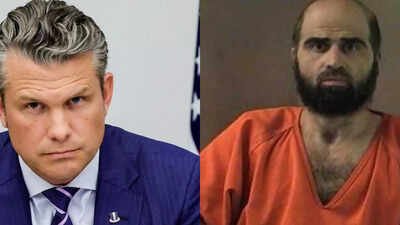
The Pentagon has announced that it will livestream the firing squad execution of Nidal Malik Hasan, the former Army psychiatrist convicted of killing 13 people at Fort Hood in 2009. The execution is scheduled for December 3 at the Texas military base where Hasan carried out the shooting.A Pentagon official confirmed the livestream to Reuters on Thursday, saying, “It will be livestreamed. Details will follow.” Defence secretary Pete Hegseth also confirmed the plan in a post on X, a day after saying the execution would be “public”.Hasan is set to become the first person executed by a US military firing squad since 1945. The Army announced earlier this week that the execution would take place at Fort Hood, where Hasan opened fire in a medical facility on November 5, 2009, killing 13 people and injuring 32 others.Hegseth, who championed the decision to execute Hasan by firing squad, said the public should be able to watch the execution because people needed to understand that such crimes carried “serious consequences”. He told the conservative programme Human Events Daily that scheduling the execution at Fort Hood on a Thursday at 1 pm, around the time and day of the original shooting, was a “no-brainer”.Asked whether Hasan had made any final requests, Hegseth said, “Don’t care. We’ll see him on December 3.”The decision has raised questions about the legal and ethical implications of broadcasting an execution, particularly as the US faces renewed scrutiny over capital punishment following a botched lethal injection in Tennessee last week.Media organisations have sought to televise US executions in the past but have been blocked by courts. Reuters reported that experts were unaware of any other country currently televising or livestreaming a legally sanctioned execution. Public executions have become rare worldwide, although Iran and Taliban-run Afghanistan have conducted them in recent years.The last legally sanctioned public execution in the US took place in 1936, when thousands watched the hanging of a Black man convicted of raping a white woman, according to death penalty experts cited by Reuters.
Experts question the need for a public execution
Legal experts have raised concerns about the purpose of livestreaming Hasan’s execution and whether it could face a legal challenge.Eugene Fidell, a military law expert and visiting lecturer at Yale Law School, told the Associated Press that Hasan could seek to delay the execution by filing a habeas petition in civilian court, challenging the legality of his detention. Fidell also told Reuters that livestreaming an execution would be “extremely, extremely strange” and that Hasan would need to sue in federal court if he wanted to block the public broadcast.The US Supreme Court has never directly addressed the question of livestreaming an execution, Fidell told Reuters, leaving open questions about how courts might approach such a challenge.Elisabeth Semel, co-director of the Death Penalty Clinic at UC Berkeley Law, told the Associated Press that the decision raised questions about the condemned prisoner’s dignity, who would be allowed to view the broadcast and what the administration hoped to achieve through the spectacle.“This is a president who’s about spectacle and that’s, I think, precisely the message that he intends to deliver,” Semel said, referring to president Donald Trump.Other experts said the debate over livestreaming came at a time when states were struggling to carry out lethal injections because of difficulties obtaining drugs and finding medical professionals willing to participate in executions.
Trump approves execution amid scrutiny of death penalty
Under US military law, the president must approve an execution by firing squad. Trump authorised Hasan’s execution on Hegseth’s recommendation, the Pentagon said earlier this week. The White House referred questions about the livestream to the Pentagon and did not say whether Trump supported broadcasting it.A military jury sentenced Hasan to death in August 2013 after finding him guilty of 45 counts of premeditated murder and attempted premeditated murder. He was 39 at the time of the attack and was scheduled to deploy to Afghanistan weeks later. He was shot by law enforcement during his arrest, leaving him partially paralysed and confined to a wheelchair.Hasan represented himself at trial after dismissing his lawyers, acknowledged that he was the gunman and did little to mount a defence. He said he had acted to prevent soldiers from going to Afghanistan and killing fellow Muslims, but a military judge barred him from presenting that argument as a defence.It remains unclear whether Hasan will challenge the execution.The case has also brought renewed attention to the methods used to carry out the death penalty in the US. At least five states permit firing squads, according to the Death Penalty Information Center. South Carolina carried out the first firing squad execution in the US in 15 years in 2025.The Trump administration has also expanded the methods permitted for federal executions to include firing squads, electrocution and gas asphyxiation, partly because of difficulties obtaining lethal-injection drugs.