Vaibhav Sooryavanshi continues to rise in stature with each passing game of the Indian Premier League (IPL) 2026. The 15-year-old has already scored 440 runs for the franchise in 11 games, and his performance in the remaining three league fixtures will decide whether the Rajasthan Royals make it to the playoffs or not. While the left-hander continues to make the right kind of noise with his batting, one major concern has emerged: his role as an impact player.
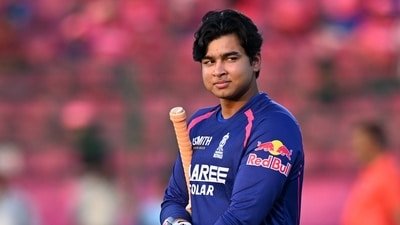
The franchise’s decision to have the youngster just bat in the IPL 2026 games continues to ruffle a few feathers. Rajasthan Royals assistant coach Trevor Penny had also earlier revealed that Sooryavanshi isn’t too happy, as he wants to be out there on the field. However, it seems the Royals haven’t been able to convince the batter to play the field, as he continues to feature as an impact player.
Former India batter Sanjay Manjrekar has now weighed in on the matter, saying the franchise might just be hampering the youngster’s growth, as fielding too is a specialist job and an important area for any cricketer. With the clamour growing for Sooryavanshi to be played in India’s T20I playing XI, Manjrekar had a piece of advice for the Royals.
“I’m increasingly thinking that we have to do away with impact sub for this reason as well. Is that what you want to see about Vaibhav Sooryavanshi, just the one side of him? Yeah. Isn’t a cricketer somebody who bats well and fields well as well? Earlier, we used to respect, and in Inzamam-ul-Haq for his batting, but you saw the other side of his as well, as a field or whatever. And that helped you sort of gauge and rate that player. Just using somebody’s hitting abilities to get him to play 6 balls, that’s it, and you don’t see the other side,” Manjrekar said on the Sporstar’s Insight Edge Podcast.
“We are not expecting to see all 3 dimensions of a player. But the more I think of it, it all makes sense, and you’re right, Sooryavanshi, you want to see him be on the field and see what happens and be put under pressure as well. If he is a great batter, but a slight liability in the field, I’d like to see that exploited. That is also something we have experienced as fielders when we drop a catch at the tension that comes with it, which is going to be batting and chilling. You don’t want one of the highest sort of levels of the sport to be that easy,” he added.
The former Indian batter added that a cricketer can’t be just someone who bats or bowls, as international sport demands that all three formats be tested. He also minced no words, saying the Royals are hampering the youngster’s growth by having Sooryavanshi play just an impact player.
“Absolutely (Is having him play as an impact player hampering his growth as a fielder). And that is an issue that’s going to be there. India won the T20 World Cup despite the impact player rule being there, despite a guy like Shivam Dube not bowling at all, but still doing well in the T20 World Cup. So things are happening. But I believe that a cricketer, not somebody, will just come in and tuck, tuck, tuck, then take a break and enjoy life. I just wanted to become a little more testing for every player, not just if he is a good bowler, bowls his 4 overs, I’d like to see him in the field as well,” said Manjrekar.
‘Easy money’
Of late, former Mumbai Indians captain Rohit Sharma has also been playing as an impact sub. It is important to mention that this happened last year as well, but in 2026, the decision to have Rohit just bat was taken after he sustained a hamstring injury, which led to him missing five matches for the franchise.
Manjrekar cited Rohit’s example and argued for scrapping the impact player, as it is doing more harm than good.
“When I saw Rohit Sharma bat in the last game, he got 22 runs in 15 balls. I mean, I’m not somebody who wants to focus too much on how much money he’s getting, but for 15 balls, he’s going to get paid the entire match fees or whatever. So when there is easy money to be made and a reward for very little effort, you’ve got to start worrying about that model because that’s never going to be a long-term, successful model,” said Manjrekar.