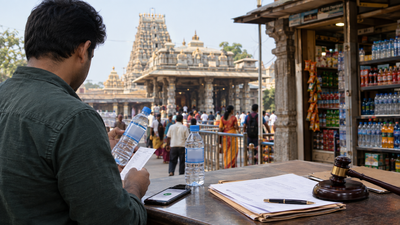
NEW DELHI: The Kakinada district consumer commission has ordered a temple shop licensee to pay Rs 7 lakh to the consumer welfare fund for charging Rs 25 for a one-litre water bottle marked at Rs 18. The commission also ordered a refund of Rs 7, Rs 10,000 compensation and Rs 5,000 litigation costs to the consumer. The order was passed on August 28, 2026.Why did the consumer approach the commission?According to the commission order, D Venkateswara Rao visited Sri Veera Venkata Satyanarayana Swamy Temple at Annavaram on February 22, 2026. He bought a one-litre packaged drinking water bottle from a shop run by the temple’s licensee.The bottle had an MRP of Rs 18, but the shop charged him Rs 25 through UPI. When Rao questioned the price, the shopkeeper allegedly said he was authorised to sell the bottle above its MRP. Rao also complained to the temple administration through WhatsApp but said there was no action from their side.The shopkeeper denied the claim of charging Rs 25 for only the water bottle, he said the complainant had also bought a Rs 20 cool drink and a Rs 5 biscuit packet, and that the Rs 25 payment was for those items.The temple administration also denied responsibility. It said the shop was run by an independent licensee and that it had taken action against the licensee after receiving complaints about overcharging.What did the commission find?The bench comprising President Ch. Raghupathy Vasantha Kumar and member Chakka Susi and member Chaganti Nageswara Rao said the UPI payment proof, photograph of the water bottle and other evidence supported Rao’s claim. It also noted that the licensee had not produced convincing documents to support his version that the Rs 25 payment was for a cool drink and biscuit.The commission found that Rao had bought only the water bottle and that the licensee had charged Rs 25 against the printed MRP of Rs 18. It further noted that the temple administration had received earlier complaints about overcharging by the same licensee and had issued several notices against him.The commission said the MRP printed on a packaged product is the highest price at which it can legally be sold to a consumer. Charging more than the printed MRP is not allowed.“Such conduct squarely falls within the definition of “unfair trade practice” under Section 2(47) of the Consumer Protection Act, 2019, as it adopts an unfair method for promoting and supplying goods by violating statutory law and misleading consumers regarding the lawful sale price. It also amounts to deficiency in service, since the consumer is deprived of the protection guaranteed by law,” the commission said.The commission said the matter was more serious because the sale took place at a major pilgrimage centre, where thousands of devotees visit every day. It said people buying essential items such as drinking water at such places may have little choice but to pay the price demanded.“Consumers purchasing essential commodities such as drinking water at such places are ordinarily left with little or no bargaining power and are compelled to purchase at the price demanded. Exploiting such circumstances to collect amounts above the statutory MRP is a serious unfair trade practice affecting not merely one consumer, but the consumer public at large,” it observed.The commission said the temple administration had supervisory control over the licensed shops but found no evidence that it had instructed or allowed the licensee to charge more than the MRP.It therefore dismissed the complaint against the temple administration and did not order it to pay any money. However, it directed the temple authorities to make sure that all licensed shops clearly display the MRP of packaged products.The temple administration was also directed to make announcements at hourly intervals asking devotees to buy goods at MRP and not pay more. It was also told to maintain an effective complaint system for devotees.The commission said simply returning the extra Rs 7 would not be enough because similar overcharging could affect many other consumers.“If the Commission were to merely direct refund of the excess amount collected from the complainant, the opposite party would still stand to benefit from similar illegal collections made from innumerable other consumers. Such an approach would render the statutory prohibition ineffective and would encourage repetition of the violation. The Consumer Protection Act is a beneficial legislation enacted not merely to compensate an individual consumer but also to ensure fairness in trade, protect the consumer community at large, and eliminate unfair trade practices from the marketplace,” it said.The commission therefore ordered the licensee to pay Rs 7 lakh as punitive damages to the Consumer Welfare Fund. It said the amount was meant to discourage such practices and protect consumers at public places and pilgrimage centres.The licensee was also ordered to refund Rs 7 to Rao, pay him Rs 10,000 compensation and Rs 5,000 towards litigation costs. The directions have to be followed within 45 days, failing which the monetary amounts will carry 9 percent annual interest from the date of default until payment.