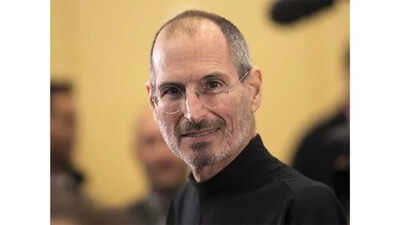
While they are all on the same page when it comes to the company’s products, two of Apple’s CEOs across the decades have opposite approaches to the same German sports car maker. Back in 1987, Steve Jobs rushed to hide his Porsche ahead of an investor pitch because he didn’t want his struggling startup, NeXT, to look flush with cash. Nearly forty years later, Apple’s newly appointed chief executive, John Ternus, owns one of the rarest track-only Porsches ever built, and regularly pushes it to its limits on California racetracks.
The day Steve Jobs ‘hid’ his Porsche
The story of Jobs’ car cover-up dates to his post-Apple venture, NeXT, which Apple eventually acquired years later to form the software base of OS X. According to former NeXT engineer Randy Adams, Jobs came running into the workspace right before billionaire businessman Ross Perot arrived for an investment meeting:“Randy, we have to hide the Porsches,” Jobs said.Up until that morning, Jobs and Adams had been parking their personal vehicles diagonally across three parking stalls to safeguard the paint from door dings. Concerned that pulling up to an office flanked by luxury sports cars would give Perot the impression that the young enterprise did not need cash, Jobs had the vehicles moved out of sight behind NeXT’s Palo Alto building.The low-profile appearance did the trick: Perot went on to inject $20 million into the company.
John Ternus and his the 700-horsepower Porsche 935
While Jobs viewed his car as a financial signal that needed to disappear during negotiations, Ternus engages with the brand in an entirely different setting: amateur motorsport. According to Motor1, Ternus owns one of only 77 units of the track-exclusive Porsche 935. Based on the 991-generation 911 GT2 RS, the vehicle carries an original base price topping $800,000 (€701,948 before taxes) and packs serious mechanical muscle.Its engine output is 700 horsepower via a 3.8-liter twin-turbocharged flat-six and it has a lightweight frame of 3,042 pounds (around 1380 kg). It is not street-legal and lacks conventional race championship homologation, making it strictly an instrument for private track events, Clubsport sessions and driver clinics.Rather than locking the vehicle away in a showroom as a static financial asset, Ternus runs the car at WeatherTech Raceway Laguna Seca. As reported by The Wall Street Journal, he has clocked lap times under 1 minute and 40 seconds – a quick pace for a non-professional driver.
Engineering Roots and High-Performance DNA
Ternus’s passion for circuit racing mirrors his technical background. Before stepping into the CEO role on September 1, 2026, he built his career through mechanical engineering. He graduated with a mechanical engineering degree from the University of Pennsylvania, worked as a mechanical engineer prior to joining Apple in 2001; Promoted to vice president of hardware engineering in 2013 and joined Apple’s executive leadership team in 2021.An active follower of Formula 1 and competitive motorsport, with Apple services head Eddy Cue previously highlighting Ternus’s participation in amateur track driving.While Jobs saw the sports car as an image liability to conceal behind an office wall, Ternus treats the ultra-rare machine as an engineering outlet.