Every time India take the field now, one question drowns out everything else: When does Vaibhav Sooryavanshi get his India cap? And it’s a perfectly valid question.
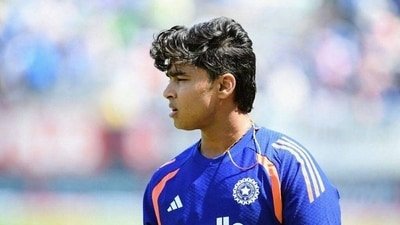
He smashed 776 runs in IPL 2026 at a strike rate nearing 240. The BCCI rewarded him with a senior-team call-up almost immediately, and he justified the hype by blasting 94 off just 29 balls for India A in the tri-series final in Sri Lanka earlier this month.
But fair questions don’t always have simple answers. India resisted the temptation to throw him straight into the XI in Ireland, a decision that drew criticism from experts and former cricketers after the defending champions suffered a shocking 0-2 series defeat, with their star-studded batting line-up misfiring in both matches.
And there is every chance Sooryavanshi may have to wait a little longer in England as well. If that happens, it should not be mistaken for selectorial cowardice. It is simply good team management.
Let’s begin with the most obvious point. Recent years have seen Indian cricket become more competitive than ever. Experts around the world have repeatedly pointed out that the BCCI is perhaps the only board capable of fielding multiple international-quality teams simultaneously.
ALSO READ: Shreyas Iyer keeps Vaibhav Sooryavanshi’s England debut decision ‘private’
That depth has been built during India’s most successful white-ball era in recent memory. Since reaching the 2023 ODI World Cup final, India have won the 2024 and 2026 T20 World Cups, alongside the Champions Trophy and Asia Cup, losing just one white-ball match during that stretch.
This is also an Indian team where even Shubman Gill and Yashasvi Jaiswal have had to fight for T20I opportunities despite their consistency. It is an India where even Virat Kohli and Rohit Sharma have had to answer questions over lean patches despite being among the greatest ODI batters of all time. If that is the standard set for two modern legends, it tells you everything about how places in India’s XI are earned. Nothing is gifted, regardless of reputation, history or hype.
Which is precisely why Sanju Samson, Abhishek Sharma and even Ishan Kishan deserve backing after earning their spots through performances, which includes the T20 Word Cup earlier this year.
The dressing room principle India refuse to compromise
India assistant coach Ryan ten Doeschate summed up the team’s thinking perfectly. Asked how close Sooryavanshi was to making his debut in Ireland, he explained that it would be difficult to tell someone like Samson — a player who “went a long way to winning India the World Cup” just months ago — that his place was suddenly under threat.
More importantly, he reiterated India’s philosophy of giving players an extended run.
“It’s important in terms of giving players confidence, and the message we’re sending to players. We want to give guys a long run in the team,” ten Doeschate said.
That isn’t sentiment. It’s about protecting the principle that sustained performance matters more than one spectacular tournament, no matter how extraordinary it was.
If India start dropping World Cup winners after two poor innings simply to accommodate an uncapped teenager, what message does that send to everyone else competing for a place?
Captain Shreyas Iyer echoed the same sentiment ahead of the England series.
“Every individual who is in the team has performed, but every player should also be given some sense of security and belief so that they have confidence. These players have been important pillars in this format, so it is very important to back them,” he said.
Neither Iyer nor ten Doeschate questioned Sooryavanshi’s readiness. In fact, the assistant coach was emphatic that the teenager is “absolutely ready to play international cricket.”
The point is simply that readiness alone does not guarantee immediate selection.
For Sooryavanshi, this waiting period could prove invaluable. Training in English conditions, watching senior professionals respond to setbacks and understanding the demands of international cricket offers lessons that no IPL innings, however breathtaking, can provide.
Ravichandran Ashwin made a similar observation on his YouTube channel.
He suggested that sitting in the dugout today allows Sooryavanshi to “learn from someone else’s experience” — perhaps the most valuable education available at this stage of his career. England’s surfaces, the seam movement and the discipline of international new-ball bowling bear little resemblance to the flat pitches and short boundaries that fuelled his IPL heroics. This isn’t punishment. It’s incubation.
None of this changes one undeniable truth. Vaibhav Sooryavanshi is a generational talent.
He has already shown enough to suggest he belongs on the biggest stage. He will almost certainly play for India, and quite possibly enjoy a long and distinguished career.
But that opportunity should come organically, through form, injuries or genuine tactical necessity, not because of external pressure. Right now, India need to show faith in the players who earned this team’s trust. That faith could well extend through the entire England series. If that means Sooryavanshi has to wait a little longer, so be it.
Zimbabwe later this month, or the Asian Games, could provide the perfect stage for his international debut. Until then, patience may prove to be India’s smartest selection call. After all, truly exceptional talents rarely have to wait for long.