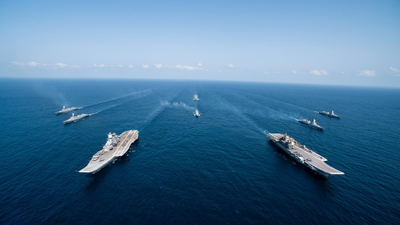
Aircraft carriers are the primary means of projecting power away from friendly shores. The United States, by law, requires eleven operational aircraft carriers. Currently, the US Navy has eleven aircraft carriers, across two classes, on its register. With four ships undergoing maintenance, three at port, four deployed and one ship undergoing training. Navies across the world work on what is called a system of thirds. This means that for any one ship to be deployed for a mission, the force will have one ship on deployment, one undergoing training and the third of these ships would be at port undergoing maintenance. There are currently four Carrier Battle Groups (CBGs) deployed.Two of these CBGs, headed by USS George H.W. Bush and USS George Washington, are actively deployed with the US 5th Fleet in the Central Command’s area of operations in west Asia. Meanwhile, a CBG centred around the USS Carl Vinson is in the North Atlantic on a deployment under the Third Fleet, which is subservient to the US Northern Command. This comes as the USS Abraham Lincoln leaves the west Asian area of operations after a prolonged deployment that began in November 2025. The average age of the ten Nimitz-Class carriers is 36 years, and as these ships age, their maintenance and refit cycles will be longer. Periodic maintenance and refits of these maritime behemoths could last from a few months to the USS George Washington’s nearly six-year-long (August 2017–May 2023) Refueling Complex Overhaul (RCOH) on the other end of the spectrum. A deep overhaul could take as much as 18 months.This USS George Washington, which has replaced the USS Lincoln, is nominally deployed in the Western Pacific Ocean and has its home port at Yokosuka, Japan. The deployment of this CBG to the west Asian theatre leaves the US Navy without an aircraft carrier in an environment where China is asserting itself and currently has three aircraft carriers in service and is expanding its fleet of aircraft carriers. The US Department of War, as per a report released in November last year, claims that the Chinese Navy plans to induct six new and more powerful aircraft carriers, which will bring the total of China’s flat tops to nine. This will be just two short of what the US Navy possesses.
India’s carrier fleet
The Indian Navy currently has two aircraft carriers in service. These carriers are the indigenously developed INS Vikrant and the refurbished Kiev-Class carrier INS Vikramaditya. India has a rich history of operating aircraft carriers and was the first Asian nation to operate such ships, with the Navy sailing into its age of aircraft carriers with the induction of the first INS Vikrant, a Majestic-Class light carrier. The aircraft embarked on this ship saw action in the eastern theatre during the 1971 war. India is one of the few navies that has seen continuous carrier operations since 1961. Many other navies, including the UK’s Royal Navy, have had gaps in carrier service. The Royal Navy did not have an operational carrier in service for three years, from the decommissioning of HMS Illustrious in 2014 to the commissioning of HMS Queen Elizabeth in 2017.The Navy had deployed the indigenously developed INS Vikrant as the centre of its carrier battle group. The deployment of the Vikrant-led CBG put the Pakistani maritime forces in a defensive posture. The Indian Navy is procuring Rafale-Ms to equip its aircraft carriers with more potent fighter aircraft, thus providing the fleet with a more formidable punch. The Navy currently operates around 40 MiG-29Ks. These aircraft are deployed across two squadrons, namely INAS 300, the ‘White Tigers’, and INAS 303, the ‘Panthers’. These aircraft, nominally based at INS Hansa in Goa when on land, operate from both aircraft carriers.With two aircraft carriers in its fleet, the Indian Navy can’t maintain the optimal number of ships, which would be a multiple of three, as discussed earlier. The Indian Navy has been looking for a third aircraft carrier. A capability development document released by the armed forces last year lists the Navy’s requirement for another aircraft carrier. The document has a timeline of fifteen years. This would mean that the Navy is seeking to acquire an aircraft carrier in that time frame. This is the same time period at the end of which the Navy would be planning to retire INS Vikramaditya.This is despite the fact that the Navy has repeatedly asked for a third aircraft carrier. As per reports, the Navy could go for a larger aircraft carrier, which would be in the 65,000-tonne class range. If the Navy goes for such a ship, then this would be the largest vessel ever operated by the Indian Navy. The increased size of the ship would also provide the ship with much larger aviation facilities. An aircraft carrier of this class would be able to carry 50-60 aircraft. This would be much more significant than the 36 aircraft that can embark on INS Vikrant, which has a displacement of 45,000 tonnes.The Defence Research and Development Organisation (DRDO) is currently experimenting with the Electromagnetic Aircraft Launch System (EMALS). It employs linear induction motors to launch aircraft with greater precision and faster recharge cycles. The system’s smooth acceleration reduces stress on airframes, while its lighter weight and lower maintenance demands promise long-term savings. Crucially, EMALS can move between launching heavier and lighter aircraft in quick time, thereby expanding operational flexibility. By cutting fresh-water requirements, it also eases the burden of desalination. For carrier aviation, EMALS signals a technological leap toward efficiency and adaptability. This system was developed by General Atomics for the US Navy, and it represents an improvement over steam catapults. It was first fitted on USS Gerald R. Ford in 2015. US President Donald Trump has recently ordered the removal of these systems from the later models of the US Navy’s Gerald R. Ford-Class carriers over what are said to be reliability issues.
India cannot afford to delay its aircraft carrier decision any longer. The gestation period for building such a platform is at least a decade, which means planning must begin now if the Navy is to meet its future operational needs. The requirement is clear: a larger carrier of around 65,000 tons, equipped with catapult launch capability to operate heavier aircraft and advanced drones. And to truly project sustained power across the Indian Ocean, the ship must be nuclear‑powered, to power the systems on the vessel and also to ensure endurance without dependence on refuelling. A third carrier is not a luxury—it is a strategic necessity to secure India’s maritime frontiers.
Captain Manish Luthra (retired), Aviation Specialist for INS Vikramaditya induction
The protracted periods of deep maintenance cycles of these ships could put additional pressure on the remaining carriers of the fleet, thus reducing the war-waging capability of a navy. For a navy like India’s, which has two coasts or flanks to operate on and is readying for a two-front conflict, the lack of an aircraft carrier due to unavailability because of a maintenance schedule could be a limiting factor in a conflict, especially as the Chinese Navy is planning to field as many as nine carrier battle groups. The United States Navy’s current predicament of not being able to deploy a CBG in the Pacific, the area in which it is fighting its biggest fight for influence since the fall of the Berlin Wall, shows the importance of having additional ready forces that can help it project its influence in contested areas. India too faced a similar situation during the 1965 war, when its sole aircraft carrier was sitting the war out in a dry dock in Mumbai, having to wait for six years to prove its worth.