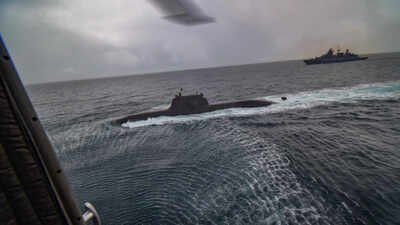
The Canadian government has selected German firm ThyssenKrupp Marine Systems (TKMS) as the preferred supplier for the Type 212CD submarine under the Canadian Patrol Submarine Project (CPSP). The project, which could see Canada acquire up to 12 vessels, will be the biggest defence procurement in Canadian history.“These submarines provide an unparalleled combination of advanced technology and lethality that will enable the RCN to detect, track, deter and, if necessary, defeat adversaries in all three oceans bordering Canada,” said a release from the Canadian government.The deal comes at a time when Canada, along with other NATO members, has increased its defence spending to 2% of GDP for the first time since the end of the Cold War.This is the second major submarine deal announced by a NATO member in recent weeks, with Poland signing a deal with Sweden for three A26 or Blekinge-class submarines. These deals are taking place at a time when submarine fleet expansion is seeing a resurgence across the board.The US Navy is seeking to procure 15 submarines by 2031 as part of its Future Years Defense Program (FYDP). These procurements are scheduled to take place between 2027 and 2031. Five of these submarines will be Columbia-class ballistic missile submarines, while the other ten will be Virginia-class attack submarines.This comes at a time when China is expanding its submarine fleet with newer and increasingly advanced vessels. Pakistan is also expanding its submarine fleet, adding eight Type-039 vessels, locally known as the Hangor-class, to its fleet of five submarines. India’s conventional submarine fleet strength currently stands at 16.The Indian Navy is planning to procure between six and nine submarines as part of the Project-75I submarine programme. This is part of the Navy’s thirty-year submarine building plan, which is now running behind schedule. The programme was drawn up in 1999 under Vice Admiral A K Chatterji. Under this programme, the Navy is planning to procure the Type-214 submarine developed by TKMS, the same firm behind Canada’s CPSP. The Type-214 is also operated by Greece, Portugal, Turkey and South Korea.The Type-214 is an air-independent propulsion (AIP) equipped submarine that can reportedly stay underwater for as many as three weeks. The vessel was designed for blue-water operations and is capable of extended patrols far from home waters.The Navy is also working on other attack as well as ballistic missile submarine projects. The most expansive of these plans is to procure a dozen conventionally powered diesel-electric submarines under Project-77 and six nuclear-powered attack submarines under Project-76. The Navy currently has three domestically developed nuclear-powered ballistic missile submarines, with one more undergoing trials.With the advent of potent anti-ship missiles and the ongoing development of hypersonic weapons, the threat to surface vessels is increasing. Submarines, which are becoming increasingly stealthier, provide the option of a sea-based platform that can act as a deterrent.