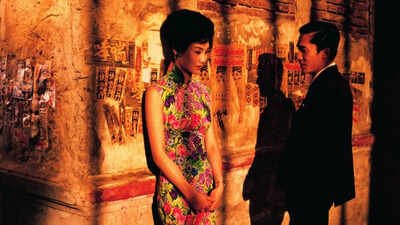
Su Li-zhen Chan (Maggie Cheug): I didn’t think you’d fall in love with me. Chow Mo-wan (Tony Leung Chiu-wai): I didn’t either. I was only curious to know how it started. Now I know. Feelings can creep up just like that. I thought I was in control.– In the Mood for LoveWhat if I told you the world’s best film on love is one where lovers barely touch each other? Their hands brush against one another in a couple of scenes. There are no kissing scenes or even scenes of passionate embrace. But once you watch In the Mood for Love, the 2000 masterpiece directed by Hong Kong-based Wong Kar Wai, your life will forever be changed.Love, desire, passion and relationships have all gone through a mammoth change in the 21st century. Cinema and popular culture have depicted almost all aspects of these tectonic changes; but every September 29—the day of the movie’s release in 2000—cine lovers worldwide watch In the Mood for Love yet again, and social media is abuzz as if the film had been released yesterday.Then there’s the fact that every prestigious poll on “greatest cinema” has the Wong Kar Wai classic on its top five list. Even now. The last poll was by The New York Times. In mid-2025, NYT published its milestone poll ranking the ‘100 Best Movies of the 21st Century’. Voted into the fourth position by a panel of film critics, directors and scholars was Wong Kar-wai’s masterpiece. It secured its place at the top tier of modern cinema. This high honour also builds upon decades of global critical acclaim.The film was previously placed second in the BBC’s 2016 poll of 21st-century cinema and claimed fifth place in the British Film Institute’s prestigious 2022 Sight & Sound critics’ poll of the greatest films of all time. So what is it about a film where lovers just barely brush past one another that continues to draw in every generation? Even Gen X and Gen Alpha.
Restraint, the invaluable currency in our hyper-connected world
Well, this film relies almost entirely on emotional restraint. To every generation first watching this film, it’s a revelation; but to this generation—so used to and exhausted with swiping right and left, and the inevitability of looking for love through an app—it hits different.We also live in an era dominated by high-budget spectacles, fast-paced editing and explicit screenwriting, and that’s what we often expect out of every love story on celluloid.In the Mood for Love does the opposite. It tells a story where the central lovers just pass one another on streets, think about each other—and their own all-encompassing loneliness—and have to keep up the pretence of being just next-door neighbours.Set in the crowded apartment blocks of 1962 Hong Kong, the narrative follows two neighbours: newspaper editor Chow Mo-wan (Tony Leung Chiu-wai) and corporate secretary Su Li-zhen (Maggie Cheung). Together, they make a painful discovery: their respective spouses are having an extramarital affair with each other.Rather than seeking sudden revenge or plunging into a physical affair of their own, Chow and Su draw close through shared grief. They role-play imaginary conversations to figure out how their partners betrayed them, while silently making a solemn promise to themselves: “We won’t be like them”. But they do fall in love with one another. And that promise hangs in the balance.The late legendary movie critic Roger Ebert had wrote about the film: “They are in the mood for love, but not in the time and place for it. They look at each other with big damp eyes of yearning and sweetness, and go home to sleep by themselves. Adultery has sullied their lives: his wife and her husband are having an affair. “For us to do the same thing,” they agree, “would mean we are no better than they are.” The key word there is “agree.” The fact is, they do not agree. It is simply that neither one has the courage to disagree, and time is passing…”Through this vow of self-control, Wong Kar-wai delivers a powerful and unforgettable emotional experience. His love is not an act of physical possession at all. It is a lingering, unfulfilled state of longing that stays in memory forever. It cuts you to pieces. Every scene. From the beginning till the end.For 21st-century audiences living in a hyper-connected world, this movie can feel like a meditation. Nothing in this movie is explicitly said or made obvious. Wong’s vision of intimacy is this: true closeness is often born from what remains unsaid, untouched and unconsumed.

True closeness is often born from what remains unsaid, untouched and unconsumed.
The power of what is unsaid but lingers in the air
To understand Wong Kar-wai’s artistic genius, we must examine his definition of intimacy. In traditional romance movies, intimacy is usually shown through physical touch, explicit confessions or sexual union. Wong completely flips this formula.In his cinematic universe, physical contact is often brief or misleading, whereas true intimacy flourishes in shared spaces, quiet silences and mutual understanding.Reflecting on his storytelling approach, Wong explained the main direction he gave to actress Maggie Cheung during filming: “We’re not making a movie about what’s said – we’re making one about what’s hidden”.This idea forms the core of his aesthetic. Intimacy in In the Mood for Love is built through delicate body language, small gestures and the physical environment. Wong instructed his lead actors to let their hands do the talking, noting that hands betray what faces hide, and that desire lives in subtle details like holding a cigarette, holding a letter or touching the edge of a dress.This focus on small gestures is tied to the physical setting of 1960s Hong Kong. He recalled how tiny living spaces forced people together with no privacy. Life was an open book read over one’s shoulder, creating thick human connections inside buildings with paper-thin walls.In such a tight environment, romance could not be displayed openly without causing neighbourhood gossip and social shame. As a result, intimacy shifted into quiet daily routines, like, brushing past one another on narrow stairwells while carrying takeaway noodle tins, standing under rain-soaked awnings or waiting in dim hallways.
Did the rice cooker change the definition of love?
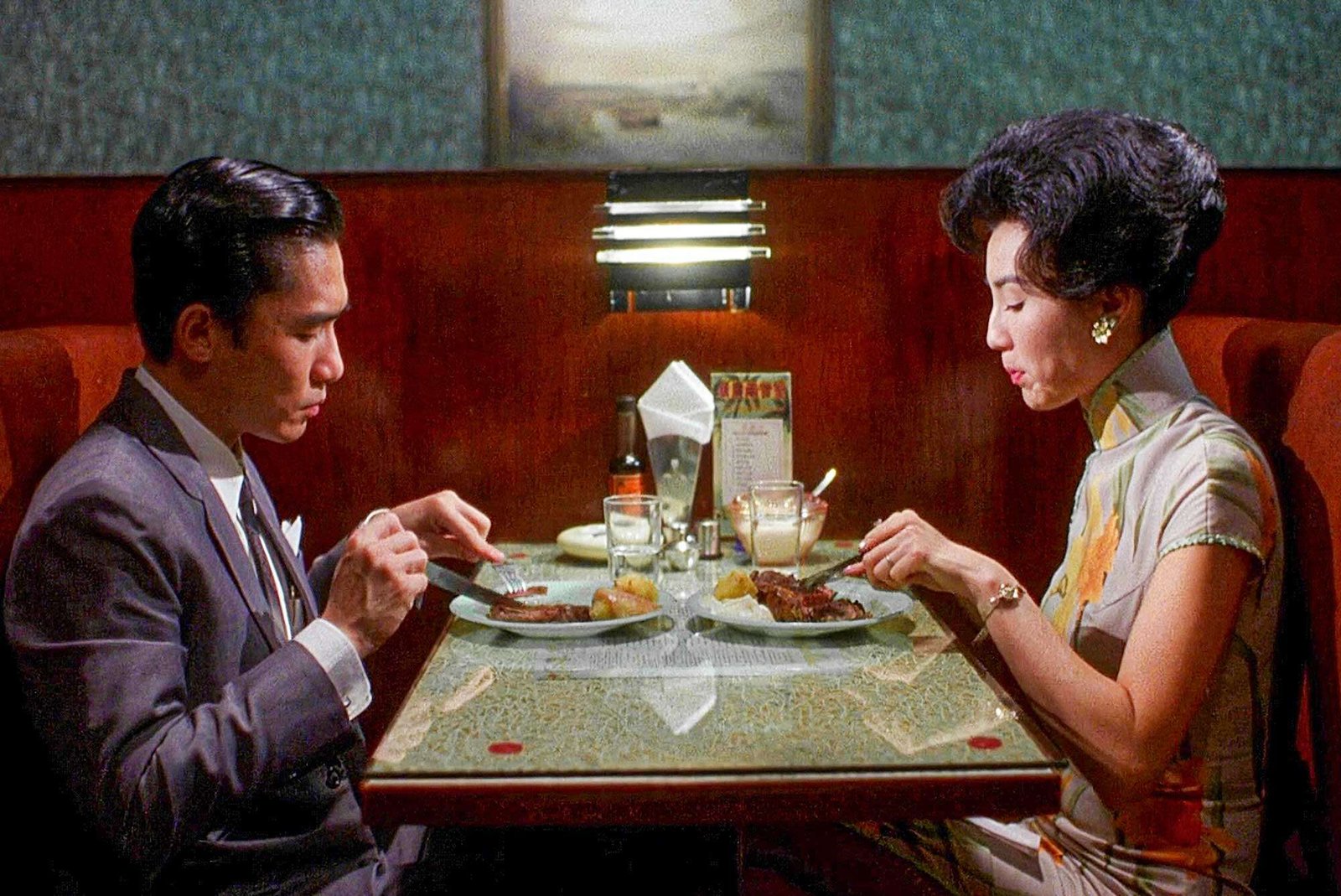
Wong pointed out that simple daily inventions like rice cookers, instant noodles and 24-hour convenience stores changed Asian intimacy far more deeply than romantic love letters, because these objects altered how people moved through space and met each other every day.For instance, when Chow and Su practise role-playing scenarios to understand their spouses’ affair, they create a private emotional world. They pretend to confront each other, flirt and say goodbye. Yet, as they act out these scenes, the line between performance and reality begins to disappear. They fall in love by sharing the exact weight of their heartbreak. For instance, in a restaurant while having dinner, and both heartbroken by their spouses’ betrayal, Chow orders Su’s husband’s favourite dish, and Su asks for Chow’s wife’s favourite. While biting into each piece both the protagonists are trying to process grief and trying to understand each other’s spouses, who are having the affair. The scene is at once – jarring, uncomfortable, intimate and absolute heartbreak.
Can food tell you about people’s souls?
Then of course, is Wong Kar-wai’s brilliant choice of cinematography and music, which are main characters in this movie – as essential as the protagonists. Christopher Doyle, the cinematographer, and Yumeji’s Theme, the main soundtrack of the film, composed by Shigeru Umebayashi.While In the Mood for Love takes place in 1962 and was released in 2000, its core themes continue to resonate with audiences today. Modern life is filled with rapid digital communication, dating apps, instant text messages and social media oversharing. Relationships can start quickly and end just as fast, with romance often reduced to quick interactions and immediate responses.Against this backdrop, the film’s slow unfolding feels striking. There is time to notice a glance, a pause, a hesitation. Feelings are allowed to exist without immediately being named or acted upon. The characters’ silences become as important as their conversations, and what they choose not to do becomes the most important part of the story.The film also leaves us with an intriguing idea about unfulfilled desire. What remains unresolved can acquire a strange permanence because it never has the opportunity to become ordinary. Chow and Su’s relationship remains suspended between possibility and impossibility – protected from the routines and compromises that might have accompanied another life together. That is why it continues to feel so intimate.
The everlasting echo of unfulfilled desire
This turn-of-the-millennium movie is a major achievement in global cinema also because it captures a feeling that can transcend culture and age: the ache of wanting something that can never quite become yours.Its fourth-place spot on The New York Times list of the top 100 movies of the 21st century is only the latest recognition of a film that has remained remarkably alive in popular and critical culture.Through its rich colours, small physical gestures and expressive music, the film shows how much emotional weight can be carried by the smallest moments.That is the secret of its enduring appeal. In the Mood for Love does not give us the satisfaction of a conventional love story with a beginning, middle and resolution. It leaves us with a feeling — unfinished, unresolved and lingering. The romance ends, but the longing remains, suspended somewhere between memory and imagination.Maybe that’s why, more than two decades after its release, we keep returning to it.