NEW DELHI: A CCTV camera may have recorded exactly what happened inside a police station, school or government office. But for the person who needs that footage as evidence, the bigger challenge may be reaching it before it disappears.Most CCTV systems overwrite old recordings after a limited period. And that creates an awkward race against time: an RTI application may not get you the footage, a court can order it to be preserved, but by the time a citizen figures out which route to take, the recording may already be gone.A recent Allahabad high court ruling has brought this problem into sharp focus. The court held that CCTV footage covered by exemptions under the RTI Act cannot simply be handed over through an RTI request. It can, however, still be preserved and summoned by courts and other competent authorities.That leaves a practical question for anyone who believes a CCTV recording could prove what happened: what do you do when the evidence exists today, but may not exist a few weeks from now?
So, why can’t citizens simply seek CCTV footage under RTI
According to the Allahabad high court ruling, CCTV footage can fall within Section 8(1)(g) of the RTI Act where disclosure could endanger someone’s life or physical safety or reveal a confidential source of information. Where the exemption applies, the footage cannot be provided directly through an RTI application.RTI activist Subhash Chandra Agrawal said CCTV footage can also raise privacy concerns under Section 8(1)(j), particularly where it reveals the identity or movements of individuals.At the same time, Agrawal pointed to situations involving illegal detention, custodial violence or police misconduct. “In such cases, going to courts for seeking directions is a costly, cumbersome and time-consuming aspect,” he said, arguing that where allegations concern serious misconduct, there could be a case for making the footage available rather than requiring the complainant to begin a separate court process merely to obtain it.

–
Does the Allahabad HC ruling follow the Supreme Court’s position
Broadly, yes, lawyers said, although the contexts need to be understood separately.Neeha Nagpal, founding and managing partner at N & Company Legal, said the Allahabad high court ruling is broadly consistent with the Supreme Court’s 2017 directions in Pradyuman Bisht v Union of India concerning CCTV cameras in court complexes.The Supreme Court later dealt specifically with CCTV systems in police stations in Paramvir Singh Saini v Baljit Singh. It directed installation and preservation of CCTV footage in police stations and said a Human Rights Commission or court could immediately summon relevant footage for safe keeping in cases involving alleged human-rights violations.Hormuz Mehta, partner at JSA Advocates & Solicitors, said the Allahabad high court ruling does not create a new bar on securing CCTV evidence. “The Allahabad high court ruling supplements the 2017 directions and is consistent with the Supreme Court’s framework in Paramvir Singh Saini,” he said.
So what can a citizen do if the footage is needed as evidence
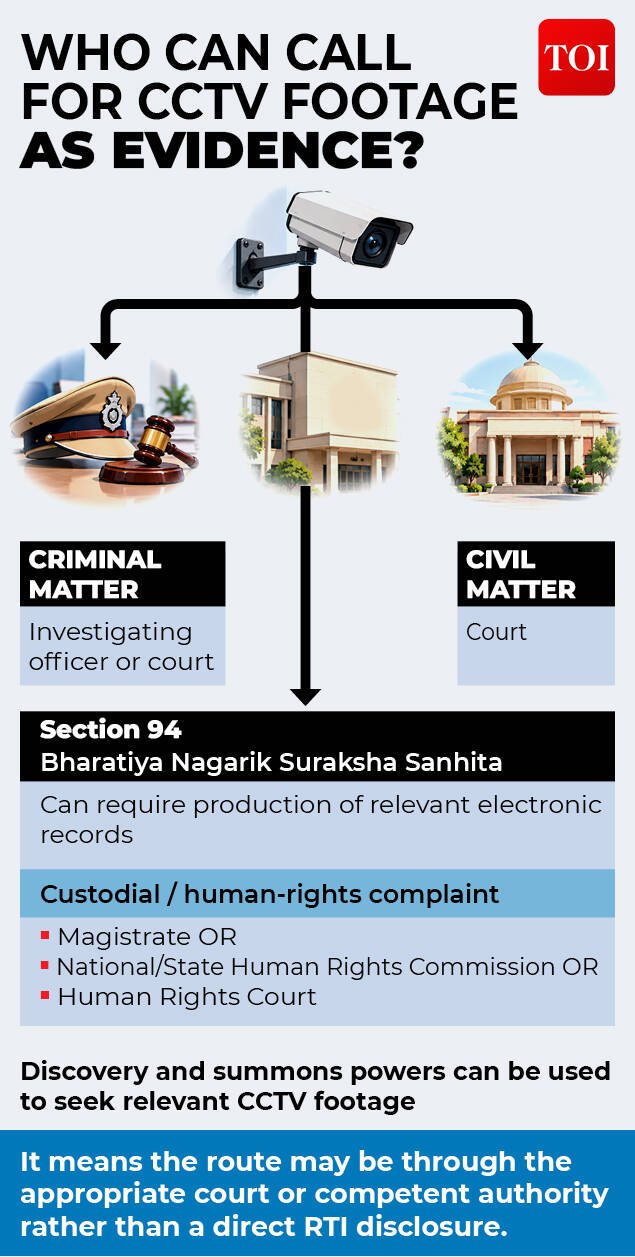
Nagpal said a person should approach the forum dealing with the underlying grievance and ask it to preserve and call for the footage. In a criminal matter, an investigating officer or court can require production of electronic records under Section 94 of the Bharatiya Nagarik Suraksha Sanhita. In civil proceedings, production can be sought through the court’s discovery and summons powers.Mehta said a person can also approach a Magistrate, the National or State Human Rights Commission or a Human Rights Court, depending on the nature of the complaint.But timing is critical. “The request should be made at the earliest possible stage because many CCTV systems overwrite data automatically,” Nagpal said. She advised applicants to identify the location, date, approximate time and cameras involved as precisely as possible.

–
What should a person do before approaching a court
Lawyers said citizens should create a written record seeking preservation. Nagpal suggested sending a specific request to the authority controlling the cameras and seeking an acknowledgment.Mehta similarly said a person can write to the station house officer, school principal or head of the public authority, identifying the date, time and camera concerned. “If no action follows or no response is received, the citizen should immediately approach a Magistrate, the National/State Human Rights Commission, or a Human Rights Court for a preservation direction,” he said.An RTI application by itself may not stop the recording from being deleted. This becomes particularly difficult when a person does not yet have a formal case pending.
Does the procedure change for police stations, schools and government offices
Police stations have a specific framework because of the Supreme Court’s directions on CCTV and custodial accountability. Mehta said complaints involving alleged custodial misconduct can be taken to a Magistrate, the National or State Human Rights Commission or a Human Rights Court, depending on the circumstances.For schools, government offices and other public authorities, a court can be asked to direct production where the footage is relevant to a criminal or civil proceeding.
–
What if the authority says the footage has already been deleted
Nagpal said a court can examine the applicable retention policy, when the footage was overwritten and whether the authority had already received a request to preserve it.Mehta said the consequences can be more serious if footage was destroyed despite a preservation order. Depending on the circumstances, this could lead to contempt proceedings, an adverse inference or departmental action.“The citizen is not without recourse,” Mehta said, adding that the circumstances surrounding the destruction can be examined where footage was not preserved despite a direction.
Does restricting RTI access make accountability harder
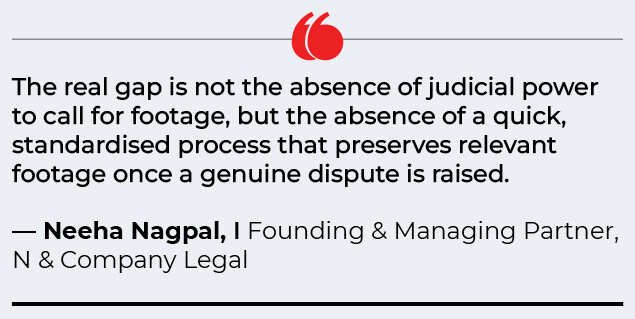
Lawyers said it can, particularly because RTI is relatively inexpensive and does not ordinarily require a citizen to begin substantive legal proceedings.Mehta said requiring a person to approach a court or commission involves additional legal costs, procedural requirements and delays. The problem becomes more serious because, he said, “most DVR systems may overwrite footage in 15 to 30 days”.Nagpal said the legal framework does provide mechanisms to preserve and summon CCTV footage, but there is no single, quick preservation mechanism covering every police station, school, government office and public authority.“The real gap is not the absence of judicial power to call for footage, but the absence of a quick, standardised process that preserves relevant footage once a genuine dispute is raised,” Nagpal said.Agrawal also pointed to the difficulty for ordinary citizens in cases involving alleged police misconduct, saying that requiring them to go to court before getting access can be costly and cumbersome.
Is there a gap between the right to evidence and the right to privacy
That is perhaps the larger issue raised by the dispute. CCTV recordings can contain information about several people who have nothing to do with the complaint. Releasing an entire recording through RTI could expose their movements, identities or other personal information.At the same time, the person seeking the footage may be doing so precisely because the recording could establish what happened during an incident.The difficulty is that CCTV is not ordinary paper information that can wait for a lengthy legal process. It can be overwritten automatically.

–
What could make the system work better
Both lawyers pointed to the need for faster preservation. Mehta suggested a pre-litigation mechanism under which a written request from a citizen could require a public authority to preserve relevant footage for a defined period, giving the person time to approach the appropriate forum.Nagpal similarly said the system would benefit from a quick and standardised process for preservation.For now, the practical advice from lawyers is clear. A person who believes CCTV may contain important evidence should not wait for an RTI application to run its course. The person should identify the exact location, date and approximate time, make a written preservation request, keep proof of that request and approach the appropriate court, police authority or commission where necessary.
–
The Allahabad high court ruling may limit one route to the footage, but it does not close every route. The larger concern is what happens between the moment a citizen realises that CCTV could prove something and the moment a competent authority is asked to preserve it. If the recording disappears during that gap, the legal right to seek evidence may exist on paper while the evidence itself no longer exists.