Kolkata: Nostalgia hung heavy in the humid air of Chennai as the sea of yellow rose for MS Dhoni, chanting his name with a passion that seemed to acknowledge that time is slipping away for the Chennai Super Kings talisman. Walking out for the mandatory team photograph during the innings break, Dhoni smiled, acknowledging the crowd with the ease of a man who has occupied this stage for nearly two decades.
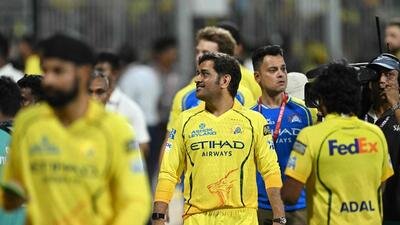
Dhoni hasn’t retired. Officially, there is no ending yet. But for CSK, it already feels like the beginning of life after him. And it hasn’t been a happy start.
That is the uncomfortable truth surrounding CSK’s season. Although Dhoni is technically still in the squad, this is the team’s first campaign without his constant presence on the field shaping every moment. He was absent from the dugout, detached from the everyday rhythms that used to revolve around him. In that vacuum, the cracks of transition have become hard to ignore.
The five-time champions are on the brink of finishing the season outside the playoffs for the third year in a row. For a franchise built on certainty, continuity and ruthless efficiency, this reality carries an enormous weight. Once used to qualifying as a routine, CSK are now confronting the messier reality of transition and reconstruction.
Transitions in sport are rarely elegant, which even the smartest teams have found. The assumption is that great teams simply replace legends and move forward seamlessly. In reality, they often discover that greatness was not structural at all but embodied in one individual who quietly solved problems before they became visible. CSK are learning that in real time.
Head coach Stephen Fleming admitted as much. Asked whether he had spoken to the 44-year-old Dhoni about the next season, his answer was short. “No, we’re working through this one.” It wasn’t a denial. It wasn’t a reassurance either.
More revealing however was the reality when Fleming started discussing Ruturaj Gaikwad, the man entrusted with leading the team into the next era. “It’s a big transition from having one of the best captains in the cricket scene running the franchise for such a long time to a new captain,” Fleming said. “So, it’s going to take a little bit of time.”
That “little bit of time” feels like an exaggeration. Gaikwad’s first full season carrying the weight of captaincy has exposed the scale of the task and the burden of comparison. His numbers are respectable in isolation: 321 runs in 13 innings, two half-centuries. But his strike rate of 120.67 is not merely below elite standards, it looks out of sync with the modern game. “I think Ruturaj can do more,” said Fleming. “He’s done more in the past. He’s been a fine player at the top. He hasn’t produced the quantity of runs and the pace of runs that he’s done in his career. And that’s something that he will address.”
The challenge for CSK is that Gaikwad’s form is only one layer of a deeper uncertainty. Injuries have disrupted their campaign repeatedly, robbing the side of continuity. Yet injuries alone do not explain why CSK increasingly appear caught between identities—too conservative to match the league’s most explosive batting units, yet no longer possessing the bowling precision or tactical control that once compensated for it.
For years, Dhoni functioned as strategist and emotional centre. His presence simplified decision-making for everyone. Players spoke constantly about the clarity: of role and expectation, and how to perform under pressure. CSK’s system looked timeless because Dhoni’s influence made chaos appear manageable. The franchise now looks mortal despite the assuring presence of Sanju Samson at the top.
That doesn’t mean the transition is doomed. Fleming is convinced about Gaikwad’s leadership qualities. “He has a massive amount of respect for this group of players,” he said. “And he’s learning all the time and putting that into play. So going forward, I have no doubt he’ll be a fine captain for this franchise.”
Gaikwad is calm, technically gifted and is respected in the dressing room. But inheriting Dhoni’s team was never going to resemble a normal succession plan. It is closer to taking over a cultural institution whose identity became inseparable from one figure.
That’s why Monday night felt heavier than another routine defeat at the end of another disappointing season. The chants for Dhoni were not only about affection. They were about uncertainty. CSK supporters know what is coming, even if the announcement hasn’t been made.